PublicationsPublication IndexActiveResearch NoteSubstantial outward-facing research writing from the Panta Rhei Research Program.
research notes
Research Notes
Substantial outward-facing research writing from the Panta Rhei Research Program.
PDF-backed artifacts
Research Notes are dated publication objects with stable URLs, citable PDFs where available, and explicit claim boundaries.
Connected to the system
Each note points to the relevant Corpus, Results, Verify, Recovery, and publication surfaces when those links exist.
Scholarly updates
Notes carry substantial research writing: responses to anchor papers, pre-registrations, verification explainers, and bridge texts.
What Research Notes are
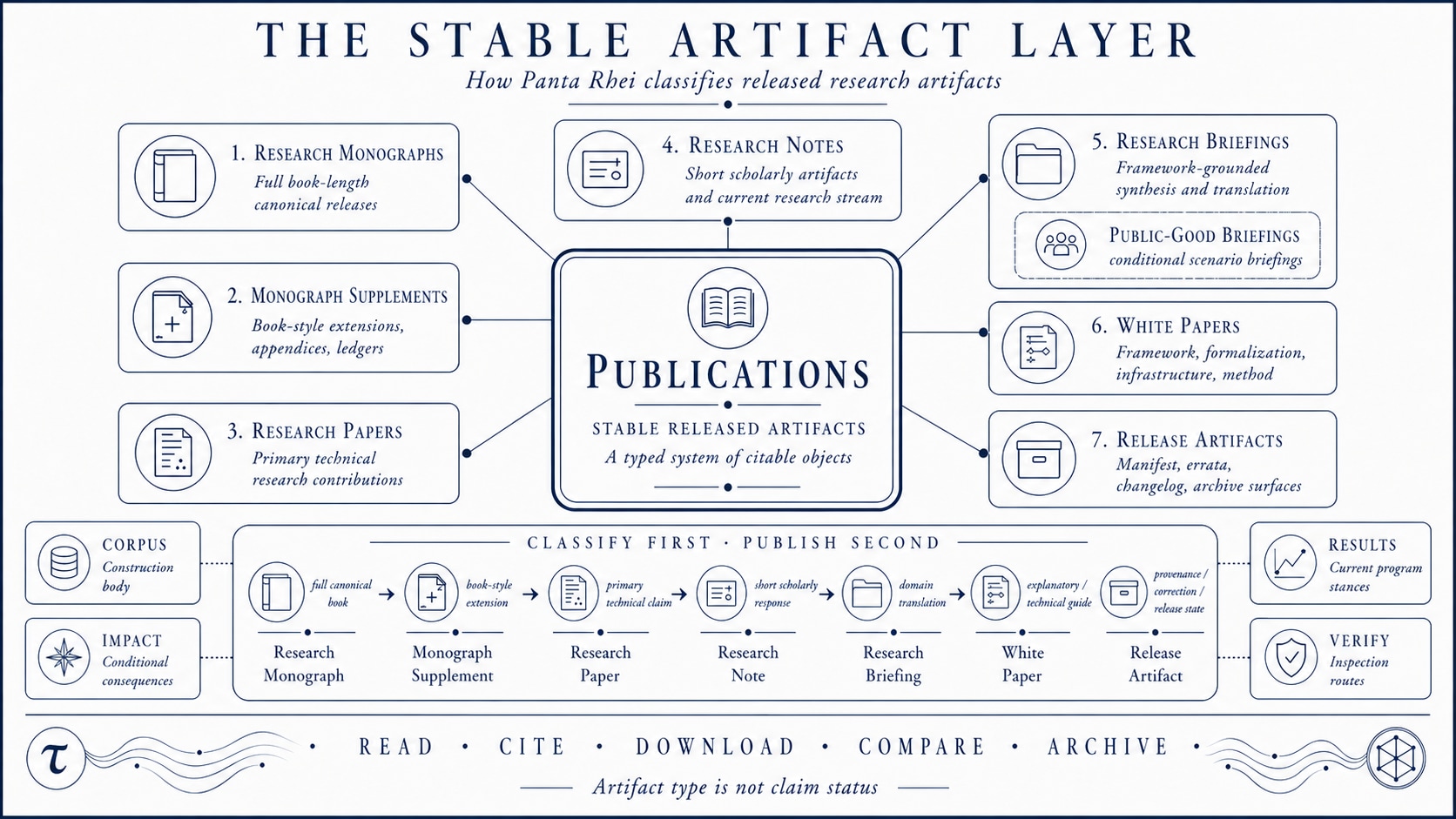
Research Notes are the program’s dated scholarly publication channel for substantial public-facing research writing. They publish responses to anchor papers, observational pre-registrations, verification explainers, framework-based reinterpretations of recent results, and bridge texts that may later become white papers or Public-Good Briefings.
Research Notes are not informal commentary, promotional updates, or a changelog. They are dated, article-like texts written for readers who want to follow the program’s thinking as it develops.
Research Notes inside the publication taxonomy
Research Notes are shorter scholarly artifacts in the ongoing research stream, distinct from Research Papers, Research Briefings, and Anchor Documents.
Research Notes are publication artifacts, not status updates. They carry dated scholarly arguments, comparisons, pre-registrations, responses, and verification explainers while remaining distinct from Research Papers, Research Briefings, and Anchor Documents.
What each note exposes
Each Research Note makes its status inspectable: date, note type, domain, abstract, anchor paper or context, core claim, what is not claimed, falsification or verification route, related Corpus/Results/Verify/Recovery links, citation guidance, and any downloadable PDF artifact when one exists.
Note families
Response / Anchor-Paper Notes compare the framework against a named external paper, result, or observational report.
Structural Comparison Notes compare an external theory or construction with a Category τ structure without claiming identity or external proof.
Mechanism-Alignment / Slot-Filler Notes identify cases where an external mechanism appears to fill a structural slot already required by the framework.
Pre-Registration / Falsification Notes place a framework commitment on a future or live empirical target before the decisive test is complete.
Prediction-Ledger Observational Comparisons compare pre-registered numerical or structural commitments with current observational constraints.
Falsification-Discriminator Notes identify empirical or structural tests that could distinguish Category τ from another framework.
Verification Notes explain what the public verification surfaces do and do not establish.
Conceptual and Edition Notes clarify framework interpretation, public release changes, and reading order.
Launch seed set
The current Research Notes surface begins with a deliberately small seed set. Empty or sparse filters are not errors; they show where the publication channel is ready before a full family of notes exists.
How to receive Publication Notifications
New Research Notes and other publication releases can be received through Publication Notifications. Subscription is handled by Buttondown with double opt-in.
The Corpus-backed Latest Publications stream lists released, superseded, and archived publication artifacts across the full Publications lane.
The searchable browse section below is generated from the public Research Notes metadata.
Browse Research Notes
Domain
Sort
11 of 11 notes
No Research Notes match the current filters. to see everything.
A guarded bridge note between Wolfram's ruliological P-vs-NP microcosms and τ-admissible witness construction
The note treats Wolfram's 2026 essay as a public comparator for finite computational difficulty. It separates Wolfram's ruliological exploration, the internal τ-admissibility claim, and the orthodox Clay/Turing/ZFC P-vs-NP problem. It does not claim to solve orthodox P vs NP, identify the Ruliad with Category τ, or treat Wolfram's finite experiments as validation of Panta Rhei. Post-peer-review-panel RC2 release: 5-referee panel (computational complexity / Wolfram-ruliology / category theory / mathematical logic / editor + recipient-perspective) returned MAJOR-tilt verdict with 12 HIGH-priority fixes applied. The RC2 revision retitled the note to foreground the address-construction reading, rendered the CRT reassembly mechanism as a Hopkins–Bousfield arithmetic fracture-square pullback, added explicit engagement with the natural-proofs / algebrization / relativization barriers, and disambiguated the ZFC-provability horizon.
Para-Minds, the Earned Belnap-Truth4 Classifier, and the Φ_∂ Boundary Functor of Exact Gluing
PROMETHEUS (Mahadevan 2026, arXiv:2605.12835v1) is a framework for 'automating deep causal research' that turns retrieved corpora into sheaf-like causal atlases of local Predictive State Representations (PSRs) over context covers, with restriction maps and four gluing diagnostics: agreement, drift, contradiction, underdetermination. The author calls the result a Topos World Model. Engineering substance is real; the categorical machinery is invoked heuristically (the §7 'operational sheaf condition' is an averaging rule with a numerical compatibility check, not a Mac Lane-Moerdijk sheaf condition; the 4-fold diagnostic is left as an ad-hoc taxonomy; the predicate 'Belnap' appears nowhere in the references). This note articulates three τ-canon structural contributions: (1) the 4-fold diagnostic IS the earned subobject classifier Ω_τ = Truth4 = {T, F, B, N} of an earned topos (Theorem I.T25 of Book I), with the orthogonality e_+ · e_- = 0 earned from spectral structure rather than imposed by fiat; (2) exact gluing is achievable via the boundary functor Φ_∂ (Langlands Coherent Force, Theorem III.T50 of Book III) which PROMETHEUS lacks; (3) the Para-Mind reading (Definition VII.D55 of Book VII) explains why PROMETHEUS's externalization of the topos layer is structurally licensed. One constructive structural prediction is introduced: PROMETHEUS's existing cSQL polarity field is the route to a fifth Belnap-F gluing diagnostic. Seven explicit non-claims keep the trust budget honest. The dialogue is articulative, not adversarial: PROMETHEUS observes, τ-canon proves.
A τ-Categorical Pre-Registration against the Natarajan, Chiang & Dutra (2026) Multiscale Cluster-Lensing CDM Crisis
Natarajan, Chiang & Dutra (2026, ApJL 1001, L12) report a new cold-dark-matter crisis from multiscale gravitational lensing of three massive clusters (MACS J0416, J1206, J1149) compared to TNG-Cluster ΛCDM analogs. Four substructure diagnostics yield a dichotomy: the same member-galaxy subhalos must carry steep inner density slopes (core-collapsed SIDM-like) and collisionless-CDM-like outer tidal extents. We pre-register a Category-τ reading as one D-sector readout in two regimes, with three τ-distinctive positive readings (outer Newtonian-limit r_t; inner M∂(R) number-promotion; transition r_trans ≈ 3.4–10.8 kpc), and an 11-row N16 falsification surface. Headline pre-registered falsifier: host-mass independence of r_trans at fixed SHMF, testable with Euclid + Rubin LSST + JWST/Roman by ~2029. Three derivational gaps are flagged honestly; the inner-density-slope-direction tension is reframed as a count-axis-vs-slope-axis discriminator in GGSL+kinematics joint inference.
Book VI's parity slot and Paltiel et al.'s dynamic CISS mechanism
The note does not claim that Paltiel et al. validate Category τ, nor that Panta Rhei predicted their detailed molecular mechanism. Its narrower claim is a prior structural-slot record: Book VI had already articulated the need for a non-thermal, parity-sensitive amplification channel relevant to biological homochirality, and the Paltiel et al. mechanism appears to match that slot at the level of symmetry class and amplification role.
A structural answer-shape stress test of expressiveness, coherence, and translation capacity
The note uses an externally chosen popular-science problem tableau as an expressiveness and coherence probe. It asks whether the existing τ-construction grammar produces differentiated answer-shapes across thirty familiar problem surfaces, or collapses into one vague explanation repeated thirty times. It does not claim to solve those problems or validate the framework.
Persistent homology, gaze, and the Book VII aesthetic-functional picture
This research note reads Dmitruk et al.'s PLOS Computational Biology paper on persistent homology, gaze, EEG, and abstract art as a guarded external readout surface for Book VII's categorical aesthetics. It does not claim that topology measures beauty or that the external paper validates Category τ. Instead, it builds a typed bridge from image-filtration descriptors to possible pre-symbolic motif readout, while making the lossy measurement chain, caveats, and falsification surfaces explicit.
Vocabulary evolution, word embeddings, and the Book VII readout-functor picture
The note reads Guo et al. 2026, Statistical structure and the evolution of languages, as an external anchor for Book VII's language architecture. It distinguishes subsymbolic pattern fields, readout functors, public language, corpora, embedding instruments, and observed statistics, then frames the paper's regularities as calibration surfaces for future Category τ-facing language/readout models rather than as confirmation of Category τ.
A categorical pre-registration versus end-of-2025 CMB and BAO constraints
The note compares the Panta Rhei no-inflaton pre-registration for the tensor-to-scalar ratio and scalar spectral index with late-2025 CMB and BAO constraints. It separates the framework's internal commitment from external acceptance and identifies near-term falsification routes.
A categorical pre-registration against the Gallardo et al. 2026 pairwise-kSZ constraint
The note places the Panta Rhei force-law stance on the Gallardo et al. 2026 pairwise-kSZ constraint: Category τ rejects both a new dark-matter particle and a fundamental MOND transition at the tested scale, while committing to a Newtonian inverse-square force-law exponent in the cluster-pair regime. The note defines falsification surfaces and reporting targets rather than claiming external acceptance.
A categorical reinterpretation of the G2-manifold remnant
The note reads a 2026 G2-manifold remnant proposal as an anchor for comparison with the Panta Rhei black-hole layer. It distinguishes the anchor's extra-dimensional Einstein-Cartan mechanism from the categorical account of torus horizons, no-shrink stability, and information preservation.
The note compares the Hartnoll-Yang chain from BKL dynamics to hyperbolic billiards, automorphic forms, L-functions, and the primon gas with the Panta Rhei derivation of prime polarity, L-functions, and hyperbolic structure from the categorical kernel. It is a conditional comparison, not an external proof of Category τ.
Search across Corpus, TauLib, Monographs, Research Notes, and Errata.
Try a result name (Hubble tension), a doctrine term
(τ-totality), or a Lean theorem ID
(Theorem 3.2.4).