Research Papers
Standalone scholarly papers carrying primary technical contributions — the Hinge series.
 v4.0 · 2 May 2026 · manifest 07ea80a
The construction body of the theory: definitions, derivations, monographs, registry objects, TauLib projection, and dependency relations.
The Corpus is the construction body of the theory.
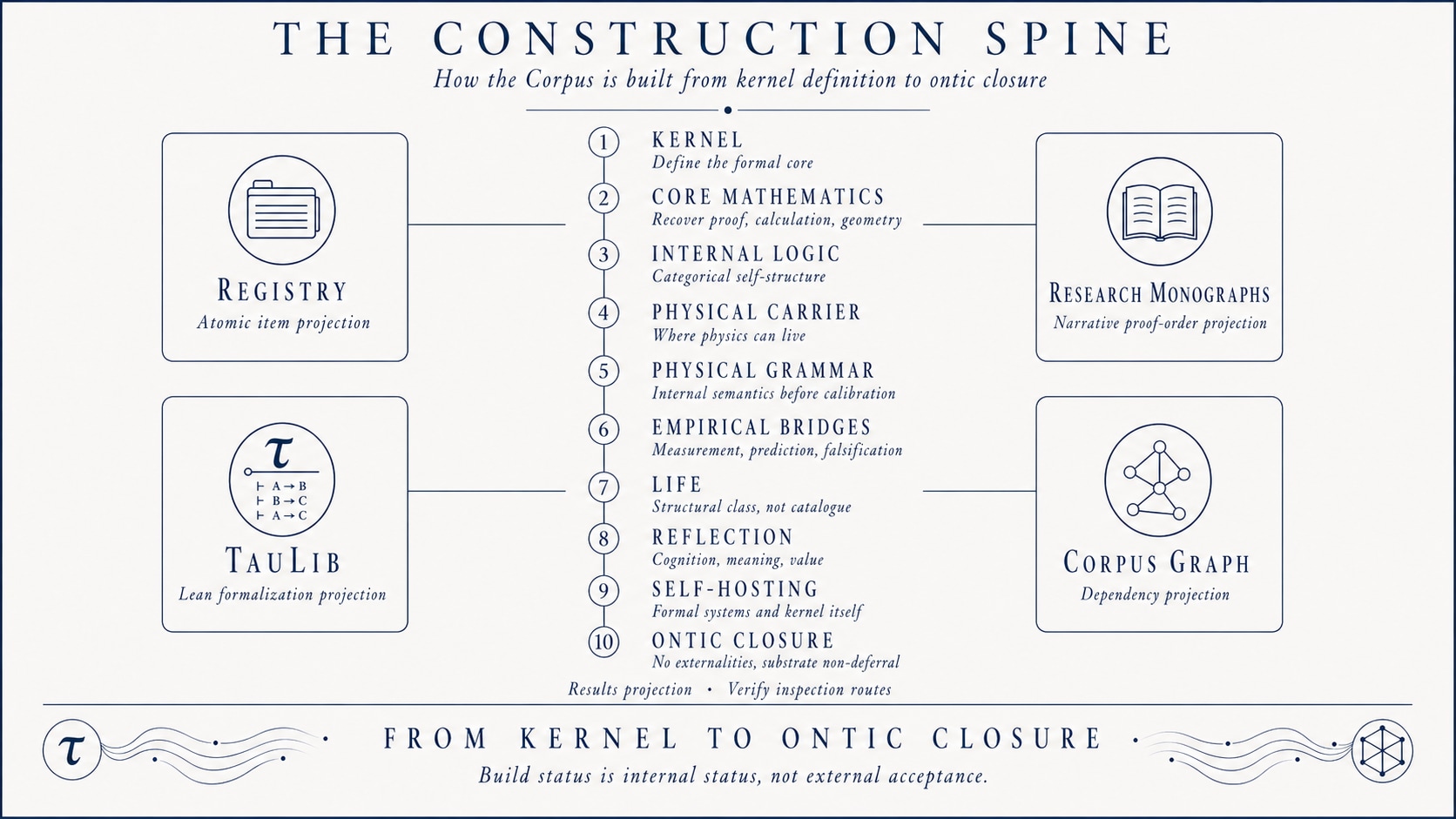
The Construction Spine gives the ten-step public build order.
The Monograph Corpus shows how the seven-book monograph series realizes that build order across books, parts, and chapters.
The Registry exposes atomic objects. TauLib exposes formal proof surfaces where available. The Corpus Graph exposes dependencies. Results shows what follows. Verify shows how the build can be inspected. Publications holds citable release artifacts.
For the implementation view of how Corpus, Results, Verify, Publications, and Engage are connected as public surfaces, see Building a Public Research Observatory for High-Scope Open Research.
The build-order at a glance

The Construction Spine is the primary human-readable route into the Corpus. It shows the build-order narrative from kernel definition through mathematics, physics, life, reflective structure, self-hosting, and ontic closure. The spine’s End-to-end construction view shows how the ten steps form a single construction chain, with each step inheriting what earlier steps have earned and handing forward what later steps need.
The Corpus is updated by — and connected to — the active publication stream. Publications-class artifacts that touch the Corpus appear in five projections:
Standalone scholarly papers carrying primary technical contributions — the Hinge series.
Shorter scholarly artifacts from the ongoing research stream — frontier responses, comparative readings.
Framework dossiers and translation artifacts — including The Construction Spine itself as a Dossier-class artifact.
Version, provenance, correction, manifest — the release-governance surface for Corpus snapshots.
The dated public ledger of research-stream events touching the Corpus.

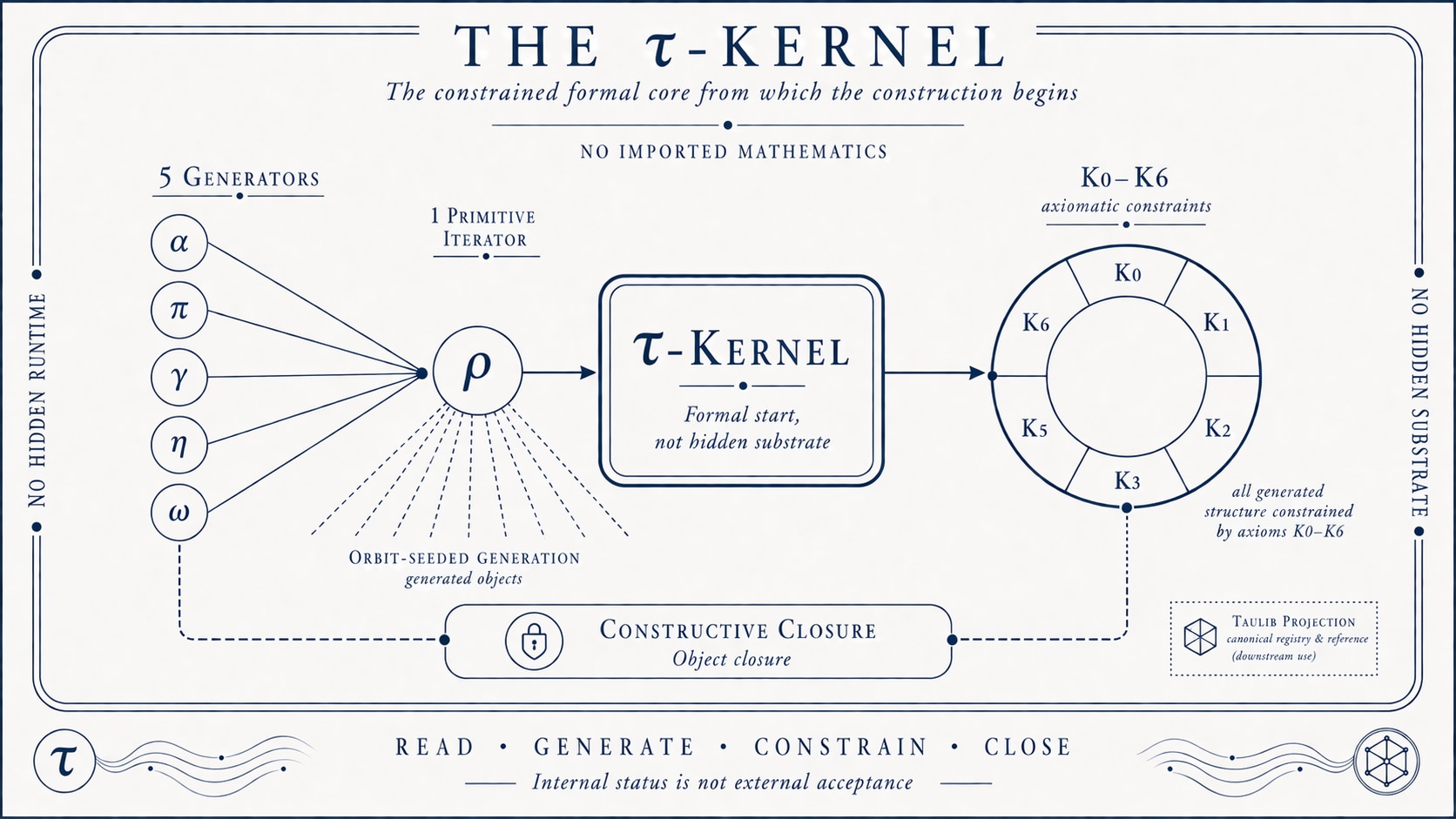
The τ-Kernel is the formal starting point of the construction. It is not a hidden physical substrate; it is the constrained formal core from which the Corpus begins.

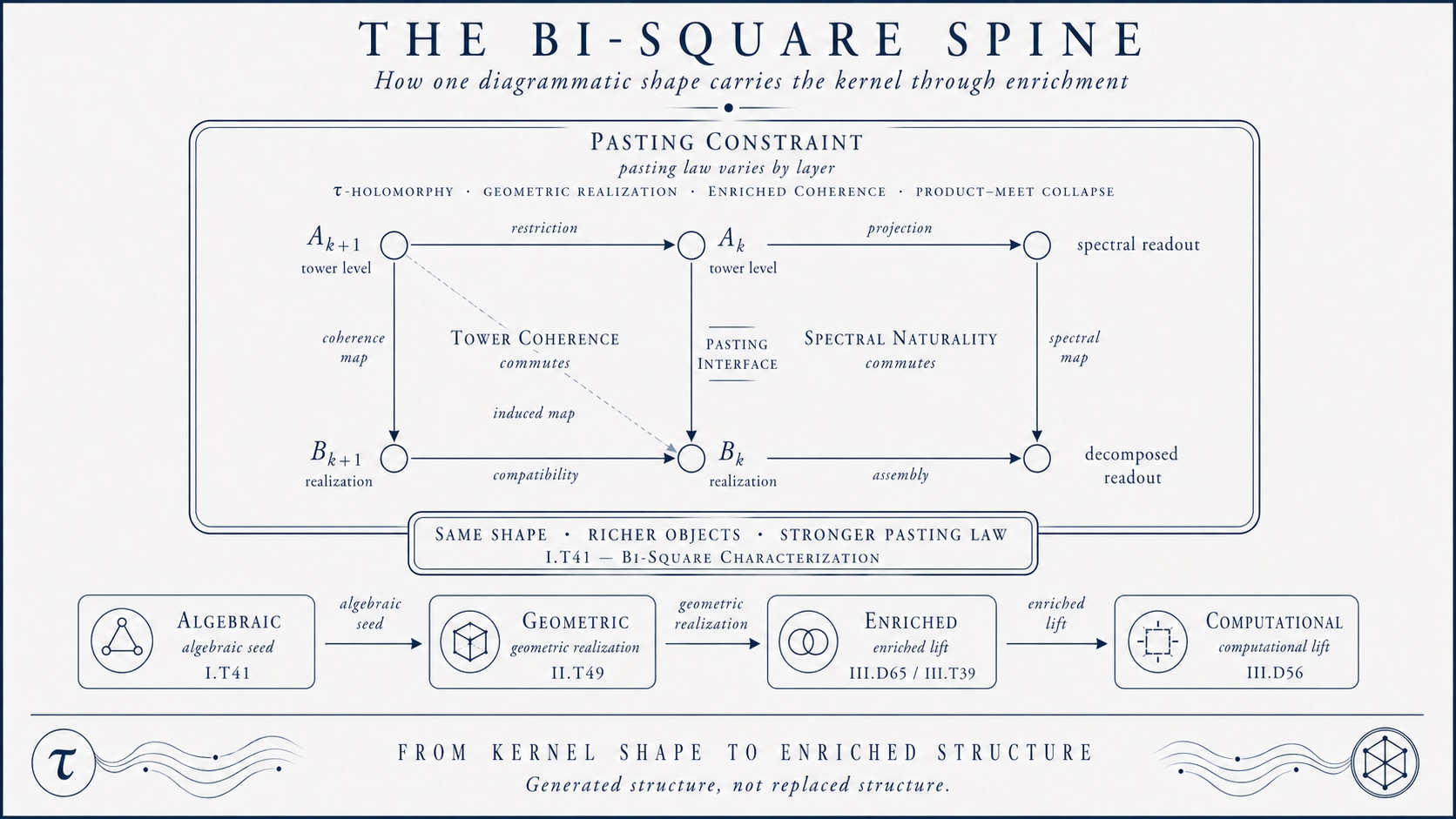
The Bi-Square Motif is the Corpus route for the repeated proof-organizing diagram behind the kernel buildup. The Construction Spine gives the build order; the bi-square gives a stable categorical shape that reappears as algebraic, geometric, enriched, and computational structure. It is a construction motif, not a second construction spine.
The first three construction steps have a dedicated reviewer packet route: eight foundational research papers plus a bundle memo, surfaced through Corpus-native gateway pages. These pages explain how the kernel is built, how core mathematics is recovered, and how self-enrichment begins. They are an orientation and stress-test packet, not a standalone Corpus collection.
The same construction body appears through several public projections:
Ten-step build order from kernel definition through ontic closure.
Seven-book narrative projection: Book → Part → Chapter summaries with registry anchors, TauLib links, and construction-step tags.
Atomic object map: definitions, lemmas, propositions, theorems, remarks, axioms, constructions, corollaries.
Lean 4 formalization browser, module / declaration view, and pinned source link.
Dependency and relation graph across objects, monograph exposition, results, and verification routes.
How counts, dashboards, snapshots, and release surfaces should be read.
Results as answer surfaces, Verify as inspection routes, Publications as the citable artifact shelf.
These routes are preserved because they are useful for review, but Wave 3 treats them as construction metadata rather than top-level Corpus peers.
The repeated proof-organizing diagram shape across algebraic, geometric, enriched, and computational layers.
The reviewer stress-test route for the first mathematical construction packet (Steps 1-3).
An external expressiveness probe: familiar open-problem surfaces read through the existing construction grammar as answer-shapes, not solved results.
The current registry is the public atomic projection of the corpus. The primary human-readable route into the Corpus is the Construction Spine: the build-order narrative from kernel definition through mathematics, physics, life, reflective structure, self-hosting, and ontic closure.
The public build narrative that aligns Agenda obligations, Corpus construction, and Results status.
The reviewer-facing stress-test route for the mathematical packet behind Steps 1-3.
The current public spine across all seven books.
Registry objects currently typed as axiom.
Registry objects currently typed as construction.
Registry objects currently typed as corollary.
Registry objects currently typed as definition.
Registry objects currently typed as lemma.
Registry objects currently typed as proposition.
Registry objects currently typed as remark.
Registry objects currently typed as theorem.
The Corpus lane is the place to ask: what has actually been built, how does one item depend on another, and where does a public result touch the underlying research body?
A focused subset of FAQ entries on what the Corpus actually is, how to cite it, what’s in the Registry vs TauLib, and why count drift matters.
The Corpus is the construction body of the theory: definitions, derivations, monograph exposition, registry objects, TauLib projections, and dependency relations.
The Corpus is where the theory is built rather than merely announced. It is not identical to the books, the Registry, or TauLib; those are projections of the Corpus. A reviewer asks there what was constructed, in what order, from what earlier obligations, and with which dependency anchors.
The Registry is the object/dependency map of the Corpus; TauLib is the Lean formalization projection of selected formal content.
A registry object is a stable public ID for a Corpus item. A TauLib module is a Lean source file. The meaningful audit question is whether claimed mappings between Registry, Corpus, and TauLib are explicit and inspectable.
They count different units with different filter rules: registry objects, dashboard-display objects, formalized dashboard objects, Lean modules, and direct `sorry` counts.
Registry objects are not Lean modules. Dashboard totals are filtered views. Formalized counts apply status filters. `sorry` count is a source scan. The first question is always which filter rule each page uses.
Cite books and papers through DOI/citation pages, cite results by stable URL and status label, and cite registry objects by stable object ID and permalink.
Use the publication artifact for citable works, stable Result URLs for claims, Registry IDs for atomic objects, and the Release Manifest/TauLib for formalization claims.
Download a portable dossier, copy a reviewer note, or send this page to someone who can inspect it.