Start Here
The fastest general route for first-time visitors.
 v4.0 · 2 May 2026 · manifest 07ea80a
Start here. A guided first-contact route into the Panta Rhei Research Program — the canonical landing surface for readers arriving from a launch post, podcast, or external link.
Panta Rhei is an independent open research program dedicated to building a coherent theory of reality.
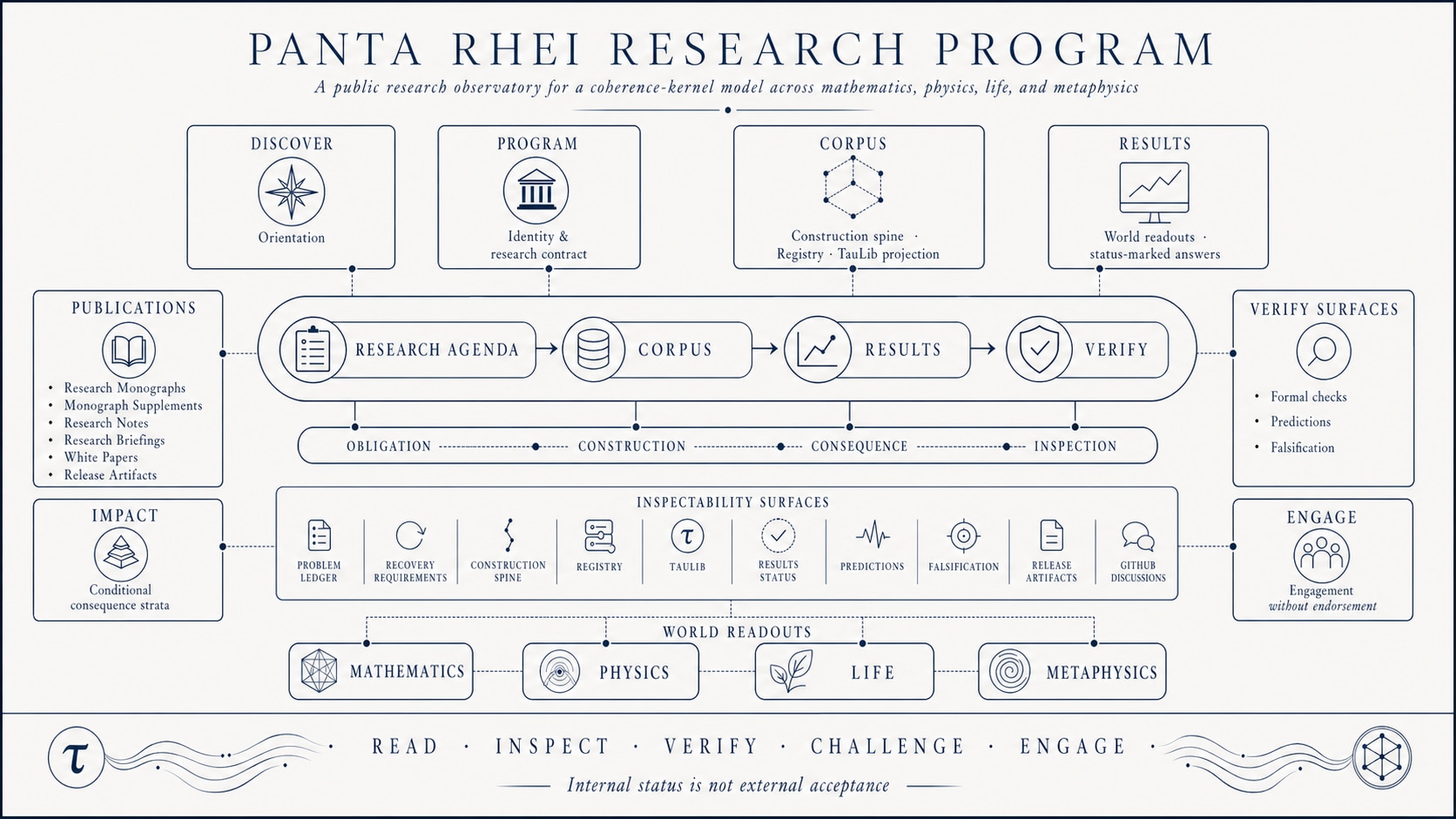
The website is a structured public interface to that research system. Discover is the entry layer: deeper than the homepage, but still built for orientation rather than exhaustive explanation. It helps readers move from orientation into the research spine: Agenda, Corpus, Results, and Verify.

Use this map to orient yourself before entering the deeper lanes.

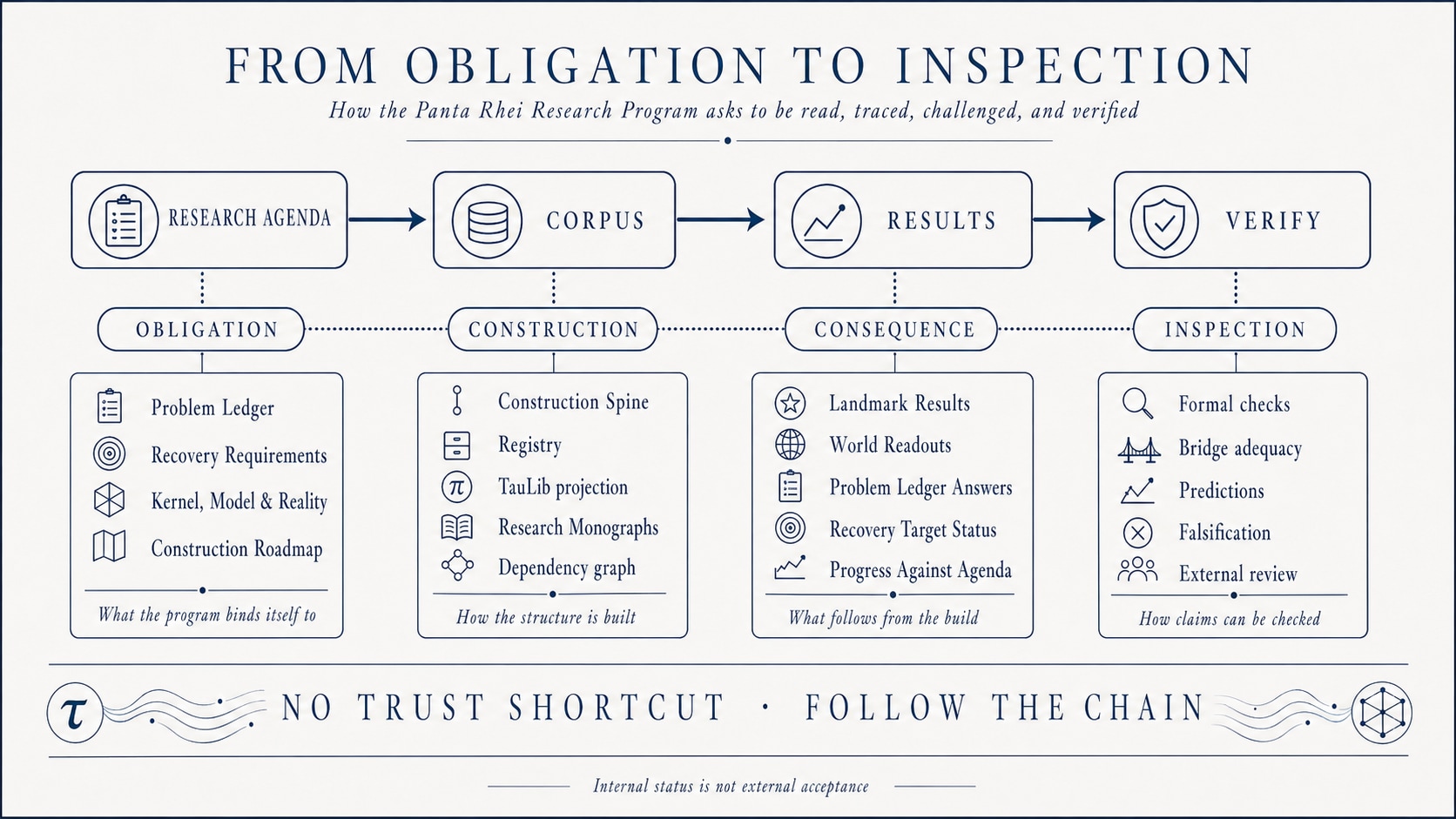
Use this chain to read the site: obligations first, construction second, consequences third, inspection always.

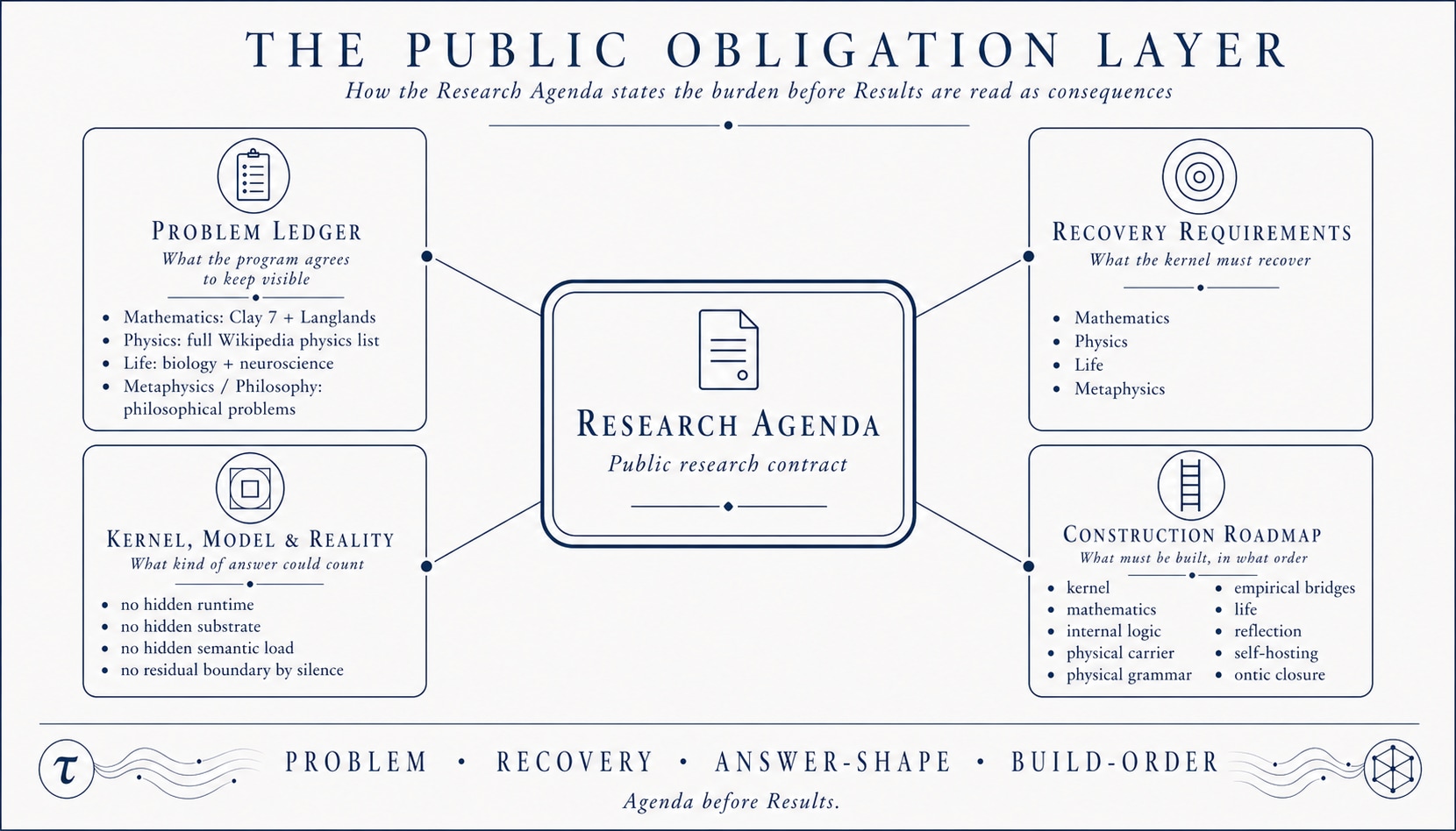
Agenda states the burden: what language must be earned, which questions must remain visible, what kind of answer could count, and what must be built first.
For journalists and public readers, the current Open Research Brief explains the safest first story: the inspection standard, not endorsement of the theory.
The public site is itself part of the research form. Panta Rhei at a Glance (WP000) is the shortest public orientation; the Public Research Observatory Blueprint (WP004) explains the technical blueprint: how panta-rhei.site, public source repositories, generated projections, search, release manifests, publication artifacts, and correction routes work together as one public research observatory.
Read the Public Research Observatory Brief if you want the newsroom version before entering the research lanes.
If you want an outside-in first-pass assessment, use the AI-Assisted Discovery prompts. They are copy-ready templates for generating structured orientation reports, seriousness checks, journalist briefs, route recommendations, and critical dossiers using a web-enabled LLM.
These prompts are not verification, peer review, or endorsement. They are guided discovery aids that should route back into Program, Agenda, Corpus, Results, and Verify.
Open the AI-Assisted Discovery prompt catalog.
The fastest general route for first-time visitors.
A curated set of flagship answer surfaces before the full ledger.
The major problem families that define the program's burden of proof.
The lane architecture and public research pipeline in one place.
Curated pathways across Program, Agenda, Corpus, Results, Verify, Impact, Engage, and Artifacts & Releases.
Research Notes as released artifacts; Changelog for site, release, and infrastructure records.
This is not a blog, not a monograph landing page, and not a documentation dump. It is organized around public research surfaces:
Publications remains the stable artifact and release layer: Anchor Documents, Research Monographs, Monograph Supplements, Research Papers, Research Notes, Research Briefings, Release Artifacts, and Errata.
Two structured FAQ layers paired with this Discover hub:
Both render below as native accordions. The full 73-entry FAQ is at /faq/.
Panta Rhei is an independent open research program published as a public research observatory for inspecting a proposed coherent theory of reality.
Panta Rhei is not a single paper, a blog, or a software project. It is a public research observatory around a structured research program: Discover orients, Program defines scope, Agenda states obligations, Corpus carries construction, Results reports consequence surfaces, Verify exposes inspection routes, Impact maps conditional relevance, and Publications provides citable artifacts.
No. The public claim is that the work is structured, inspectable, and review-worthy; correctness still requires expert review and domain validation.
The site separates inspection architecture from validation. TauLib can check encoded formal claims, but Lean compilation does not prove empirical truth, bridge adequacy, semantic interpretation, public-good relevance, or external scientific acceptance. The first public claim is inspectability, not acceptance.
Not yet by traditional journals. The work is public and open for structured scrutiny through review routes, assessment protocols, formalization surfaces, and citable artifacts.
The program is independently published and does not claim traditional peer review as completed validation. It exposes a public review architecture: TauLib, Release Manifest, assessment protocols, role-specific review routes, Reviewer/Media Kit surfaces, and correction channels. These are preparation for review, not a substitute for review.
The program is independently authored and self-funded by Dr. Thorsten Fuchs and Anna-Sophie Fuchs; the site states that there is no institutional funder, grant sponsor, or corporate backer.
Panta Rhei is presented as an independent research program rather than an institutionally funded project. This independence explains the open-publication model but does not validate the claims. Public communication should report authorship and funding status neutrally.
No. The site avoids that label and uses “coherent theory of reality” to name a burden of construction, inspection, and scope discipline rather than a completed proof.
The phrase “coherent theory of reality” should not be read as a claim of finality. It marks a stricter burden: earn the language, earn the questions, build the answers, disclose limits, and make the claim structure inspectable. The recommended public framing is not “theory of everything proved.”
The safest first angle is: “What should a serious theory of reality have to expose before asking for belief?”
The responsible first story is not that the claims are validated. It is that an unusually ambitious independent research program has exposed obligations, construction spine, status labels, formalization, falsification paths, release manifests, errata, and review routes before asking for belief.
You should not yet believe the scientific claims. You should believe only that the work is public, structured, inspectable, and serious enough to route into expert scrutiny.
After five minutes, the appropriate conclusion is not acceptance of the framework. The appropriate conclusion is that the public artifact exposes enough structure to deserve inspection: Program, Agenda, Corpus, Results, Verify, Release Manifest, TauLib, prediction/falsification surfaces, errata, and reviewer/journalist routes. Whether the claims are correct remains a separate expert-review question.
Start with Discover. It is the guided first-contact route and explains how the site’s Program, Agenda, Corpus, Results, Verify, Impact, and Publications lanes fit together.
A non-specialist should begin with orientation rather than claims. Discover explains the site structure and routes readers into the construction body, consequence surfaces, and inspection routes. The safest reading order is orientation first, obligations second, construction third, results fourth, verification always.
Agenda states the burden, Corpus carries the construction, Results reports current consequence surfaces, and Verify exposes inspection routes.
The site is organized as a research observatory. Discover orients; Program states identity and scope; Agenda defines obligations; Corpus carries construction; Results reports consequence surfaces; Verify exposes inspection, bridge, and falsification routes; Publications holds citable artifacts; Impact maps conditional relevance.
The Corpus is the construction body of the theory: definitions, derivations, monograph exposition, registry objects, TauLib projections, and dependency relations.
The Corpus is where the theory is built rather than merely announced. It is not identical to the books, the Registry, or TauLib; those are projections of the Corpus. A reviewer asks there what was constructed, in what order, from what earlier obligations, and with which dependency anchors.
Results are status-marked consequence surfaces of the built Corpus. They are not the same as external verification or scientific acceptance.
Results show what the framework currently says follows across mathematics, physics, life, and metaphysics. They must be read with status markers: internal stance, verification route, and external-acceptance boundary are separate. A result can be internally addressed without being externally accepted.
The first visible claims are the master constant, the typed Results catalogue, 67 quantitative predictions, 30 falsification tests, and domain readouts across mathematics, physics, life, and metaphysics.
The homepage intentionally surfaces striking claims early, but it also tells readers these claims are not equivalent in status. First orientation should identify high-signal claims and then route them into Results and Verify rather than accepting them from the homepage alone.
The master constant is the scalar value ι_τ = 2/(π + e) used by the numerical physics surface; the site treats it as a central review target, not a rhetorical shortcut.
The master constant is one of the first red-team questions. The physics surface depends on whether ι_τ is genuinely forced by the kernel/scalar-readout construction or effectively fitted. The site routes this through a research paper, Corpus H3 page, Step 2, Registry anchors, and TauLib evidence.
That is the central red-team question. The site claims a structural derivation route, but downstream numerical claims should not be weighted until this hinge is inspected.
The first question is not whether downstream numbers are impressive. It is whether ι_τ is fixed before physical calibration enters. If the derivation fails, the downstream zero-parameter physics claim weakens substantially.
Then the downstream claims depending on that hinge weaken or fail. The site should be read as a dependency structure, not as a list of independent claims.
Claims are routed through construction steps, hinge pages, Registry entries, TauLib modules, and Verify surfaces. If a hinge fails, the relevant downstream claims need to be relabeled, weakened, repaired, or withdrawn according to dependency.
TauLib proves that encoded formal statements compile under the pinned Lean environment. It does not by itself prove empirical truth, bridge adequacy, or scientific acceptance.
TauLib is the Lean formalization projection. If a theorem is encoded and compiles, Lean checks that theorem relative to the formal environment, trusted computing base, and disclosed assumptions. Bridge claims and empirical interpretations remain separate burdens.
Verification does not settle empirical truth, semantic interpretation, bridge adequacy, domain validity, public-good relevance, or external scientific acceptance.
Formal checking can certify encoded formal claims; prediction surfaces can expose commitments; falsification packs can identify failure paths. None of those alone establishes that a mathematical construction describes the physical world or that a public-good application is ready.
Failure paths are exposed through prediction timing, falsification pack, hinge pages, Release Manifest, errata, and Verify routes.
Failure is not one thing. Mathematical hinges can fail; formal builds can fail; bridge claims can fail; empirical predictions can fail; public-good translations can fail. The site should route each kind of failure to the right inspection surface.
Read Discover, then Verify, then either the Master Constant hinge or Results overview, depending on whether your next question is credibility or substance.
A practical route is: Discover for structure; Verify for inspection boundaries; Master Constant for physics skepticism; Results for consequence surfaces; Corpus/Construction Spine for construction burden; Journalist FAQ for responsible coverage. Do not start by reading all seven monographs.
Download a portable dossier, copy a reviewer note, or send this page to someone who can inspect it.