
How to Verify
Practical entry points for inspecting the program from different directions.
How the verification matrix becomes a route

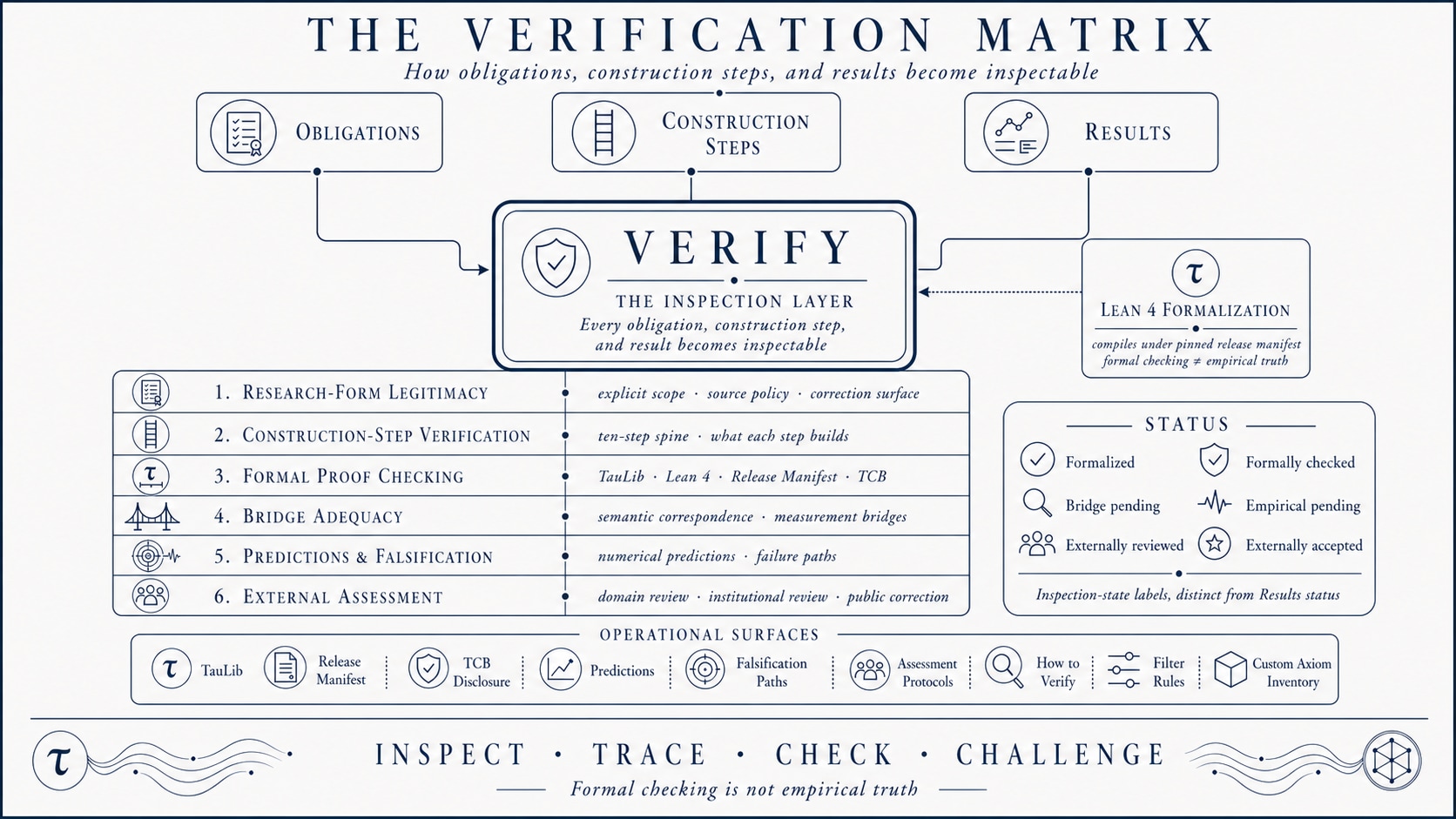
The matrix is not a single checklist. It is a routing layer that helps a reader choose which inspection mode fits the claim under review.
Review routes
The former broad reviewer-kit concept has been split into routed Verify/Engage workflows and a media-facing Review Kit for expert handoff.
Use this page to choose an inspection route. Use Assessment Protocols for structured workflows. Use Engage → Review the Work to offer bounded review, critique, correction, or contribution. Use the Media Review Kit when a journalist, editor, or institution needs to route a bounded question to the right expert.
Review is a routed activity. The Media Review Kit helps with expert handoff; Verify and Engage carry the deeper inspection and contribution routes.
Start with the inspection architecture
Before inspecting any individual claim, start with the inspection architecture.
Panta Rhei is organized so that reviewers can move from:
Program -> Agenda -> Corpus -> Results -> Verify
This means:
- first inspect the identity, status, and doctrine;
- then inspect the obligations;
- then inspect the construction;
- then inspect the current result stance;
- then inspect the verification route.
This route does not replace expert review. It orients bounded inspection.
Choose Your Entry Route
Practical First Pass
- Read Scientific Rigor to understand the program’s self-binding standards.
- Use the Verification Framework to identify the kind of verification your question needs.
- If the question is construction-facing, use Verify the Construction Spine to map the relevant step to its inspection modes.
- Inspect the operational surface: TauLib, Release Manifest, Predictions & Falsification, or Assessment Protocols.
First-pass inspection checklist
- Is the scope and burden of proof explicit?
- Are the Structural Challenge Ledger and source-policy rules visible?
- Are Core Semantics and answer-shape obligations stated separately from open problems?
- Is there a Construction Roadmap / Construction Spine?
- Is there a Corpus with stable IDs and dependency routes?
- Is there a formalization surface, and are its limits stated?
- Are Results status-marked?
- Are bridge claims explicit?
- Are falsification or failure paths visible?
- Are errata and correction routes public?
- Are remaining externalities disclosed?
- Is there a route to ask questions or report errors?
Domain entry routes
- Mathematics — Core Semantics, Foundational Hinges, TauLib, and Mathematics results.
- Physics — Kernel, Model & Reality, Physics Core Semantics, Predictions & Falsification, and Physics results.
- Life — Life Core Semantics, Life World Readout, and Life-facing results.
- Metaphysics — Kernel, Model & Reality, Metaphysics Core Semantics, Metaphysics World Readout, and Metaphysics / Philosophy-facing results.
- Formalization — TauLib, Release Manifest, and Formal Verification Stack.
Save or share this page for inspection
Download a portable dossier, copy a reviewer note, or send this page to someone who can inspect it.