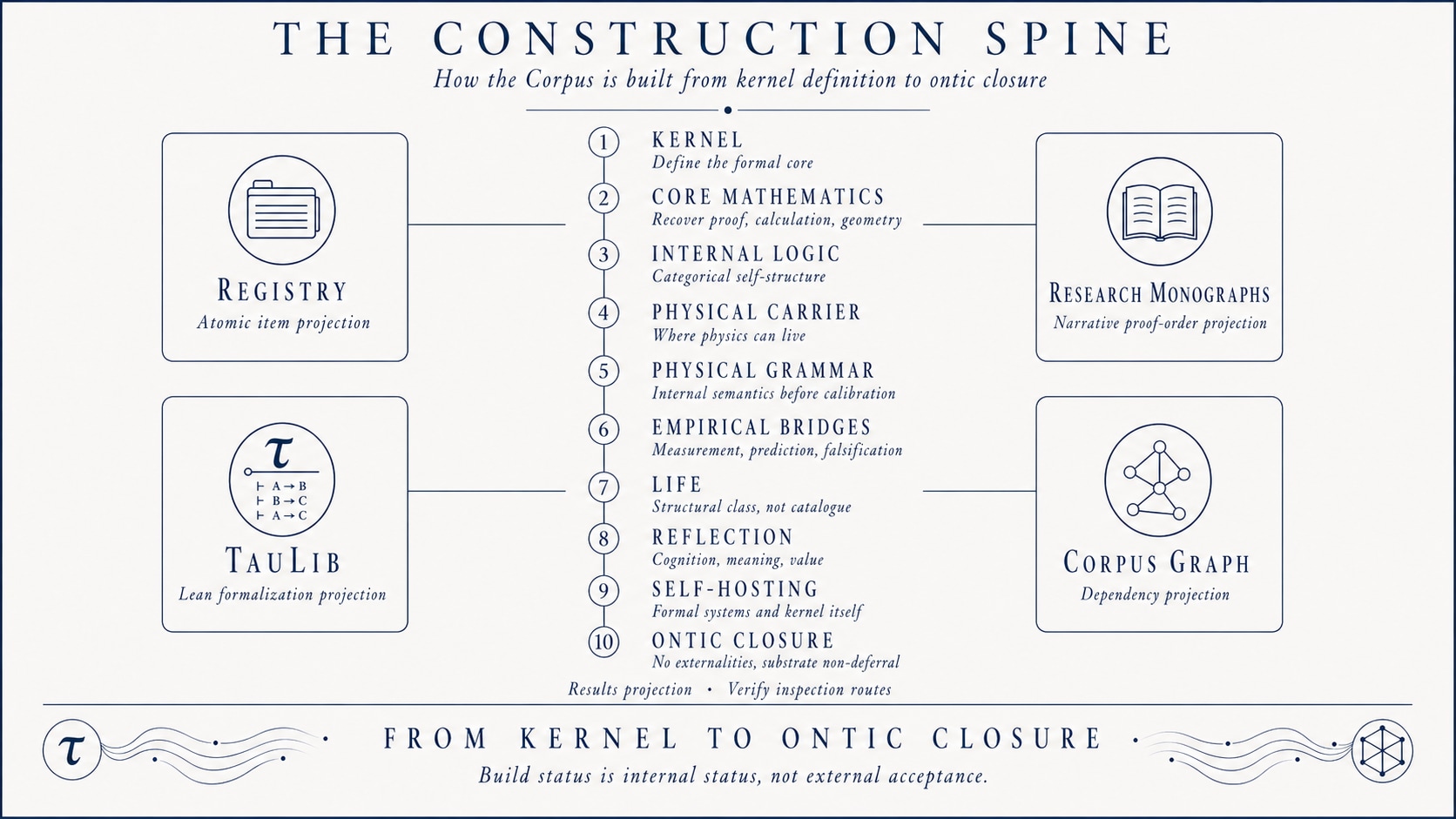
The Construction Spine is the Corpus-side realization of the Agenda’s Construction Roadmap. It shows how the Corpus is built step by step: from kernel definition through mathematics, physics, life, reflective structure, self-hosting, and ontic closure.
From kernel to ontic closure
The Construction Spine gives the human-readable build order of the Corpus: from the formal kernel through mathematical recovery, physical grammar, empirical bridges, life, reflection, self-hosting, and ontic closure.
The ten construction steps show how the Corpus is built: not as a timeline or sprint plan, but as a logical build order from the formal kernel to ontic-closure testing.
Each numbered route links the compressed Full Construction Spine release-candidate construction to a stable Corpus address. The pages are scaffolded from the RC3 whitepaper and intentionally mark deeper manuscript, Registry, and TauLib anchors as pending until the source-map extraction pass promotes them.
Bi-Square Motif is the diagrammatic-shape route: tower coherence, spectral naturality, and pasting across the main algebraic, geometric, enriched, and computational lifts.
Thirty Open Problems as τ-Readout Surfaces is a derived publication projection: an external expressiveness probe that checks whether the construction grammar yields differentiated answer-shapes without claiming solved results.
Kernel starting point
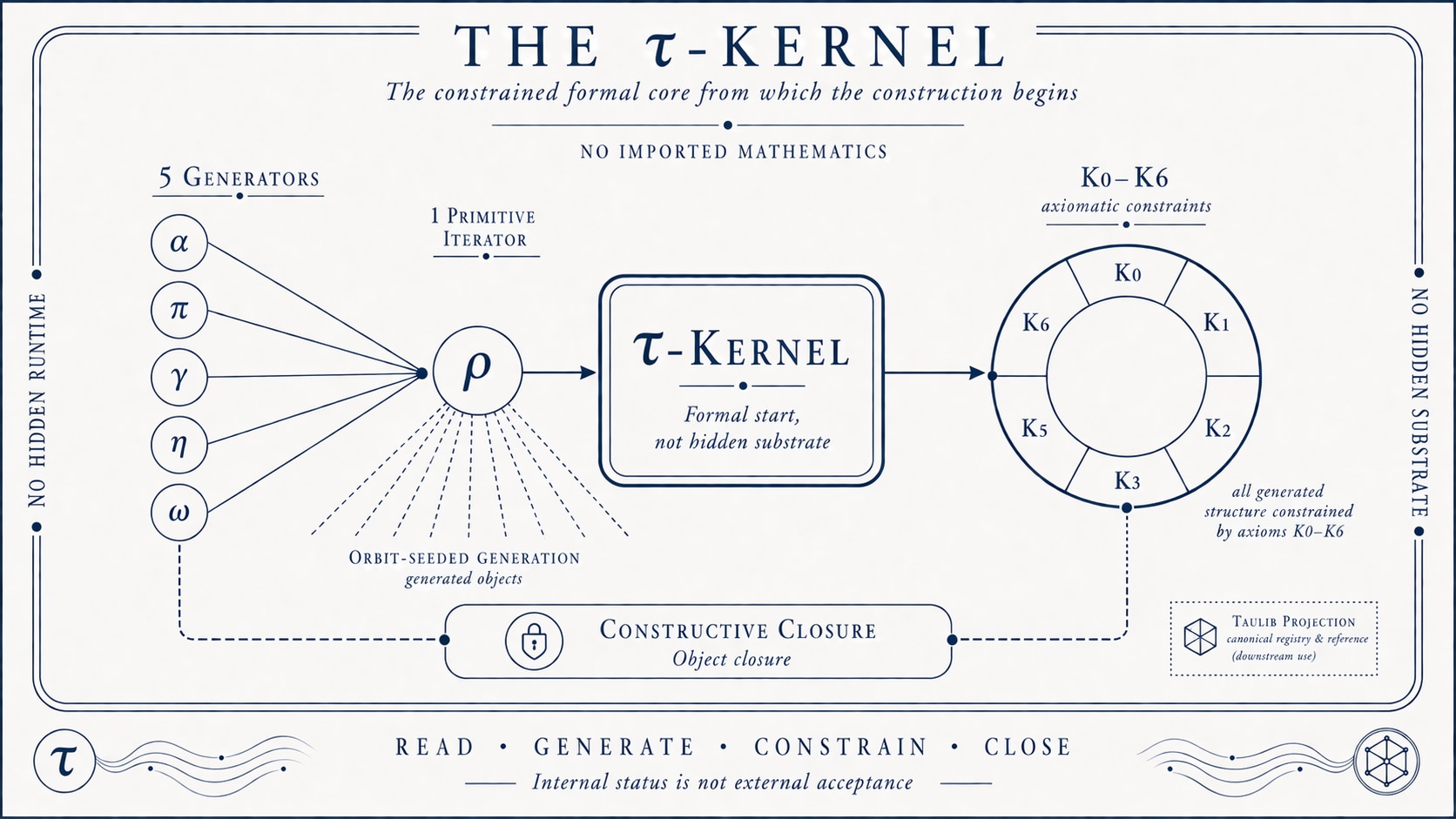
The τ-Kernel is the constrained formal core from which the construction begins: five generators, one primitive iterator, K0–K6 axiomatic constraints, and constructive closure under a no-hidden-runtime / no-hidden-substrate discipline.
The first construction step defines the kernel before later mathematics, physics, life, reflection, self-hosting, and ontic-closure burdens can be read as generated structure.
Construction review packet
The first three construction steps are supported by a construction review packet: eight standalone research papers plus a bundle memo. These papers isolate the make-or-break mathematical constructions behind the τ-Kernel, recovered mathematics, and self-enrichment. Use the review packet when you want the stress-test packet rather than the full monograph or atomic registry.
The Monograph Corpus shows how the seven books realize this chain across their parts and chapters.
How to read this section
Each step page explains what the step builds, why it is required, the key constructions, related Registry items, TauLib modules, book locations, related Results, Verify surfaces, and what the step does not yet establish.
Use Related Approaches when you want to compare this construction burden with neighboring structural, computational, geometric, life, mind, and metaphysical programs.
Status note. Build status reflects the current internal state of the Corpus. It does not imply external acceptance unless explicitly stated.
Build status legend
Framed — the step is defined as a required construction obligation.
Partially built — relevant Corpus structures exist, but mappings or verification remain incomplete.
Internally addressed — the Corpus contains a substantive internal construction for this step.
Bridge pending — internal structures exist, but measurement, standard-domain, or external bridge verification remains open.
These labels describe the program’s internal construction state. They do not indicate external verification or scientific acceptance.
Save or share this page for inspection
Download a portable dossier, copy a reviewer note, or send this page to someone who can inspect it.
Search across Corpus, TauLib, Monographs, Research Notes, and Errata.
Try a result name (Hubble tension), a doctrine term
(τ-totality), or a Lean theorem ID
(Theorem 3.2.4).