Agenda Agenda Page Canonical The logical build-order required by Agenda: from Core Semantics and stress-test questions to an admissible answer-shape.
Agenda PageCanonical

Construction Roadmap

The logical build-order required by Agenda: from Core Semantics and stress-test questions to an admissible answer-shape.

This is not a timeline

The Construction Roadmap is not a calendar, sprint plan, or publication schedule. It is the logical build-order implied by the program’s own burden of proof.

If the program seeks a no-externalities kernel of reality, it cannot begin by assuming mathematics, physics, life, mind, meaning, or lawfulness as finished inputs. These layers must be recovered in order.

This is the construction-side counterpart to Package 2’s doctrine: The Shape of a Theory of Reality frames “coherent theory of reality” as a build burden, not a completion claim or theory-of-everything slogan.

Agenda roadmap and Corpus spine

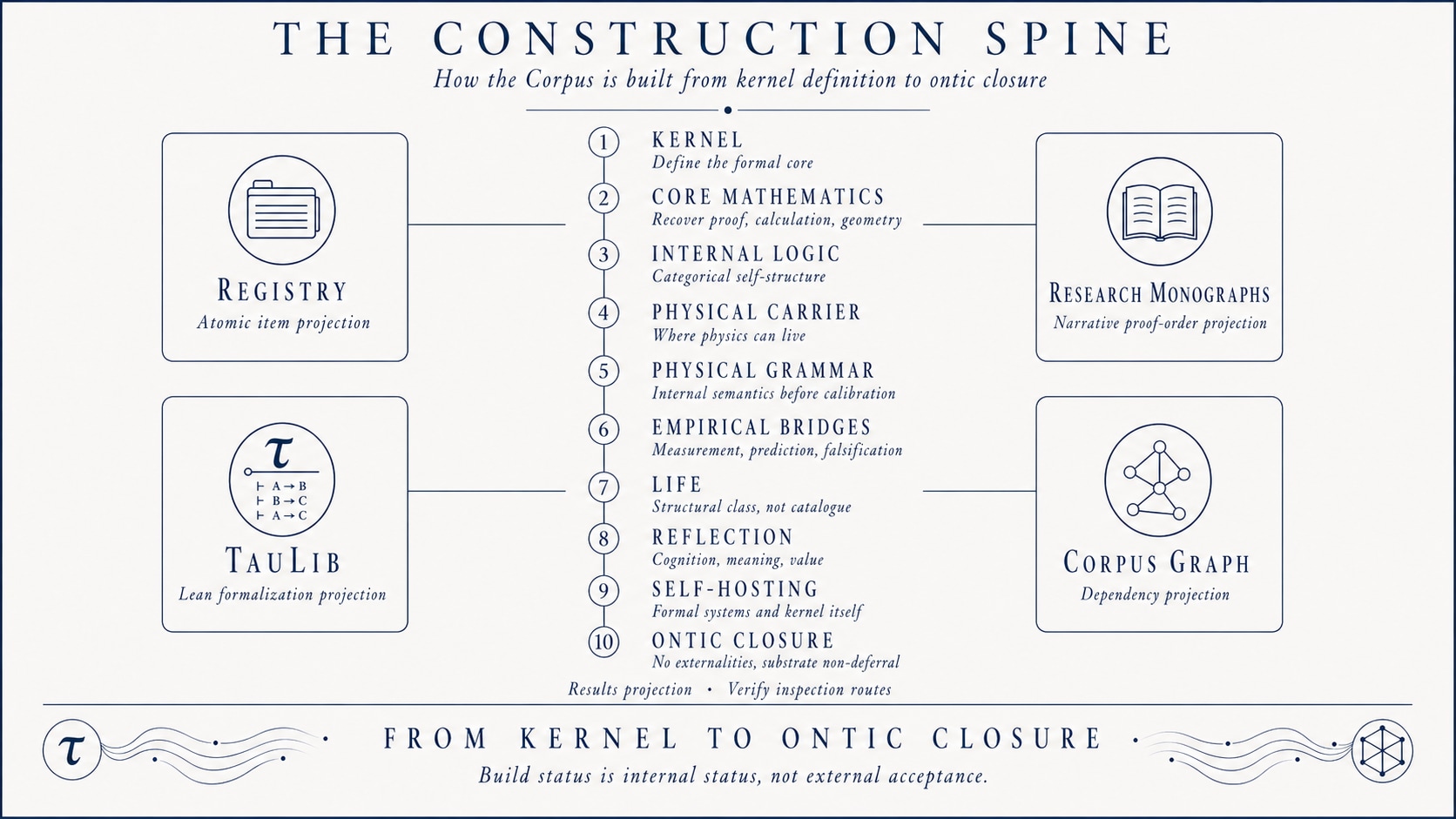
Scientific plate titled The Construction Spine, showing a vertical ten-step build sequence from Kernel to Ontic Closure, with side projections for Registry, TauLib, Monograph Corpus, and Corpus Graph.
The Construction Roadmap states what must be built; the Construction Spine shows the Corpus-side build narrative, with side projections for Registry, TauLib, Monograph Corpus, and Corpus Graph.

↓ Download print master · 1536 × 864 JPG · CC BY 4.0

The Construction Roadmap states the build-order obligation. The Construction Spine shows the Corpus-side realization of that order.

Why construction order matters

The other Agenda surfaces state what the program must face: Core Semantics, open problems, and the ontic-status burden. The Construction Roadmap explains how those burdens become a construction sequence.

The 10 construction steps

  1. 1. Build the τ-Kernel

    The program must build a kernel precise enough to generate objects, constrain admissible construction, retain global address structure, and expose the boundary behavior needed by later mathematics, physics, life, reflection, and ontic-closure tests.

    internally addressed
  2. 2. Recover Core Mathematics

    The program must recover enough mathematics for proof, arithmetic, topology, geometry, scalar readout, and later domain construction without silently importing unrestricted classical externalities.

    partially built
  3. 3. Internalize Self-Enrichment

    The program must begin to discharge the externality of speaking about τ only from outside by showing how τ can internalize its own morphism spaces, representation, and enrichment ladder.

    partially built
  4. 4. Identify the Physical Carrier

    The program must locate a structure inside the kernel capable of carrying physical semantics: locality, globality, entities, observables, interactions, dynamics, and lawfulness.

    framed
  5. 5. Recover Internal Physical Grammar

    The program must recover tau-time, tau-space, tau-mass, tau-energy, fields, observables, dynamical laws, and physical regimes as internal structures.

    partially built
  6. 6. Build Measurement, Prediction, and Empirical Bridges

    The program must distinguish what is calibrated, what is predicted, what is dimensionful, what is dimensionless, and what would falsify or pressure the framework.

    bridge pending
  7. 7. Recover Life as a Structural Class

    The program must recover boundary, individuality, metabolism, encoding, heredity, reproduction, variation, evolution, morphogenesis, classification, and ecology as structural capacities.

    framed
  8. 8. Recover Reflective Structure

    The program must recover the structures through which life becomes reflective, symbolic, and meaning-bearing.

    framed
  9. 9. Self-Host Formal Systems and the Kernel Itself

    The program must recover the ability to host ZFC-like systems, Lean-like proof kernels, and the tau-kernel itself as internal objects after reflective symbolic structure exists.

    framed
  10. 10. Test Universal Closure and Ontic Status

    The program must test whether the kernel can earn ontic seriousness after mathematics, physics, life, reflection, and self-hosting have been built.

    framed

How this roadmap appears in Corpus

In the Agenda, the sequence names obligations: what must be built and why. In the Corpus Construction Spine, the same sequence becomes the public construction narrative: what has been built, where it appears in the Registry, how TauLib touches it, and which publications narrate it.

How this roadmap appears in Verify

In Verify the Construction Spine, the same sequence becomes an inspection matrix: what would count as formal checking, bridge review, empirical pressure, or failure for each construction step.

How this roadmap appears in Results

In Results, the sequence is not the primary organizing principle. Results is where the built Corpus becomes a world: landmark consequences, world readouts, Challenge Responses, Core Semantics status, and the Progress Against Agenda dashboard.

Current status and next reading

Each step carries an internal build status. These statuses do not imply external acceptance or final verification. They are reading aids for tracing obligation, construction, result, and verification together.

Save or share this page for inspection

Download a portable dossier, copy a reviewer note, or send this page to someone who can inspect it.

Email to expert