
Agenda
The public burden of the program: what must be asked, carried, built, refused, answered, and left open.
The public burden
The Agenda lane states the public burden of the program: what must be asked, carried, built, refused, answered, and left open.
The Panta Rhei Research Program is dedicated to building a coherent theory of reality. Agenda defines the burden that such a theory must carry before Results are allowed to sound like consequences.
It states which language and semantics the theory must earn, which open questions it accepts as stress tests, what kind of answer could count as ontically serious, and what logical construction order follows from those obligations.
Why an agenda is needed
A large-scope program cannot ask for serious engagement unless it states what it is trying to solve, what standards constrain it, and what will not count as success.
Agenda is that public contract. It names the questions, the foundational discipline, the design principles, the explicit refusals, and the criteria by which results should be read.
Agenda is the program’s public obligation layer: it records what the program accepts as a burden before Results are allowed to sound like consequences.
Package 2 states the doctrine-level version of this burden in The Shape of a Theory of Reality: a coherent theory of reality must earn its language, earn its questions, build its answers, disclose its limits, and state conditional relevance before it asks for belief.
The four agenda surfaces
The obligation layer at a glance
The public obligation layer

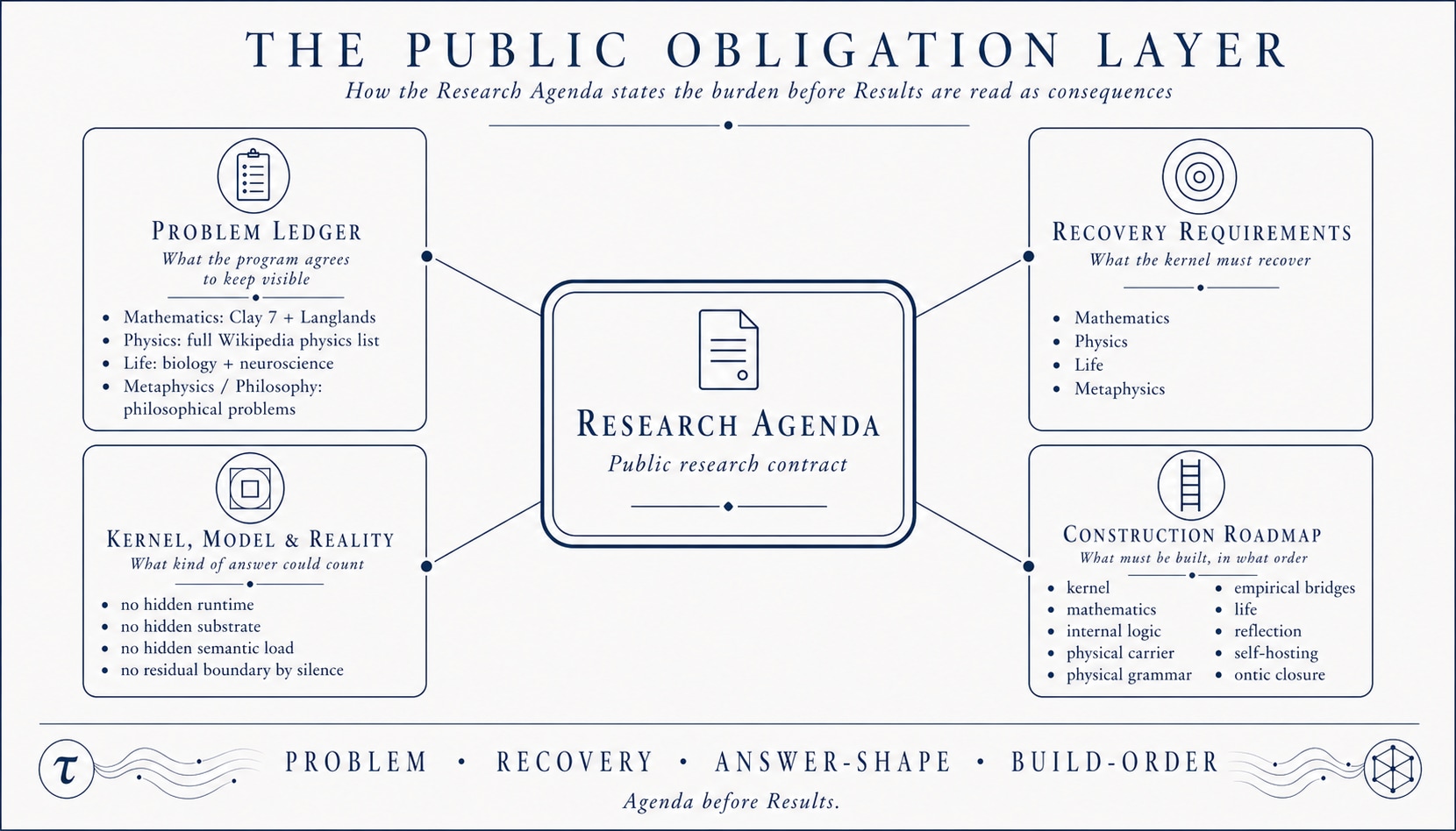
The Agenda is the program’s public obligation layer: it records Core Semantics, Structural Challenge Ledger, answer-shape burden, and construction order before Results are read as consequences.
How to read this page
If you are new to the program, read the Agenda in this order:
- Start with Core Semantics to see the language, structures, laws, and grammars the theory must earn before it can answer.
- Continue to Structural Challenge Ledger to see the external stress-test questions the program agrees to keep visible.
- Read Kernel, Model & Reality to understand the no-externalities and ontic-status burden.
- Use Construction Roadmap to see the logical build-order implied by those commitments.
- Then move to Results and Verify to inspect the current program stance and verification routes.
From obligation to inspection

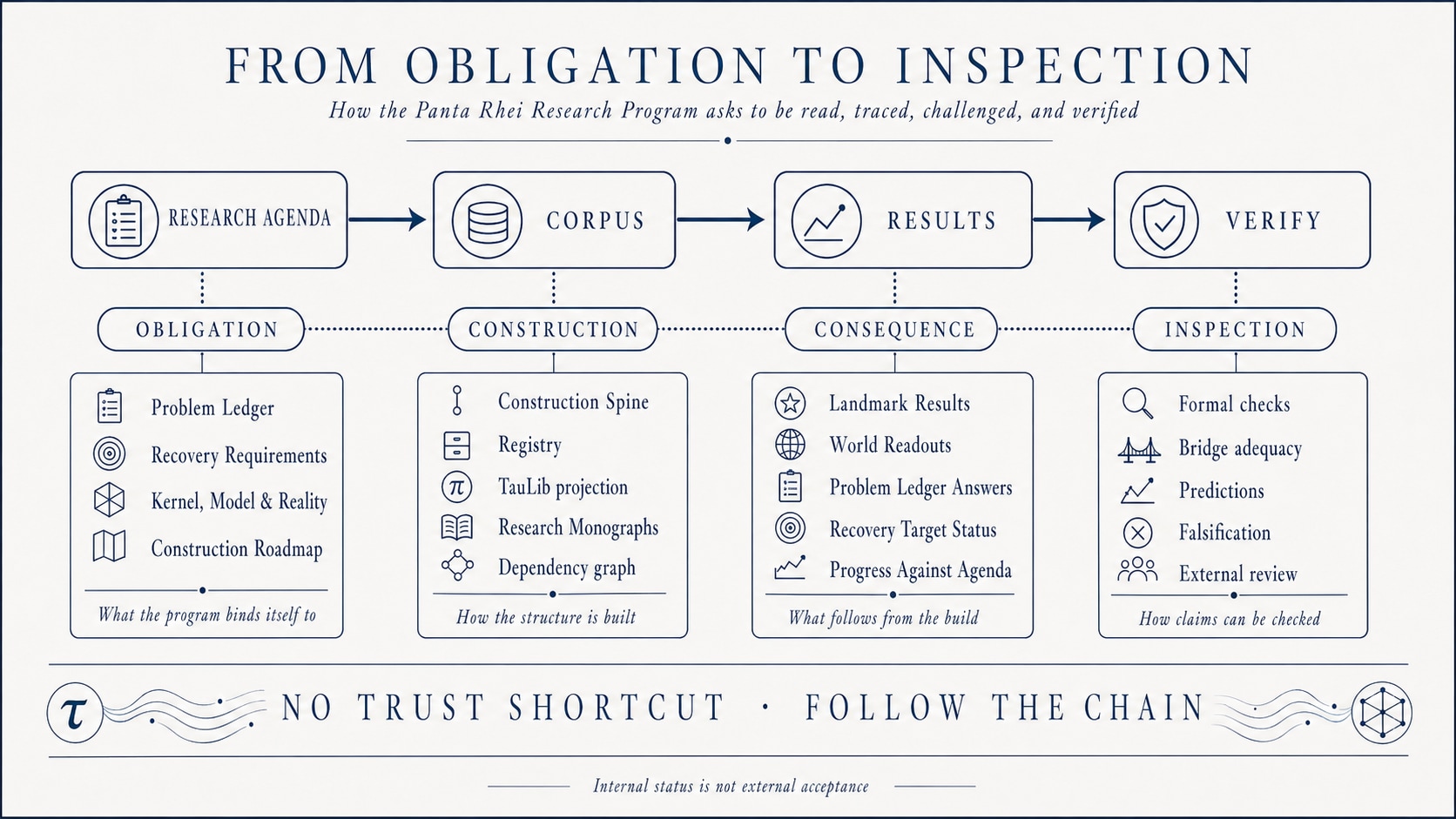
The Agenda is the obligation layer. It states the burdens the program accepts before Results are allowed to sound like consequences.
Why a Structural Challenge Ledger?
The program asks whether a constrained kernel can support a coherent theory of reality. Such a theory cannot be judged only by whether it rephrases established theories.
It must also be tested against structural challenges: places where existing knowledge remains open, where a domain’s language is still unstable, or where the framework must show that it can generate new routes to knowledge.
The Structural Challenge Ledger is therefore not a raw import of public open-problem lists. Public lists are used as source feeds. A challenge enters the canonical ledger only when it tests one of the program’s declared obligations: semantic generation, structural recovery, bridge adequacy, proof or formalization strength, prediction, falsification, explanatory compression, or a new route to knowledge.
| Domain | SCL rule | Why included |
|---|---|---|
| Mathematics | Curated: Clay + Langlands, selected Smale, Foundations & Logic, τ-native clusters | Tests the mathematical and logical strength a theory of reality must earn. |
| Physics | Wholesale external import, ringed and clustered, plus τ-native audit challenges | Physics is the most mature, formalized, measurement-facing public stress surface. |
| Life | Curated 29 structural challenges | Tests life as such: definition, origin, substrate, code, evolution, morphology, cognition, artificial life, and life beyond Earth. |
| Metaphysics / Philosophy | Curated 29 E₃ challenges | Tests ontology, truth, knowledge, logic, mind, normativity, religion, and proof/commitment boundaries. |
The retired v1.0 source mirror imported larger raw feeds for Life and Metaphysics. Those feeds are now provenance sources only. They do not define the canonical Life or Metaphysics challenge sets. See the SCL Source Policy for the full admission criteria.
Core Semantics vs Structural Challenge Ledger
Core Semantics and the Structural Challenge Ledger carry different burdens.
Core Semantics asks whether the theory can carry, retype, refine, bridge, or explicitly challenge the established language and structures of the domains it addresses: formal reasoning, mathematical bridge criteria, physical measurement architecture, life-organization grammar, reflective meaning, and metaphysical intelligibility.
Structural Challenge Ledger asks whether the theory can express, classify, constrain, answer, defer, reclassify, or reject curated structural challenges with reasons.
The two belong together. A theory cannot credibly address structural challenges if it cannot first earn the language those challenges presuppose.
Kernel, Model & Reality
The ledgers name what the program must face. Kernel, Model & Reality names the deeper burden behind that confrontation: what would make a kernel more than a useful organizing model?
The program is therefore not satisfied with a model that merely organizes observations; it asks what formal shape an admissible theory of reality would need in order to qualify as an ontically serious candidate.
This section treats ontic status as a burden, not a premise. It takes the phenomena/noumena boundary seriously, distinguishes pointing access from diagrammatic access, and applies a strict no-externalities rule: no hidden runtime, substrate, bridge, semantic load, or residual boundary may be treated as solved by silence.
Together, these four surfaces define the public research contract:
- Core Semantics asks what language, structures, laws, and grammars the theory must earn.
- the Structural Challenge Ledger asks what canonical domain stress tests the program agrees to keep visible, classify, address, reframe, or refuse with reason.
- Kernel, Model & Reality asks what kind of answer could earn ontic seriousness.
- the Construction Roadmap states the logical build-order implied by those obligations.
Construction Roadmap
The first three surfaces state the burden. The Construction Roadmap states the logical build-order required by that burden.
It is not a project timeline. It explains why the program must define the kernel, recover mathematics, internalize logic, locate the physical carrier, recover internal physical grammar, build empirical bridges, recover life, recover reflective structure, self-host formal systems, and only then test universal closure and ontic status.
Agenda pillars
The pillar pages provide the detailed machinery behind the Agenda.
- Research Aim & Desiderata What kind of answer the program is actually seeking.
- Foundational Discipline Why the program binds itself to stricter constraints upstream.
- Core Design Principles Methodological pillars that govern the work across domains.
- What the Program Refuses The explanations, shortcuts, and ceasefires the program will not treat as final.
- Core Semantics The language, structures, laws, grammars, and refusal boundaries the theory must earn before it can answer.
- Structural Challenge Ledger Canonical domain stress tests and their current program classification, evidence route, verification route, and external-review boundary.
- Source Policy How external challenge sources are selected, pinned, imported, and classified into the Structural Challenge Ledger.
- Kernel, Model & Reality The ontic-status burden, no-externalities rule, diagrammatic access mode, and required answer-shapes.
- Construction Roadmap The logical build-order that follows from the Agenda's own obligations.
- Result Criteria How claims are classified, constrained, and routed toward verification.
- Work Roadmap The operational sequence that delivers the agenda's logical build-order.
Burden-of-proof flow
Mirror to Results
This lane states the burden. The Results lane states the current answers. The two should be read together: agenda without results would be ambition without evidence; results without agenda would be a list without a public standard.
Save or share this page for inspection
Download a portable dossier, copy a reviewer note, or send this page to someone who can inspect it.