Read Carefully
Start with Discover, Program, Agenda, Corpus, and relevant Artifacts & Releases before judging isolated claims.
 v4.0 · 2 May 2026 · manifest 07ea80a
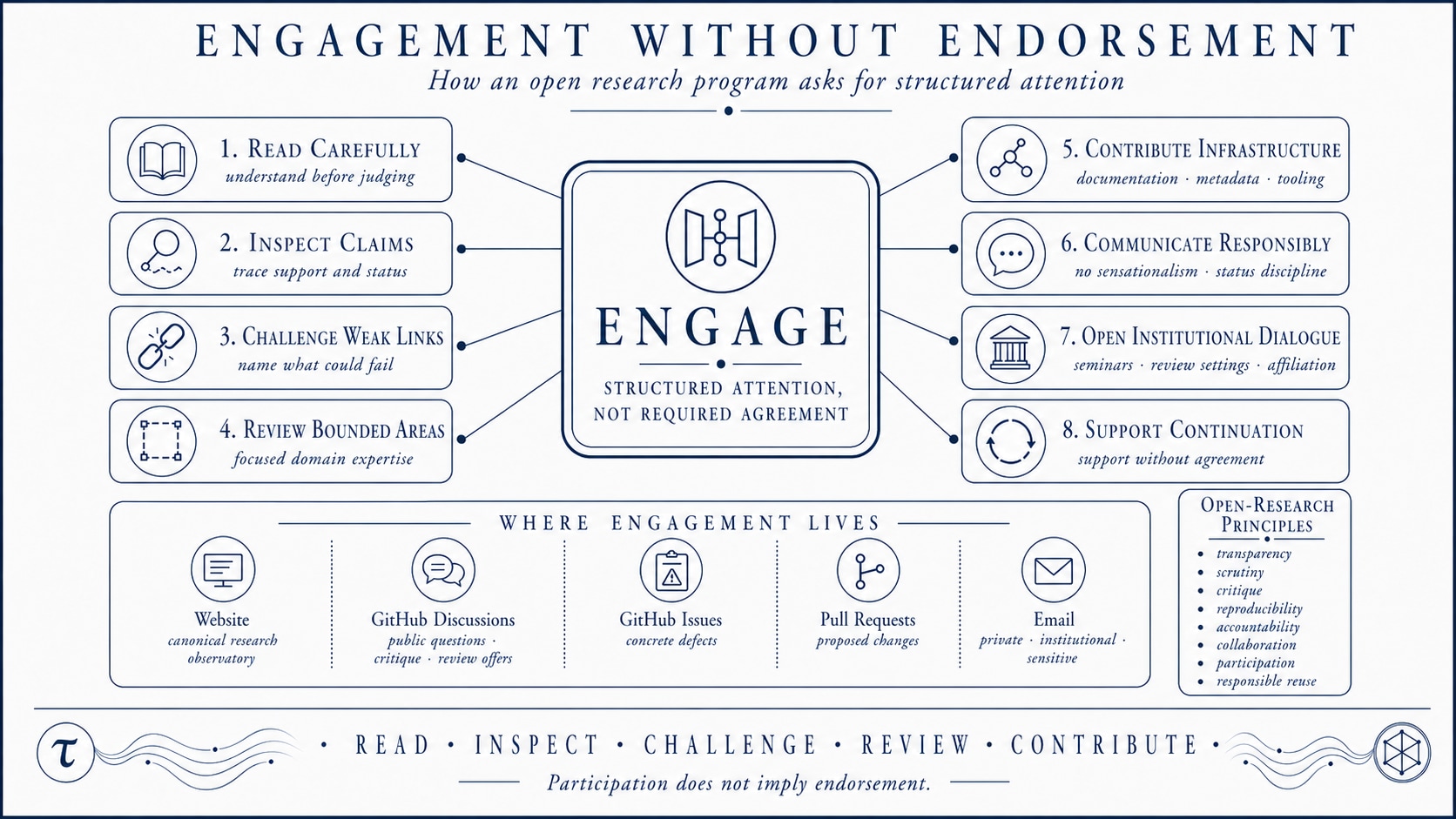
Engagement without endorsement: read carefully, inspect claims, challenge weak links, review bounded areas, contribute infrastructure, communicate responsibly, or support continuation.
Engagement without endorsement.
Engage is where openness becomes operational.
The Panta Rhei Research Program does not ask first for agreement. It asks for structured open-research engagement: careful reading, public questions, critique, reproducibility checks, domain review, correction, infrastructure contribution, responsible communication, and institutional dialogue.
The website is the public research observatory. GitHub is the public discussion and contribution substrate. Email remains the route for private, institutional, media, sensitive, or support-related contact.
Package 3 documents that public architecture in the white paper Building a Public Research Observatory for High-Scope Open Research. The point is not endorsement; it is making scrutiny, correction, and contribution routes visible.
The Engage lane is the interface through which the open research program asks the world for the kinds of attention it needs to become more correct, more inspectable, more useful, and more accountable.
Engagement does not require agreement. Participation does not imply endorsement. The most useful stance is structured attention: follow the claim, identify the support, name the weak point, and help decide what would count as correction, verification, or failure.
The participation interface at a glance

Start with Discover, Program, Agenda, Corpus, and relevant Artifacts & Releases before judging isolated claims.
Trace claims into Corpus, Results, Verify, TauLib, Release Manifest, and assessment protocols.
Use critique routes, falsification paths, source checks, and result-status challenges to identify what breaks.
Route corrections, prior-art references, claim-boundary concerns, formalization concerns, and publication errata.
Offer focused review of one Structural Challenge / Challenge Response, Core Semantics / Recovery item, construction step, result, research note, TauLib module, briefing, or site surface.
Improve documentation, metadata, search, templates, registry hygiene, TauLib documentation, import reports, or site structure.
Explain the work without sensationalism and without treating internal results as external acceptance.
Use contact routes for seminars, review settings, affiliation, archive hosting, research collaboration, or structured evaluation.
Support independent continuation without implying endorsement of the conclusions.
This is an open independent research program, not a promotional community.
The work can only improve if it is read carefully, challenged specifically, corrected publicly where possible, reviewed by domain experts, and tested through the verification routes it exposes.
For that reason, the most useful engagement is structured attention: follow the claim, identify the support, name the weak point, and help decide what would count as correction, verification, or failure.
Public questions, critique, review offers, research-note discussion, and correction candidates should begin in GitHub Discussions whenever possible.
Use email instead for private, institutional, media, sensitive, or support-related contact.
This engagement model is aligned with open-research principles: transparency, scrutiny, critique, reproducibility, collaboration, participation, accountability, and responsible reuse.
See also:
These references are context, not authority claims. The program remains accountable to the claims, sources, proofs, predictions, and corrections it exposes.
This program does not require agreement. Participation does not imply endorsement. It invites structured engagement and scrutiny. For deeper context on claims and methods, see Research Notes, Results, Verify, and Independence, Scope & Scrutiny.
For a first-pass orientation prompt before public posting, use AI-Assisted Discovery. These prompts are discovery aids, not verification.
The right first question is not “should I already believe this?” It is “where can this be inspected, and what would count against it?”
Download a portable dossier, copy a reviewer note, or send this page to someone who can inspect it.