
Foundational Science
How foundational science could change if the construction remains supported after review.
Reading discipline
Read this page through the Impact chain:
- Result
- Verification & Review
- Translation Layer
- Domain Uptake
- Consequence
If any upstream link weakens, the impact claim weakens with it.
Core idea
Foundational Science is the innermost impact stratum.
It asks what would change for mathematics, physics, life, and metaphysics if the Panta Rhei construction holds: if a finite, computable, constructive kernel can recover the structures that currently appear across separate foundational disciplines.
This is not a claim that the framework has already been accepted by those disciplines. It is a conditional consequence analysis.
The question is narrower and more precise:
If the kernel remains supported after formal, mathematical, physical, biological, and philosophical review, what would its existence imply for the foundations of science?
Self-Enrichment, Not Reduction

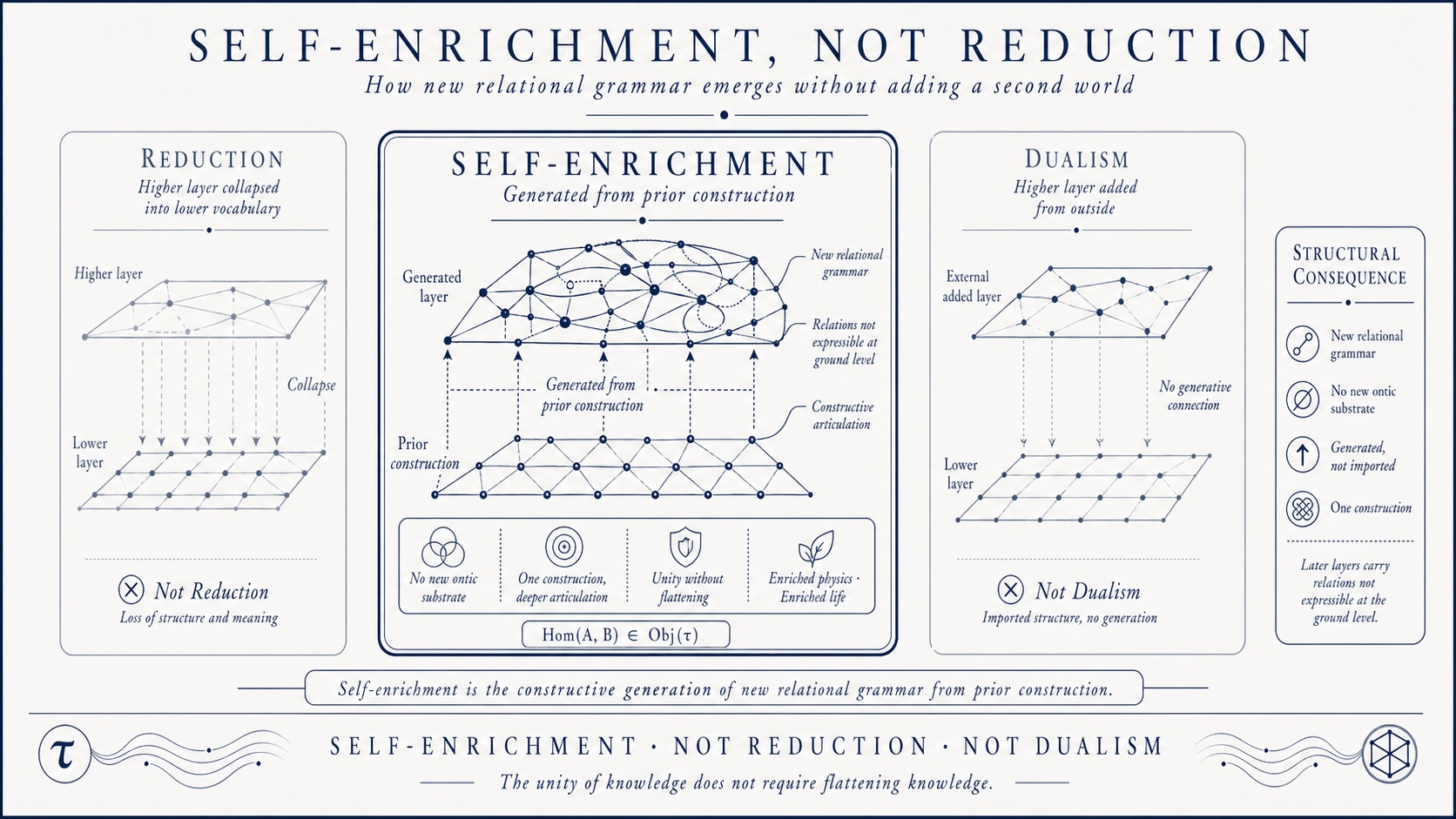
The framework rejects both flattening reduction and external dualism. Self-enrichment means new relational grammar is generated from prior construction without adding a second ontic world.
Why this stratum comes first
The first impact of a foundational theory is not practical deployment. It is not technology, policy, education, or public meaning.
The first impact is on the grammar of explanation.
A supported kernel would change what counts as a foundational answer. It would not merely add another model inside existing scientific language. It would provide a candidate explanation for why the languages of mathematics, physics, life, and reflective intelligibility can be coordinated at all.
That is why Foundational Science sits closest to the core of the Impact lane. Every wider impact stratum depends on it.
The chain is:
kernel coherence → mathematical recovery → physical grammar → empirical bridge → life and reflection → wider consequence
If the inner links fail, the outer consequences weaken or disappear.
Mathematics: earned structure rather than unrestricted virtual universe
Modern mathematics contains many powerful formal universes. Set theory, category theory, type theory, proof theory, model theory, and constructive mathematics each provide different ways to organize mathematical truth, proof, structure, and existence.
Panta Rhei does not treat all mathematical existence as automatically ontic.
The foundational consequence, if the program holds, is a distinction between:
- mathematics as a powerful formal or virtual language;
- mathematics as structure recoverable from the kernel;
- mathematics as structure required for reality-description.
This is not a rejection of classical mathematics. It is a reclassification of its role.
Classical mathematics may remain an enormous and indispensable formal universe. But the mathematics that directly reflects the kernel would be smaller, stricter, more constructive, and more tightly bound to ontic recovery.
In that setting, relevance is not decided by convention alone.
It is earned by construction.
Gödel, induction, and unearned diagonal access
Gödel requires special care in this stratum.
Panta Rhei should not be described as refuting Gödel, bypassing Gödel, or escaping incompleteness in a slogan-like sense. The relevant question is whether the formal core has the resources required for Gödel-style constructions to apply, and what follows if it does or does not.
Gödel’s incompleteness theorems have precise prerequisites. They apply to formal systems strong enough to carry a certain amount of arithmetic and to represent enough of their own proof theory. The proof does not operate in a vacuum: it depends on arithmetizing syntax, coding formulas and proofs as numbers, constructing a provability predicate, and applying a diagonal or fixed-point construction.
That distinction matters.
There are important formal systems for which completeness and decidability are known. Tarski’s first-order theory of Euclidean geometry is the classical example. This shows that Gödel incompleteness is not a universal fate of every serious formal theory.
Panta Rhei’s position is not that Gödel was wrong. It is that the Panta Rhei kernel is not built as a Peano-style arithmetic foundation with unrestricted access to formulas, predicates, proof codes, and diagonal self-reference.
The exact hinge is induction.
Peano arithmetic requires an induction principle that ranges over formulas or properties. In first-order form, induction appears as an axiom schema: for each formula of the language, a corresponding induction instance is admitted. In stronger second-order form, the principle ranges directly over predicates or sets.
Panta Rhei refuses this move at kernel level.
The kernel does not begin with a primitive notion of “all formulas,” “all predicates,” “all expressions,” or “all proof codes” over which an induction principle may range. It does not yet have a theory of syntax. It does not yet have an internal meta-language. It does not yet have a general object called “formula of the system.”
Those are not primitive resources.
They must be earned later.
This is the central difference. Peano-style induction already licenses a form of formula access. Panta Rhei’s kernel does not. The kernel may later construct representations of expressions, proofs, object theories, Peano arithmetic, or ZFC as hosted formal systems. But it may not use those notions before they have been constructed.
The difference is therefore deeper than a different axiom list. It lives at the proof-discipline level.
Panta Rhei’s calculus is closer in spirit to linear and substructural logics: assumptions and expressions are not freely reusable background material. They are resources whose use must be licensed. In particular, the kernel prohibits unearned diagonal access: it cannot quantify over its own formulas, freely copy its own expressions, or smuggle an internal syntax theory into the foundation.
The same point applies to the Gödel sentence itself.
The usual Gödel construction depends on forming a statement that is equivalent, inside the system, to a claim about its own unprovability. In standard presentations, this requires a provability predicate and a diagonal fixed point. For the second incompleteness theorem, one also needs an internalized consistency statement, usually expressible in terms of the non-existence of a proof of contradiction.
Panta Rhei does not grant this machinery at kernel level.
It does not begin with an unrestricted internal predicate of provability. It does not begin with a general encoding of formulas and derivations. It does not begin with an unconstrained negated-existential proof predicate over its own syntax.
Those structures may be studied later, but only as constructed and hosted formal objects.
So the claim is not:
Gödel fails.
The claim is:
The standard Gödel proof is not directly repeatable at kernel level unless one first shows that the kernel can internally construct the syntax, proof predicate, diagonal fixed point, and consistency predicate required by the proof.
This gives critics a precise target. If the Panta Rhei account is wrong, the way to show it is not to invoke Gödel as a slogan. The way to show it is to construct, inside the kernel and under its calculus, the missing diagonal machinery.
Until that is done, the responsible formulation is conditional:
If the Panta Rhei construction holds, then the Gödel proof is not automatically transferable into the kernel, because the kernel refuses the unearned formula-access and diagonal machinery that the proof requires.
This is the intended sense in which Panta Rhei may avoid the classical incompleteness pattern: not by contradicting Gödel, but by refusing the foundational architecture that makes the Gödel construction available in the first place.
Millennium problems and foundational stress tests
If the framework holds, the Clay Millennium Problems and Langlands are not treated as isolated prestige targets.
They become stress tests for whether the kernel can recover enough mathematical structure to reach the deepest known fault lines of modern mathematics.
The impact would not merely be that the program proposes answers to difficult problems. The deeper impact would be that these problems become visible as structural checkpoints in one construction.
In that reading:
- Riemann is not only a statement about zeros;
- Poincaré is not only a topological classification theorem;
- Yang–Mills is not only a field-theoretic existence question;
- Navier–Stokes is not only a PDE regularity problem;
- P vs NP is not only a complexity-theoretic separation;
- Birch–Swinnerton-Dyer and Hodge are not only arithmetic-geometric conjectures;
- Langlands is not only a vast correspondence program.
They become tests of whether mathematics, physics, and structure can be recovered under one coherent kernel discipline.
This is a conditional statement. It does not replace standard proof, peer review, or mathematical verification.
It says: if the construction holds, the deepest mathematical problems are no longer only external challenges. They become internal load-bearing joints.
Physics: shared ontological carrier rather than forced unification
One of the deepest pressures in modern foundational physics is the unresolved relation between quantum theory and general relativity.
The usual framing begins with two extraordinarily successful but structurally different theories: quantum field theory for microscopic and particle-scale phenomena, and general relativity for spacetime, gravitation, and cosmology. The unification problem then asks how these two formalisms can be reconciled.
If Panta Rhei holds, the foundational consequence would be different.
The framework would not unify physics by forcing quantum theory into general relativity, or general relativity into quantum theory, or by placing both inside a larger empirical model. It would instead claim to recover a deeper ontological carrier from which quantum, relativistic, and cosmological structures appear as different regime-level readouts.
In that sense, the impact would not be:
quantum physics plus general relativity are stitched together.
It would be:
the apparent need for stitching arises because both were first formulated as partial regime descriptions rather than as consequences of a shared kernel.
This is a conditional claim. It does not mean that quantum field theory or general relativity become obsolete. Both would remain indispensable descriptions of their domains. But their foundational status would change.
They would become recovered regimes of a deeper construction.
The relevant test would then be strict: the kernel must recover enough physical grammar to support quantum behavior, relativistic spacetime, gravitational dynamics, constants, measurement bridges, and cosmological structure across scales — from subatomic phenomena to large-scale universe dynamics.
Experiments remain sovereign over whether the recovered physical grammar corresponds to our world.
If that recovery succeeds, foundational physics would gain a new kind of unification: not unification by synthesis of two mature theories, but unification by common origin.
If it fails, the claim fails with it.
Life, mind, and metaphysics: constructive articulation, not reduction
A second foundational consequence concerns the relation between the hard sciences, life sciences, philosophy, and the humanities.
Modern inquiry often inherits deep gaps between these domains. Physics is treated as formally hard and experimentally anchored. Biology is treated as empirical and historical. Mind, meaning, value, identity, and metaphysical questions are often treated as philosophically important but difficult to formalize without reduction or distortion.
Attempts to bridge these domains often face a familiar danger: reductionism.
If life is grounded in physics, does life disappear as a real level of organization? If mind is grounded in biology, does meaning become merely biochemical? If metaphysics is formalized, does philosophy become a technical appendix to mathematics?
Panta Rhei’s intended answer is no.
If the framework holds, the impact is not that higher domains are collapsed into lower domains. The impact is that different domains become constructively articulated as distinct layers of one structured reality.
That distinction is essential.
Reduction says:
the higher level is only the lower level in disguise.
Constructive articulation says:
the higher level is earned by construction from prior conditions, but once earned, it has its own stable grammar, constraints, relations, and explanatory role.
In this sense, the framework would not reduce life to physics. It would ask how life becomes a recoverable structural class. It would not reduce mind to life. It would ask how reflective structure becomes possible within living organization. It would not reduce metaphysics to equations. It would ask which metaphysical questions can be typed, constrained, and made answerable inside a disciplined formal architecture.
The result would be neither a least common denominator nor a forced unity.
It would be a shared constructive language rich enough to preserve difference.
Physics, life, mind, and metaphysics would not become the same thing. They would become related without being flattened.
Self-enrichment: how new layers can be real without being separate worlds
The mechanism behind this non-reductive relation is categorical self-enrichment.
This does not need to be understood technically in order to understand the impact claim.
The essential idea is that a later layer can be determined by an earlier layer without being merely identical to it.
In category-theoretic terms, enrichment changes the kind of relations that are available. A ground layer may determine an enriched layer, but the enriched layer can carry relation-types, internal structure, and modes of comparison that were not expressible at the ground level.
That is the important point.
Panta Rhei does not need to add a second ontic world in order to explain life, mind, or metaphysics. But neither does it need to reduce those layers to the language of the ground layer.
The enriched layer is generated from the prior construction, yet it introduces new relational grammar.
This is how the framework aims to avoid both extremes:
- not dualism, because the enriched layer is not an independent world added from outside;
- not reductionism, because the enriched layer has relations that are not available at the lower level;
- not mere metaphor, because the enrichment is part of the construction itself.
In this sense, life, mind, and metaphysics would be neither external additions nor lower-level disguises. They would be self-enriched layers of the same kernel construction.
The unity of knowledge would not require flattening knowledge.
It would require showing how new layers become constructively available.
What would change for foundational science
If the framework holds, foundational science would change in five ways.
First, mathematics would be stratified. Not all formal mathematics would be treated as equally ontic. Reality-relevant mathematics would be the part recovered by the kernel.
Second, physics would gain a shared ontological carrier. The task would not only be to model observations, but to determine whether the observed world realizes the kernel’s internal physical layer.
Third, life would become a core semantic and construction target. Biology would remain empirical, but the category “life” would no longer be treated as merely peripheral to foundational science.
Fourth, metaphysics would become partially formalized. Not by reducing it to physics, but by asking which metaphysical questions can be typed, constrained, and related to the kernel’s structure.
Fifth, verification would become layered. Formal proof, construction traceability, bridge adequacy, empirical comparison, and external review would remain distinct. Compilation and formal checking do not by themselves establish truth about the physical world.
What this does not mean
This stratum must not be read as saying that foundational science has already been transformed.
It does not mean that existing mathematics is obsolete.
It does not mean that experiment becomes secondary.
It does not mean that quantum field theory or general relativity become obsolete.
It does not mean that biology is reducible to a slogan.
It does not mean that mind or meaning are dissolved into mechanism.
It does not mean that metaphysics has been solved.
It does not mean that internal derivation is external acceptance.
It means only this:
If the kernel holds, then the foundations of science acquire a new candidate architecture — one in which mathematics, physics, life, and metaphysics are no longer merely adjacent domains, but recoverable and self-enriched layers of one construction.
Boundary condition
Foundational Science impact is conditional on the strongest forms of scrutiny.
For mathematics, that means proof, formalization, and expert review.
For physics, that means bridge adequacy, prediction, measurement, and falsification.
For life, that means biological plausibility, structural adequacy, and domain expertise.
For metaphysics, that means conceptual precision, non-circularity, and answer-shape discipline.
The impact is large only if the framework remains supported after the checks appropriate to each domain.
Until then, Foundational Science remains an impact hypothesis, not a settled transformation.
Save or share this page for inspection
Download a portable dossier, copy a reviewer note, or send this page to someone who can inspect it.