
How to Engage
A routing guide for structured open-research engagement: public questions, critique, review, corrections, contribution, contact, and support.
Engagement without endorsement
Engagement does not require agreement.
The program needs different kinds of attention: careful readers, public questions, specific critique, reproducibility checks, domain review, corrections, infrastructure contributions, responsible communication, institutional dialogue, and non-endorsement support.
Choose the kind of attention you can offer
Engagement does not begin with agreement. It begins with a useful form of attention: reading, inspection, critique, review, contribution, responsible communication, institutional dialogue, or support without endorsement.

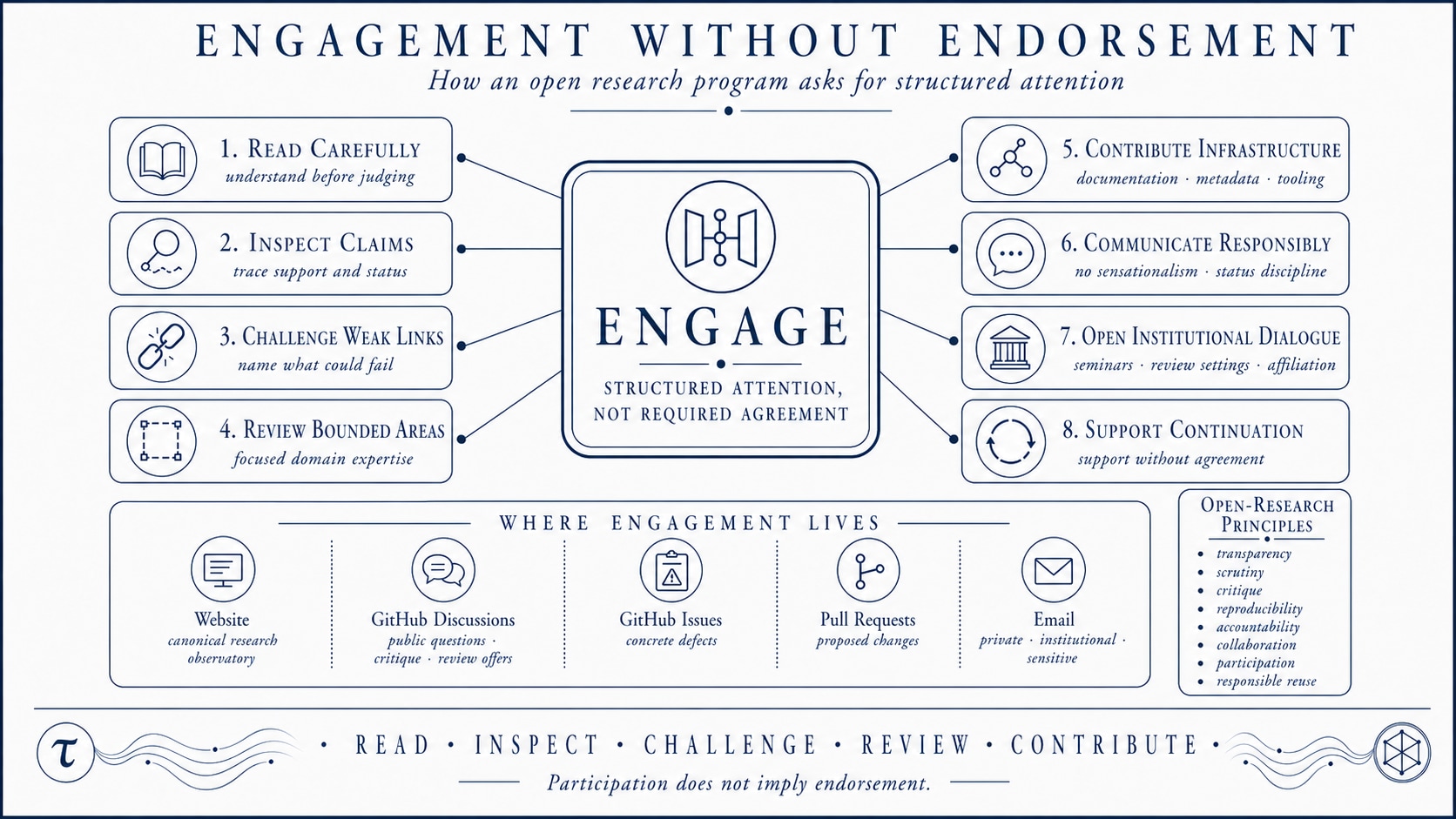
Read carefully
Use Discover, Program, Agenda, Corpus, Results, Verify, and relevant Artifacts & Releases before judging isolated claims.
Ask a public question
Use GitHub Discussions when the question and answer may help other readers.
Inspect a claim
Trace claims into Corpus, Results, Verify, TauLib, release manifests, and assessment protocols.
Challenge a weak link
Name the claim, the suspected failure mode, and what would count as correction or failure.
Submit a correction
Route corrections, prior-art references, claim-boundary concerns, publication errata, or private review feedback.
Offer bounded review
Review one Structural Challenge / Challenge Response, Core Semantics / Recovery item, result, research note, TauLib module, briefing, or page template.
Report a defect
Use Issues for broken links, wrong metadata, bad redirects, build failures, or reproducible public defects.
Propose a correction
Use Pull Requests for concrete wording, metadata, documentation, formalization, or site improvements.
Contribute infrastructure
Improve documentation, search, templates, registry hygiene, TauLib docs, import reports, or site structure.
Communicate responsibly
Describe the work as independent open research under scrutiny, not as settled external acceptance.
Open institutional dialogue
Use email for private, institutional, media, sensitive, support, or non-public collaboration context.
Support continuation
Support ongoing public artifacts, infrastructure, formalization, correction workflows, and open-research engagement.
Discussions, Issues, Pull Requests, Email
| If you want to... | Use |
|---|---|
| Ask a public question | GitHub Discussions |
| Challenge a claim publicly | GitHub Discussions |
| Submit a correction or prior-art concern | Corrections |
| Report a concrete defect | GitHub Issues |
| Propose a concrete fix | Pull Request |
| Offer domain review | GitHub Discussions or email |
| Contact privately | |
| Discuss institutional review | |
| Receive publication notices | Publication Notifications |
| Support continuation | Support the Research |
Where to start
If your question can help other readers, begin with Public Discussions.
If your concern could change a claim boundary, result status, registry object, formalization mapping, publication artifact, or prior-art record, use Corrections.
If your concern is concrete and actionable, use the relevant issue tracker:
If your message is private, institutional, media-related, sensitive, or support-related, use Contact.
Minimum good-faith posture
You do not need to agree with the theory or its conclusions. You do need to engage the right object: a book, a result, a registry object, a formalization surface, an empirical prediction, a source record, a public briefing, or a stated assumption. The engagement routes above are designed to make that object easy to find.
If you want a first-pass outside-in orientation before posting publicly, use AI-Assisted Discovery. Treat LLM output as orientation, not verification.
Save or share this page for inspection
Download a portable dossier, copy a reviewer note, or send this page to someone who can inspect it.