Explore Landmark Results
Start with the high-interpretive-force results that orient the current public readout.
 v4.0 · 2 May 2026 · manifest 07ea80a
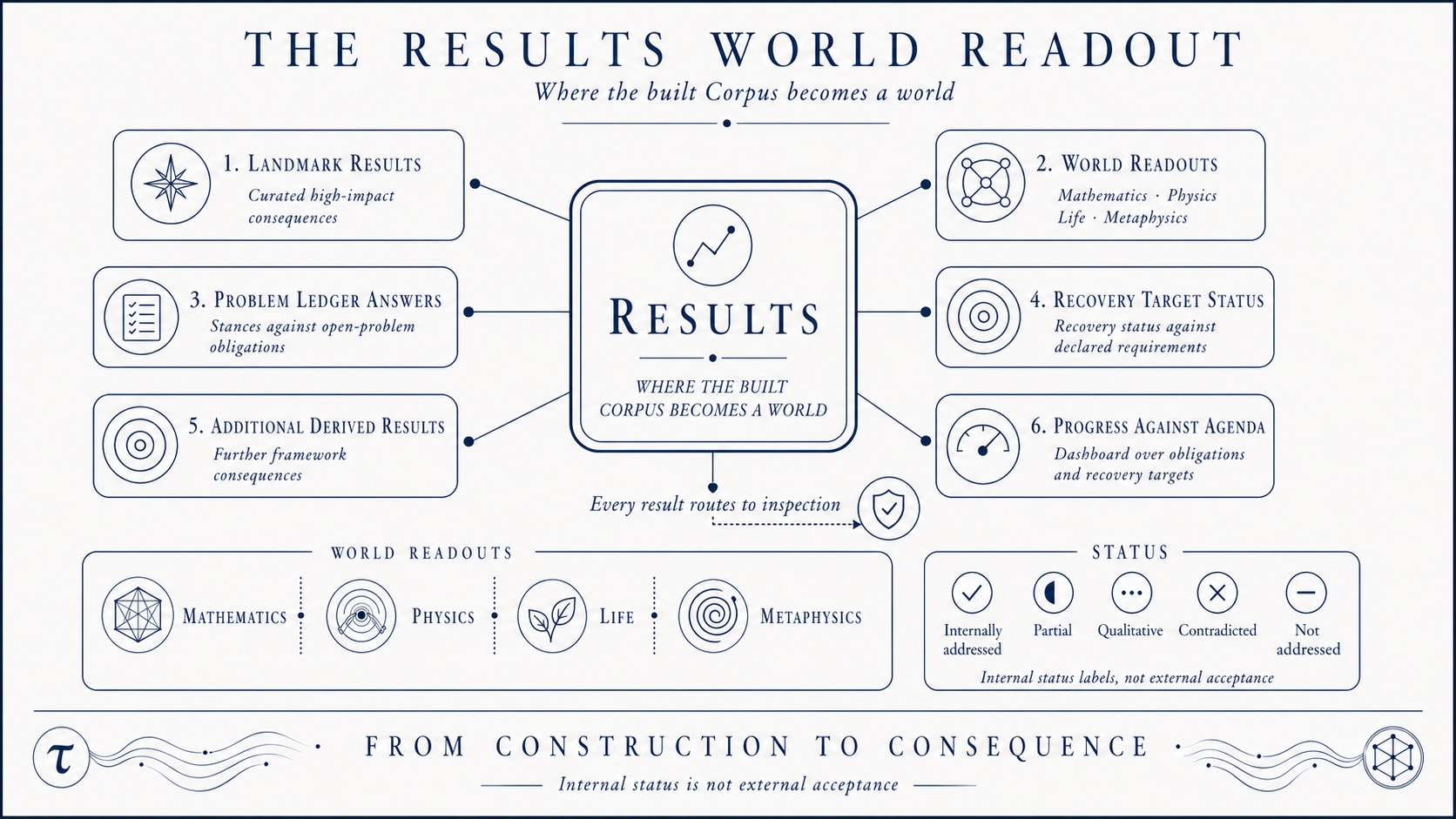
Where the built Corpus becomes a world: Landmark Results, World Readouts, Challenge Responses, Core Semantics Status, Additional Derived Results, and Progress Against Agenda.
Results is where the built Corpus becomes a world. The public domain labels include Mathematics, Physics, Life-facing results, and Metaphysics / Philosophy-facing results, with every surface kept under the site’s internal-status / verification / external-acceptance grammar.
The τ-framework’s results organize naturally into four domains, each with its own calibration cascade or categorical architecture:
The categorical kernel from which everything follows. Categoricity, holomorphy, the central theorem, Yoneda enrichment, the master constant ι_τ.
Kernel Books IV–V · Calibration Cascade95 glossary entries · 67 numerical predictions. The Calibration Cascade records how ι_τ, the neutron-mass anchor, coupling ledgers, mass ratios, unit contexts, and comparison rows connect.
Physics cascade Book VI · K_χ Multi-Branch Tree78 glossary entries. Every biological observable inherits from the Kinetic Pseudoscalar Channel (LG-Y02 / VI.L18). Five branches: chirality, energy, information, temporal, phenomenal.
Life cascade Book VII · Categorical Architecture68 glossary entries. No empirical anchor — categorical-only. Four readout registers (Reg_E/P/D/C → Obs/Norm/Proof/Stance) plus six narrowing principles (OR1–OR6).
The Agenda states the burden. The Corpus carries the build. Results shows the current consequences and world-readouts. Verify exposes the inspection routes.
Every result should be read with its status markers. An internally addressed result is not the same as external verification or scientific acceptance.

The Results World Readout frames Results as a status-marked consequence layer. Results are not isolated claims. They are consequences of the built Corpus, organized through status-marked result surfaces and routed toward inspection.
Start with the high-interpretive-force results that orient the current public readout.
Read the four domain-facing world interpretations as consequences of the Corpus.
Inspect the Results-side mirror of current stances against agenda obligations.
Browse current public progress while keeping internal status separate from external acceptance.
Specific results are often carried, supported, or pre-registered by publication-class artifacts. The four publication classes most relevant to a Results reader:
Standalone scholarly papers whose primary contribution states or proves a Result — the Hinge series.
Research Notes pre-registering a prediction or comparing the program's stance against external observations.
The Verify lane's collation of falsification packs and pre-registration notes across Results.
The full Research Notes shelf, filterable by physics / life / mathematics / metaphysics domain.
These labels report the program’s internal status. They do not indicate external verification or scientific acceptance.
A focused subset of FAQ entries on what counts as a Result, the program’s biggest claims, the master constant ι_τ, predictions and falsification paths, and what happens if a hinge fails.
Results are status-marked consequence surfaces of the built Corpus. They are not the same as external verification or scientific acceptance.
Results show what the framework currently says follows across mathematics, physics, life, and metaphysics. They must be read with status markers: internal stance, verification route, and external-acceptance boundary are separate. A result can be internally addressed without being externally accepted.
The first visible claims are the master constant, the typed Results catalogue, 67 quantitative predictions, 30 falsification tests, and domain readouts across mathematics, physics, life, and metaphysics.
The homepage intentionally surfaces striking claims early, but it also tells readers these claims are not equivalent in status. First orientation should identify high-signal claims and then route them into Results and Verify rather than accepting them from the homepage alone.
The master constant is the scalar value ι_τ = 2/(π + e) used by the numerical physics surface; the site treats it as a central review target, not a rhetorical shortcut.
The master constant is one of the first red-team questions. The physics surface depends on whether ι_τ is genuinely forced by the kernel/scalar-readout construction or effectively fitted. The site routes this through a research paper, Corpus H3 page, Step 2, Registry anchors, and TauLib evidence.
That is the central red-team question. The site claims a structural derivation route, but downstream numerical claims should not be weighted until this hinge is inspected.
The first question is not whether downstream numbers are impressive. It is whether ι_τ is fixed before physical calibration enters. If the derivation fails, the downstream zero-parameter physics claim weakens substantially.
Then the downstream claims depending on that hinge weaken or fail. The site should be read as a dependency structure, not as a list of independent claims.
Claims are routed through construction steps, hinge pages, Registry entries, TauLib modules, and Verify surfaces. If a hinge fails, the relevant downstream claims need to be relabeled, weakened, repaired, or withdrawn according to dependency.
Failure paths are exposed through prediction timing, falsification pack, hinge pages, Release Manifest, errata, and Verify routes.
Failure is not one thing. Mathematical hinges can fail; formal builds can fail; bridge claims can fail; empirical predictions can fail; public-good translations can fail. The site should route each kind of failure to the right inspection surface.
No. Results are consequence surfaces with status labels; some have formal support, some are bridge claims, some are empirical, and some remain interpretive or domain-level.
A Result page is not automatically a Lean theorem. The right question is status, Corpus support, formalized component, bridge burden, and external validation route.
Download a portable dossier, copy a reviewer note, or send this page to someone who can inspect it.