
Thirty Open Problems as τ-Readout Surfaces
A structural answer-shape stress test of expressiveness, coherence, and translation capacity
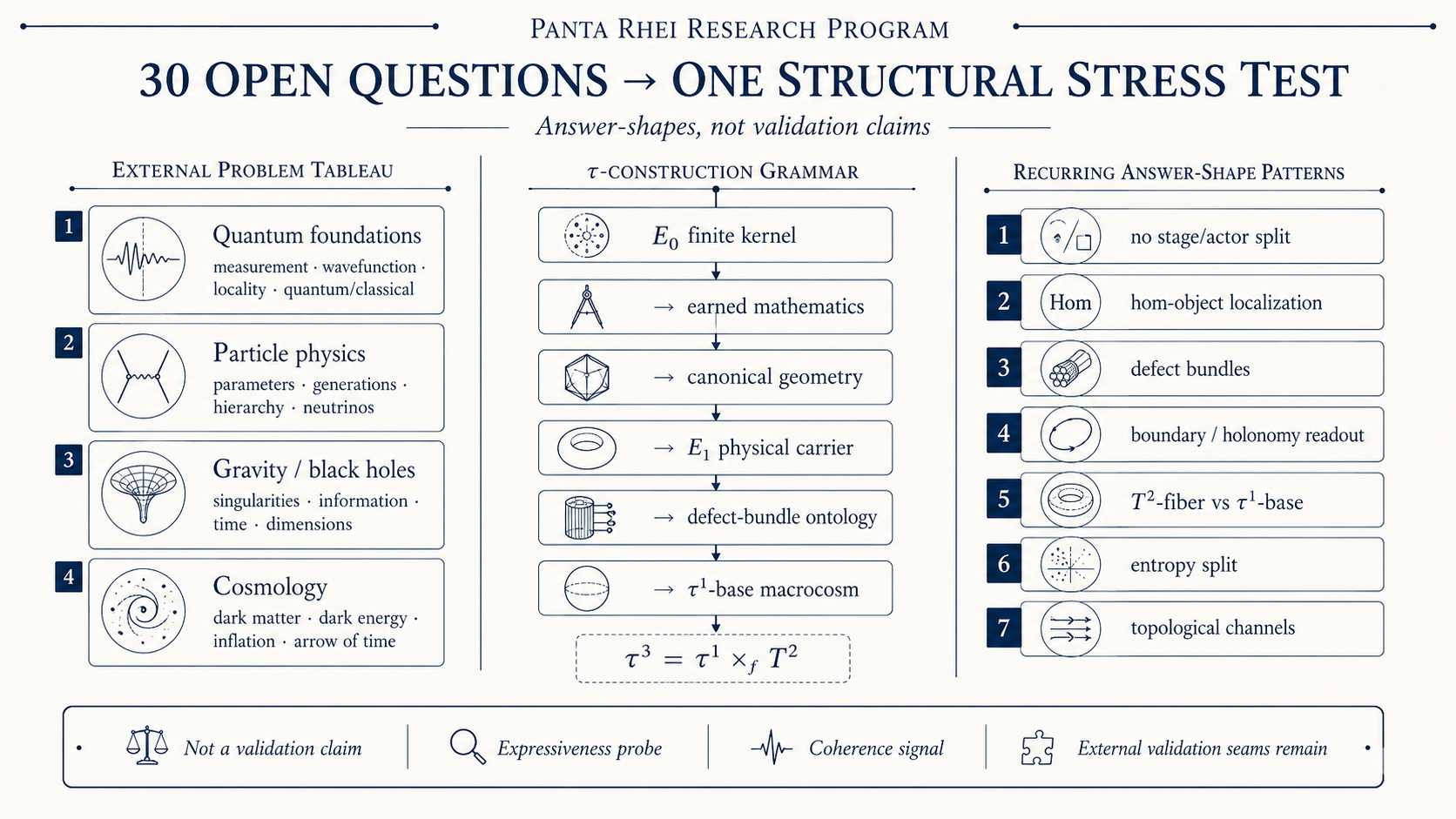
A PDF-backed expressiveness probe mapping thirty familiar open questions to structural τ-answer-shapes without claiming validation.
Publication Metadata
Review status: Program publication; external review not yet completed.
Abstract
The note uses an externally chosen popular-science problem tableau as an expressiveness and coherence probe. It asks whether the existing τ-construction grammar produces differentiated answer-shapes across thirty familiar problem surfaces, or collapses into one vague explanation repeated thirty times. It does not claim to solve those problems or validate the framework.
Anchor Paper and Context
External open-question tableau
The prompt is a recognizable popular-science list of open questions across quantum foundations, particle physics, gravity, black-hole physics, and cosmology.
Relation to this note: Used only as an external stress-test input for answer-shape differentiation, not as a scientific source or authority.
Claim Boundary
Core Claim
The note tests whether the existing τ-construction grammar produces coherent, differentiated answer-shapes across an externally chosen open-problem tableau.
What This Note Does Not Claim
- It does not claim to solve the thirty open questions.
- It does not treat the external prompt as a scientific authority.
- It does not claim external validation of the τ-framework.
- It does not treat an answer-shape as a validated answer.
Falsification and Challenge Surface
- The exercise fails if most rows require unrelated mechanisms or one vague explanation repeated thirty times.
- The exercise fails if hidden imports of standard spacetime, particles, observers, or external primitives are required.
- Any validated solution would still require row-by-row formal derivation, bridge adequacy, empirical comparison, and disciplinary review.
Verification Surface
Reading Note
The PDF contains the full argument. This web page records the public metadata, claim boundary, verification posture, and related site surfaces for the citable Research Note artifact.
Key Caveat
This note is not a solution ledger. It is an expressiveness and coherence probe. An answer-shape is not a validated answer; it is the structural form an answer would take if the τ-framework is read through its own construction grammar.
Corpus Projection
This note functions as an external expressiveness probe: thirty familiar open problem surfaces are read through the existing τ-construction grammar to test whether the framework produces coherent, differentiated answer-shapes rather than ad hoc explanations.