
For Engineering Contributors
Lean 4, CI, docstring hygiene, registry bookkeeping — the project accepts small PRs liberally and opens the door to the Lean community.
For Engineering Contributors
Lean 4, CI, docstring hygiene, registry bookkeeping — the project accepts small PRs liberally and opens the door to the Lean community. This page is the engineering on-ramp: what to send, what not to send, how PRs are reviewed, and what the CI gate actually checks.
Current Status
As of April 2026, TauLib is a public artifact, solo-authored, opening for external contributions for the first time. We are not claiming a vibrant community — just an open door. The CONTRIBUTING guide was published alongside the first external-review wave, and the repository is now accepting outside pull requests under the conventions documented there.
If you are the first external contributor to land a PR: good. That is the point of opening the door.
Infrastructure contribution
Contributing infrastructure can mean improving documentation, metadata, tooling, templates, search, formalization support, or source structure. Engineering contribution does not imply endorsement of the theory or its results.

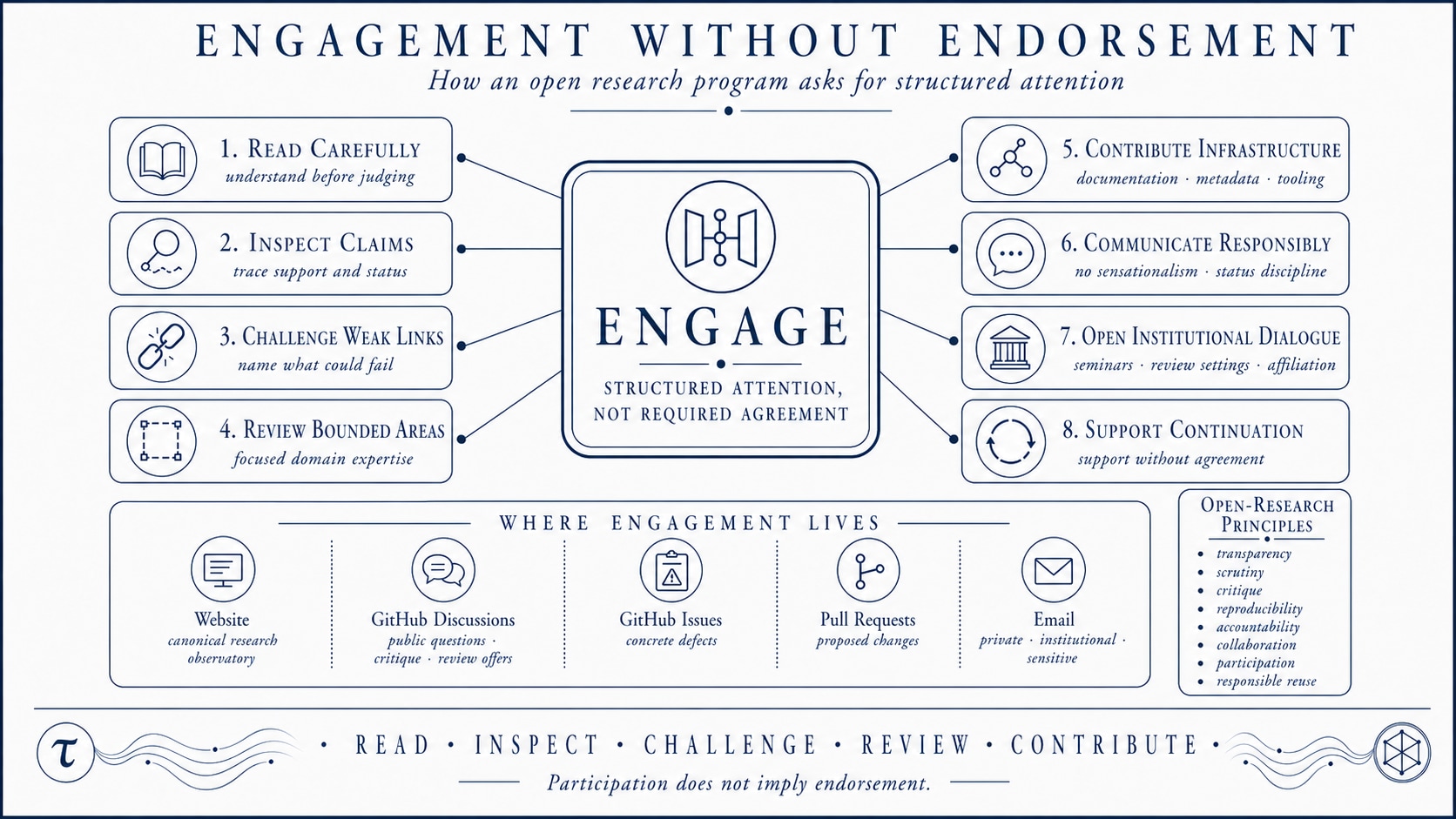
GitHub workflow
Engineering contributions happen through GitHub.
- Use Discussions for questions and design discussion.
- Use Issues for concrete defects or tasks.
- Use Pull Requests for proposed changes.
Start with the community repository for routing and contribution guidelines.
Core public repositories:
Three Contribution Paths
Small PR — merged liberally
Typos, docstring corrections, simp / omega / decide tactic simplifications, registry bookkeeping (summaries out of sync with Lean definitions), broken links. No issue required. Open a PR directly, follow the conventions in CONTRIBUTING.md, and it will be reviewed and merged as soon as CI is green and the diff is obviously correct.
If you are unsure whether a change qualifies as “small,” open an issue and ask — the answer is usually yes.
Medium PR — issue first
New lemmas supporting existing theorems, alternative proofs that do not introduce new axioms, refactors of a single module’s internals. Open an issue first describing the intent; we will triage, confirm scope, and then you open the PR against the agreed approach. This saves you from writing a large diff that gets rejected on scope grounds.
Large change — discussion first
New axioms, scope-label changes (e.g. promoting a conjectural entry to tau-effective), BookI/Kernel refactors, anything that changes the public API of the core generators or the TauLib.Main surface. Start in Organization Discussions with the proposal and rationale. Do not open a large-change PR as the first move; Issues are for concrete scoped implementation tasks, not first-pass architecture debate. Once the proposal becomes a concrete defect, scoped task, or agreed implementation path, move the actionable work into a GitHub issue or pull request. Large changes are not rejected as a category — they are just discussed in public before the PR is written.
What NOT to PR
sorryadditions. CI merge-blocks viascripts/check_no_sorry.py. The three existing methodologicalsorryentries in Book VII are flagged and scoped; no new ones are accepted.- Mathlib content imports. TauLib is tactics-only with respect to Mathlib: we import tactics (e.g.
Mathlib.Tactic.Ring) but not Mathlib content (noMathlib.Analysis.*definitions pulled into proofs). CI enforces this with a grep-guard. - K0–K6 kernel axiom changes without discussion. The seven axioms are load-bearing for the entire framework. Axiom-level changes are not merged without a public discussion thread.
- Anything that would push axiom count above 3. The current invariant is
axioms=3, sorry=0. A PR that would change the axiom count is a framework-level change, not an engineering change, and belongs in a discussion thread.
CI Invariants
Every PR runs against the following gates. A red CI is not a blocker to opening the PR — it is a signal for where to iterate.
lake buildgreen. The entire library must compile cleanly.scripts/check_no_sorry.pyreturnsaxioms=3, sorry=0. No new axioms, no newsorry.- Tactics-only-Mathlib grep-guard. Imports are restricted to Mathlib tactics; content imports fail the check.
- Docstring hygiene. Module headers follow the format specified in CONTRIBUTING.md — a one-line summary, a provenance line, and a scope-label line where applicable.
Community Channels
- Organization Discussions - public questions, review offers, claim challenges, and routing that is broader than one repository.
- GitHub issues — the primary async channel for bugs, proposals, and discussion. Triaged within 7 calendar days.
- Lean Zulip — leanprover.zulipchat.com. There is not yet a project-specific thread; a launch thread will be announced in the
#new membersstream when it opens. Do not assume a URL exists before the announcement. - Direct email — [email protected] for substantive engineering feedback that does not fit an issue thread (e.g. confidential review comments, pre-publication reports).
Licensing
Two separate licenses apply depending on what you are contributing to:
- TauLib (code, Lean sources, scripts): Apache-2.0. See the
LICENSEfile in the repository root. - Site prose (research notes, this page, lane documentation): CC BY 4.0.
- No CLA. We do not require a Contributor License Agreement.
- DCO sign-off. All commits to TauLib must carry a
Signed-off-by:trailer (the Developer Certificate of Origin).git commit -shandles this automatically.
Maintainer Responsiveness
These are commitments, not aspirations. If a window lapses, please ping the thread — silence is a failure mode, not a deliberate signal.
- Issues triaged within 7 calendar days. Triage means labeled, scoped, and responded to — not necessarily resolved.
- Small PRs reviewed within 14 days. If CI is green and the diff is obviously correct, usually much faster.
- Larger PRs and substantive issues addressed publicly in-thread. No back-channel resolutions: if a decision is made, it is written down in the thread so future contributors can read the reasoning.
Good First Contributions
Concrete, not a vague invitation. Any of the following is welcome as a first PR:
- Spot a typo in a module docstring. Open the PR; fix it; CI will do the rest.
- Propose a tactic simplification where you see a collapsible chain like
simp; simp; ringor a hand-unfolded proof thatdecideoromegacould close. - Flag a registry-entry summary that is out of sync with the Lean definition. The
registry/*.tsvfiles are human-edited and drift is real — reconciliation PRs are genuinely valuable. - Propose a missing
#evalcheck that would make a theorem’s numerical claim concrete (e.g. an#evalnext to atau-effectivescope label that computes the predicted quantity). - Fix a broken link or stale file path in a module docstring,
README, or site-adjacent artifact referenced from Lean source.
TauLib is opening for external contributions for the first time. The door is open; the conventions are written down; the CI checks what it checks. The rest is in the PR.
Save or share this page for inspection
Download a portable dossier, copy a reviewer note, or send this page to someone who can inspect it.