
Physics World-Readout
The physics world-readout cluster of the Results lane.
This is the E₁ (Physics) layer of the enrichment ladder — following the Mathematics World Readout (E₀), and followed by the Life (E₂) and Metaphysics (E₃) world readouts.
The pages collected here do not function as the detailed result catalogue of the Panta Rhei Research Program. They form the deeper narrative and epistemic layer that must come before the catalogue.
The central question is not yet which individual problem is solved, or which quantitative prediction can be read off. The central question is more prior:
If the Tau framework is taken seriously on its own terms, what kind of physical world does it describe?
That question cannot be answered by one theorem or one result card alone. It requires a sequence of pages that move from substrate to geometry, from global shape to time, from thingness to lawfulness, from sector closure to observables, and from there to the large catalog of individual physical claims.
The narrative arc: two inputs to every prediction
These 13 pages can be read as one continuous journey. The journey starts with two inputs — the algebraic posit ιτ = 2/(π + e) and the single SI anchor mn (the neutron mass) — and ends at every quantitative physical prediction the program makes. The movement between them is a four-layer calibration cascade L0 → L1 → L2 → L3 → L4: pure algebra, then dimensionless ratios, then the SI anchor, then SI-valued constants through the rescaling functor, then 30 live falsifiers.
The architectural centerpiece is the Calibration Sufficiency Theorem: (ιτ, mn) fixes every constants-ledger table entry with zero free parameters. Each page in this cluster narrates one part of that journey. The fabric pages explain what L0 algebra is made of. The geometric and global-shape pages explain the carrier world on which L1 ratios live. The sector-closure page explains why the L1 ratio space closes. The calibration page is the canonical narrative home of the full cascade, tiered in Tier A/B/C precision bands, and the Calibration Cascade is the public inspection overlay. The long-form artifact, including the flagship R0 → mp/me prediction at 0.025 ppm, remains the Numerical Prediction Supplement (209 pp, 1.11 MB).
From Kernel to Measurement

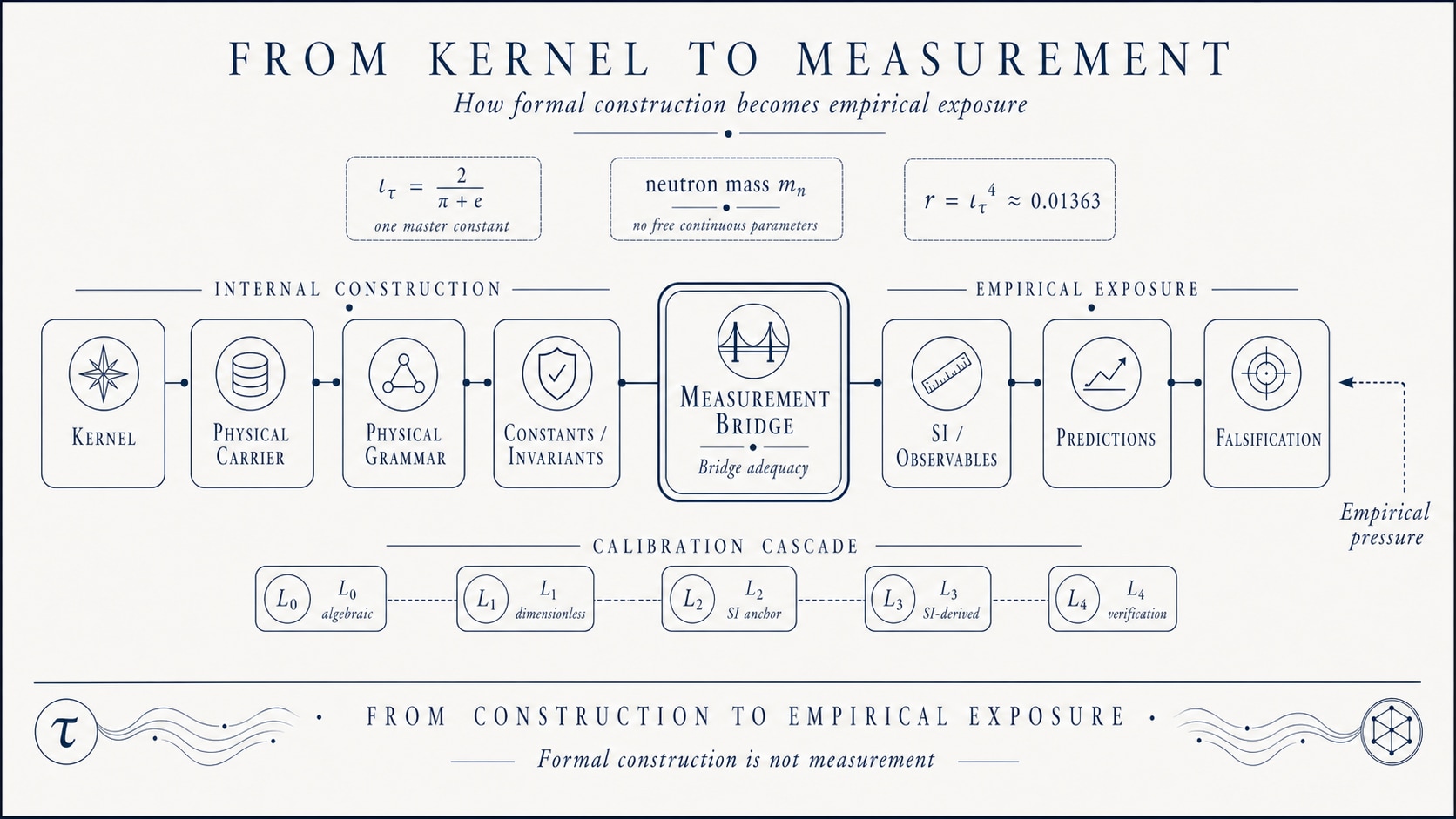
This cluster therefore does three things.
First, it describes the fabric of physical reality in Tau: what the underlying substrate is, how it is structured, and why quantization, geometry, and lawfulness are not bolted on from outside.
Second, it describes the world-picture of Tau physics: the global shape of reality, the status of time and becoming, the closure of the sector architecture, and the emergence of a quantitative hierarchy through ι<sub>τ</sub>.
Third, it prepares the transition into the detailed claims collection by showing how that collection should be read: not as a disconnected list of strong claims, but as the many readouts of one already-specified physical world.
The sequence is ordered so that each page answers a different class of question:
- What is the substrate of physical reality?
- What kind of geometry and topology does that substrate carry?
- What is the global shape of the universe?
- What is the status of time, presentness, and becoming?
- How do physical things first appear?
- Why are laws read out rather than imposed?
- Why does physical reality close into four plus one sectors?
- How do observables, constants, and calibration arise?
- How do gravity and cosmological biography unfold?
- Why is mathematics effective in nature?
- What does this physics make true?
- How can readers move from Tau to the world they inhabit?
Read in order, these pages form the conceptual entrance into the physical claims of the program. The more detailed result catalogue remains indispensable, but it becomes much easier to use once the reader has first understood the kind of world from which those result pages are being read out.
Cluster map
Epistemic posture
These pages describe what kind of physical world the Tau framework yields on the program’s own reading. They do not claim that the wider scientific community has already accepted this world-picture, nor that every bridge from Tau-internal statements to orthodox physical formulations is already settled. The individual result pages carry explicit epistemic status labels (Internally addressed, Partial, Qualitative, Contradicted, or Not Addressed) that make the strength of each specific claim transparent. If the framework holds, the physical world described here is one of its strongest consequences. If the framework does not hold, these pages describe a candidate world-picture that failed — and that is why the program insists on public verification.
Save or share this page for inspection
Download a portable dossier, copy a reviewer note, or send this page to someone who can inspect it.