
The Numerical Physics Ledger
The complete numerical scorecard — from one algebraic posit (ιτ = 2/(π+e)) plus one SI measurement (neutron mass mn) through a four-layer calibration cascade to observable values. Three τ-structural pillars, manifest-pinned falsification pack, zero free continuous parameters. Free PDF download.
| The Numerical Physics Ledger is the complete numerical scorecard of the Panta Rhei Research Program — three τ-structural pillars ( | gen | =3 from H1(τ³;ℤ)=ℤ³, θQCD=0 from SA-i mod-3, λC=ιτ(1−ιτ)) plus a 30-item falsification pack with propagated uncertainty bands, derived from the master constant ιτ = 2/(π+e) posited as framework input. Zero free continuous parameters; a combinatorial library of structural integers (Wn(k) window sums, sector assignments, homology-forced layer choices) enters via the compute-then-axiomatize discipline — full per-prediction integer-choice audit in Chapter 68 Appendix 68.A. Originally Part VII of Book V (Categorical Macrocosm), published here as a free companion document for self-contained access. |
Status and scope
The Numerical Physics Ledger is a Panta Rhei publication artifact. It records the program’s current internal numerical commitments, calibration cascade, prediction inventory, and falsification targets.
It does not imply external validation, scientific acceptance, or independent confirmation. Its purpose is to make the numerical claims inspectable, comparable, and falsifiable.
The calibration cascade (the architectural spine)
The entire numerical scorecard rests on two inputs:
- One algebraic posit: ιτ = 2/(π + e) ≈ 0.341304
- One SI measurement: the neutron mass mn = 1.674927498(95) × 10⁻²⁷ kg
From these two inputs, a four-layer cascade compiles every other quantity:
- L0 — Algebraic layer: ιτ, κD = 1−ιτ, κω = ιτ/(1+ιτ), √3 lemniscate capacity, continued-fraction window sums Wn(k).
- L1 — Dimensionless layer: all mass ratios, all mixing angles, all couplings. Key closed forms: α = (11/15)²·ιτ⁴ = (121/225)·ιτ⁴ at 9.8 ppm vs CODATA; R₀ = ιτ⁻⁷ − √3·ιτ⁻² is mn/me (neutron/electron ratio) at 7.7 ppm leading order; Koide lepton ratio Q = 2/3 exact at −9×10⁻⁶; sin²θW from κA/κB at ~2.7% (tree); αs from κC(3) at ~2.4%; αG = α¹⁸√3(1 − 3α/π). These values match Book IV §73’s Predictive Record (Theorem iv-predictive-record) line for line.
- L2 — Single SI anchor: mn (CODATA 2018). One measurement, theory-forced by the No Knobs Theorem.
- L3 — SI-anchored layer: me, G, mP, ℏ, kB, ε₀, μ₀ — obtained by the linear rescaling functor MSI = RM[Mτ] = Mτ · (mnSI / mnτ).
- L4 — Verification layer: the 30-item falsification pack N1–N30 + all observational predictions across particle physics, atomic spectroscopy, cosmology.
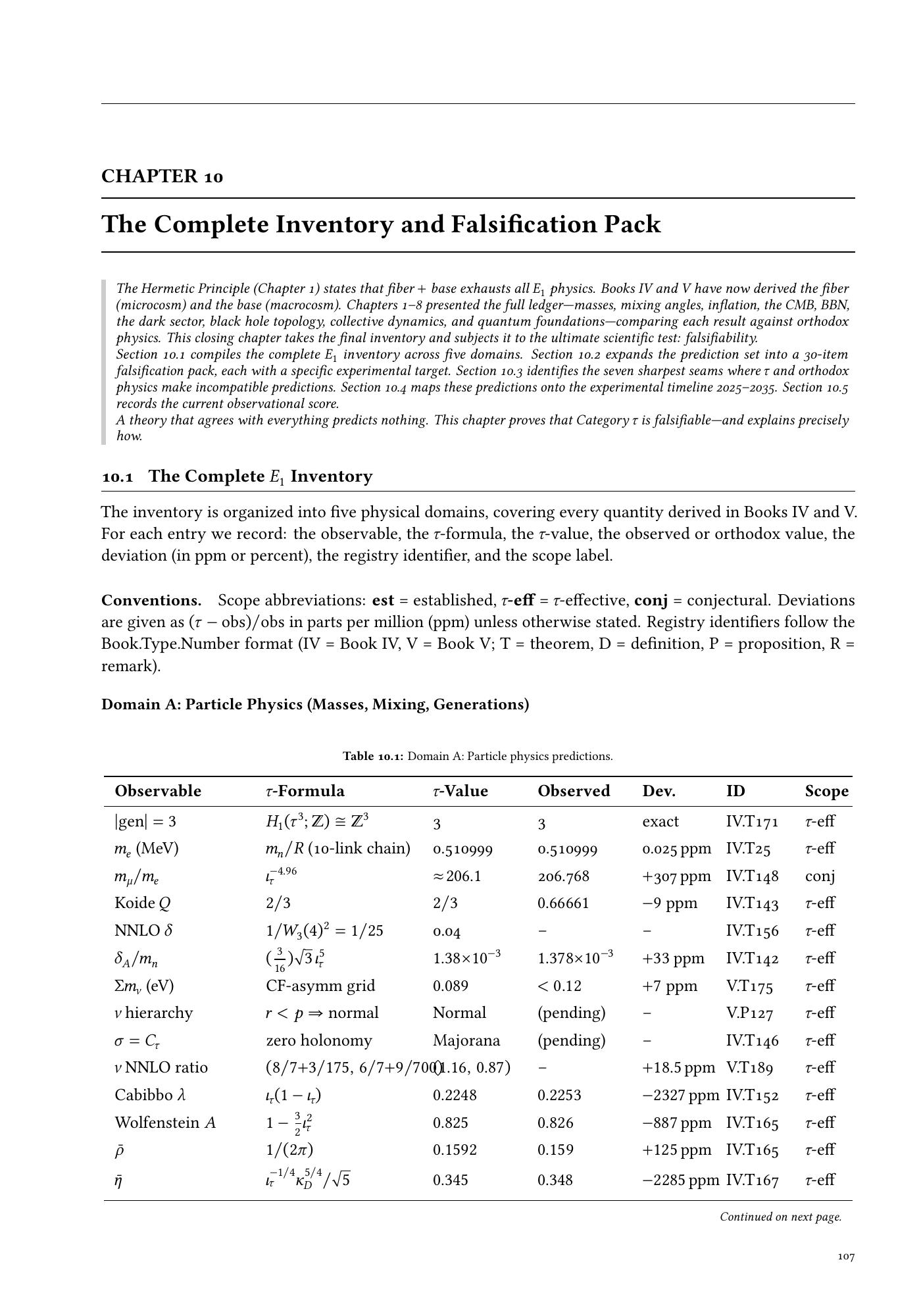
Three precision bands characterize the predictions: Precision-band (≲ 10 ppm τ-side residual; includes Koide Q exact, R = mn/me at 7.7 ppm, α at 9.8 ppm); Identity-band (∼1–3 per cent τ-side; Weinberg and strong self-coupling at tree level); and Observation-capped (capped by the experimental floor: r, ns, H0). A single “0.025 ppm” slogan was used in earlier internal drafts; it is dropped here in favour of per-row residuals, matching Book IV’s Predictive Record exactly. Chapter 58a of the companion contains the complete self-contained cascade architecture.
What the Ledger contains
-
Three τ-structural pillars (topologically forced, no fitted parameters): gen =3 from first homology; θQCD=0 from SA-i mod-3 admissibility; the Cabibbo-complement structure λC=ιτ(1−ιτ). - A two-tier coherence structure distinguishing global holonomy on H∂[ω] (which sets cosmic-mean densities like ωm, ωb, ℓ1) from local matter-phase coupling (which sets galaxy-scale dynamics via a trinary D / ω / B sector decomposition).
- A refined BTFR master formula (V.T85) with τ-natural coupling coefficients, tested on the full SPARC-175 rotation-curve sample (Lelli, McGaugh & Schombert 2016).
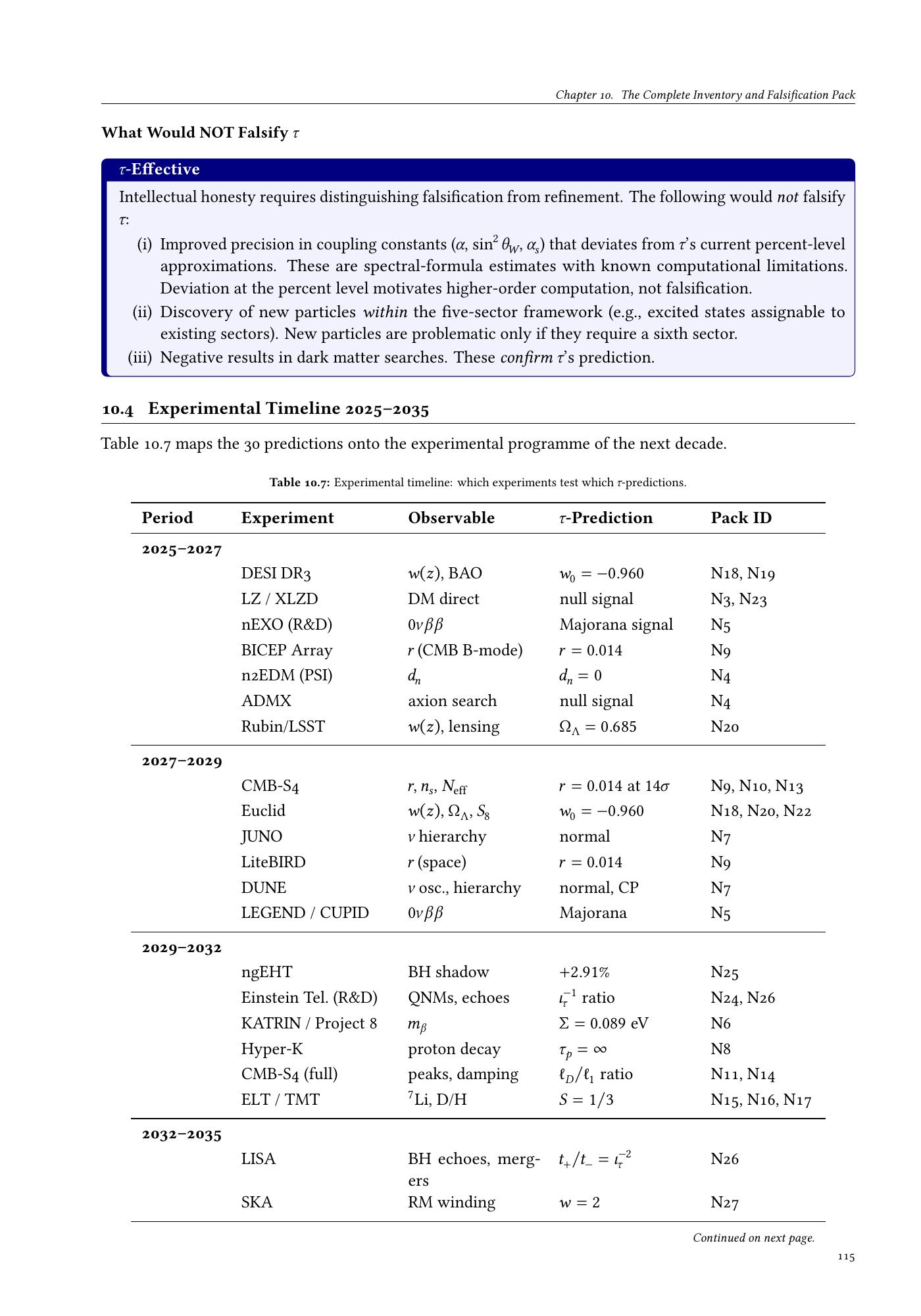
- A 30-item falsification pack (N1–N30) naming specific τ predictions, experimental instruments, and decisive thresholds for 2025–2035.
- Seven falsifiable seams where τ and orthodox physics make structurally incompatible predictions.
- A tier-1 τ-native holographic structure sketched as a research programme (not mathematically reduced to AdS/CFT; distinct in rank, boundary topology, and metric structure).
- Honest uncertainty bands propagated from integer-choice sensitivity across the 30-item pack, with a per-prediction audit in Appendix 68.A.
Open research targets (stated in the Ledger)
- Pointwise RAR discrimination between τ-natural BTFR coefficient pairs, testable on SPARC-175 HI-dominated dwarfs.
- Elliptical-galaxy BTFR test on ATLAS³D + SLUGGS samples.
- A τ-native CAMB / CLASS Boltzmann pipeline with explicit two-tier source assignment.
- A pre-registered numerical σ8 prediction from tier-1 holonomy invariants ahead of CMB-S4 and Euclid data.
- Derivation of the central charge, Zamolodchikov c-theorem analogue, and boundary-cut area law for the tier-1 holographic dictionary.
- First-principles derivation of the D / ω / B sector coupling structure from the character theory on H∂[ω].
- Bullet Cluster lensing-to-baryon offset computation within the capacity-gradient formalism.
Falsification targets on experimental timelines
- dn = 0 at nEDM/n2EDM (PSI, ~2030)
- r = ιτ⁴ ≈ 0.0136 at CMB-S4 / LiteBIRD (~2030)
- Σmν = 0.089 eV at CMB-S4 + KATRIN / Project 8 (~2032)
- No fourth-generation fermions at LHC Run 3 + FCC (~2040)
- Proton stability at Hyper-K / DUNE (~2040+)
The predictions are bridge-independent: they can be compared directly to experimental measurement without accepting the program’s deeper ontological claims. The number either agrees with experiment or it doesn’t.
Twelve chapters across five physics domains
The Correspondence Map
τ³ ↔ orthodox physics translation dictionary
The Mass Spectrum
All particle masses from one constant — neutron/electron ratio at 7.7 ppm, Higgs at 8.0 ppm
Mixing Angles & Baryogenesis
CKM, PMNS, θ_QCD = 0 exactly, baryon asymmetry η_B
Inflation, the CMB, and BBN
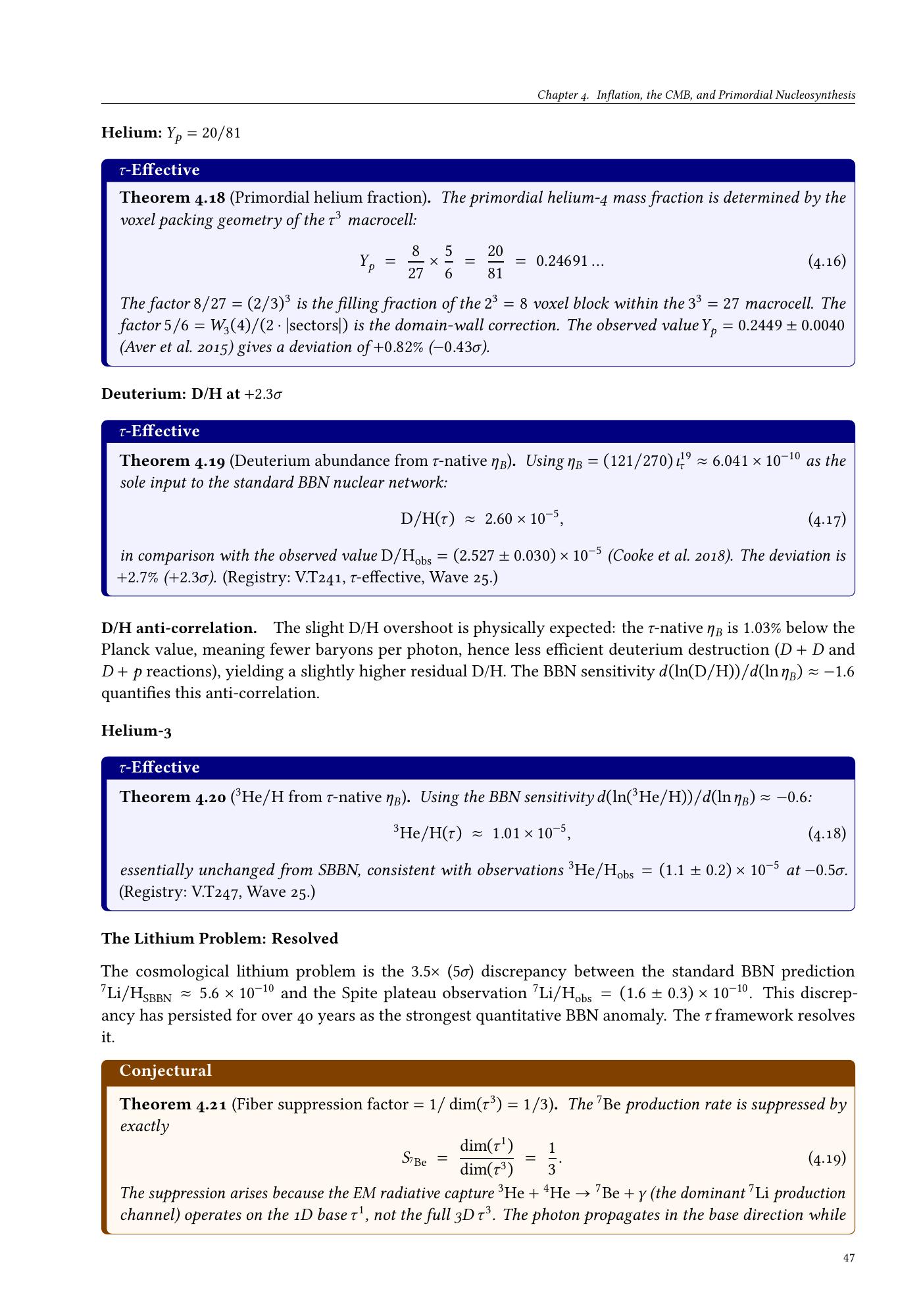
r = ιτ⁴ ≈ 0.0136, spectral index, acoustic peaks, primordial light elements
The Dark Sector Dissolved
Rotation curves without dark matter, Ω_Λ, Hubble tension internally addressed at −120 ppm
Black Hole Topology
T² horizons, QNM ratio ιτ⁻¹ ≈ 2.929, EHT shadow +2.91%, GW echoes
Collective Dynamics
She–Lévêque β = 2/3, Kolmogorov C_K = 3/2, magnetic reconnection
Foundations & Falsification
Measurement problem, why unification failed, the complete inventory + N1–N30
Precision hierarchy
Falsification Pack (N1–N30)
30 predictions with named experiments and 2025–2035 timelines. The sharpest discriminant: N9 (tensor-to-scalar ratio r = 0.0136), testable at 14σ by CMB-S4.
Seven falsifiable seams where τ and orthodox physics make structurally incompatible predictions — BH topology (T² vs S²), no dark matter (Sector Exhaustion vs WIMP/axion), w₀ vs Λ equation of state, r = ι_τ⁴ vs slow-roll inflation, a ⁷Li framework account (S = 1/3) vs the orthodox lithium anomaly, θ_QCD = 0 (no axion) vs strong-CP tuning, and the holonomy ratio ℓ_D/ℓ_1 as a structural invariant. Twelve of the 30 pack entries carry seam tags in _data/falsifications/falsifications.json (mapping to _data/seams.yml labels); the paired CMB/inflation seam N9 + N10 is the sharpest at ~14σ. Full seam-annotated card grid on Falsifications browse.
Inside the document
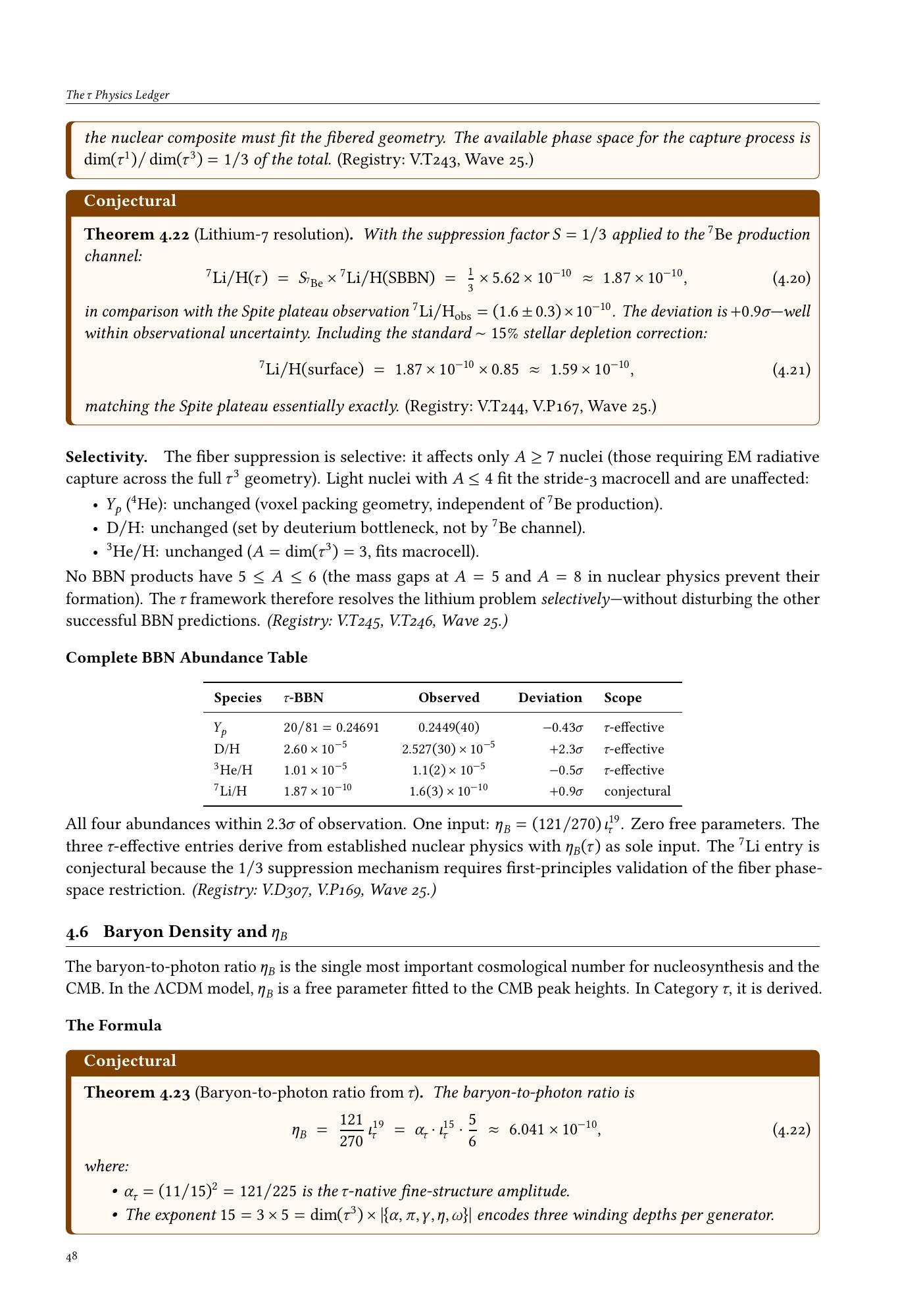
Interactive versions on this site
The predictions and falsifications are also available as interactive, filterable collections with per-item detail pages:
- Predictions Browse — 67 cards with domain/precision/scope filters, each linking to a detail page with the explicit τ-formula and derivation prose
- Falsifications Browse — 30 cards with domain/status filters, each with named experiments and current observational status
Why this document matters
If even a fraction of the sub-10 ppm predictions hold under independent scrutiny, this would be the first zero-parameter derivation of fundamental constants from a single structural constant — a result with no precedent in theoretical physics.
Save or share this page for inspection
Download a portable dossier, copy a reviewer note, or send this page to someone who can inspect it.