
Kernel, Model & Reality
The deepest burden accepted by the program: whether a kernel can earn ontic seriousness rather than merely organize useful models.
Why this section exists
Agenda cannot end with Core Semantics and open problems. It also has to state the deepest question the program is willing to carry:
If a kernel organizes mathematics, physics, life, and metaphysics, what would it take for that kernel to be more than a useful model?
This section names that burden. It does not claim that the burden has already been discharged. It states the conditions under which such a claim could become serious.
The core discipline
The program distinguishes three levels that must not be collapsed:
- a model that organizes descriptions
- phenomena that appear within empirical and conceptual access
- ontic structure that would belong to reality itself
The gap between these levels is not treated as a decorative philosophical caveat. It is the central pressure on the program’s strongest ambitions.
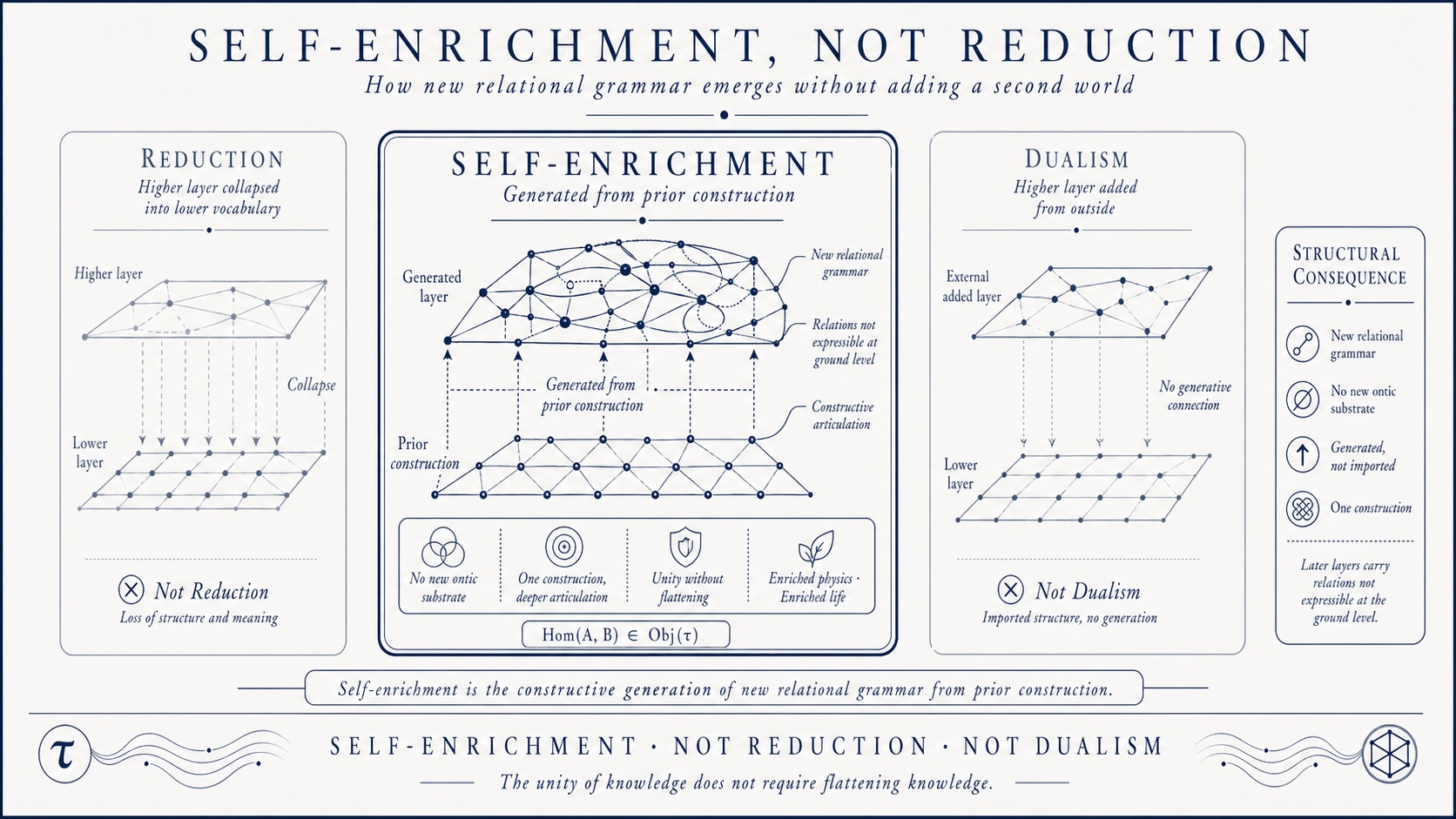
Self-Enrichment, Not Reduction

Section map
Relation to the ledgers
The Core Semantics surface records the language, structures, laws, grammars, and refusal boundaries the theory must earn.
The Structural Challenge Ledger records open questions the program accepts as public stress tests.
Kernel, Model & Reality asks a still deeper question: what sort of answer would make either surface matter ontologically, rather than merely as a useful classificatory exercise?
The public standard
The standard is intentionally strict:
- ontic status is a burden, not a premise
- no externality may remain hidden
- diagrammatic access is formal and structural, not pointing access
- substrate dependence must be internalized, derived, typed, factored out, bridged, or marked unresolved
- residual boundaries must be disclosed rather than hidden inside rhetoric
The program may fail parts of this burden. If it does, the failure should be visible.
For the general positioning map across neighboring approaches, use Program > Related Approaches. The pages in this section remain the specialist Agenda route for no-externalities and ontic-status comparisons.
Save or share this page for inspection
Download a portable dossier, copy a reviewer note, or send this page to someone who can inspect it.