
Public Discussions
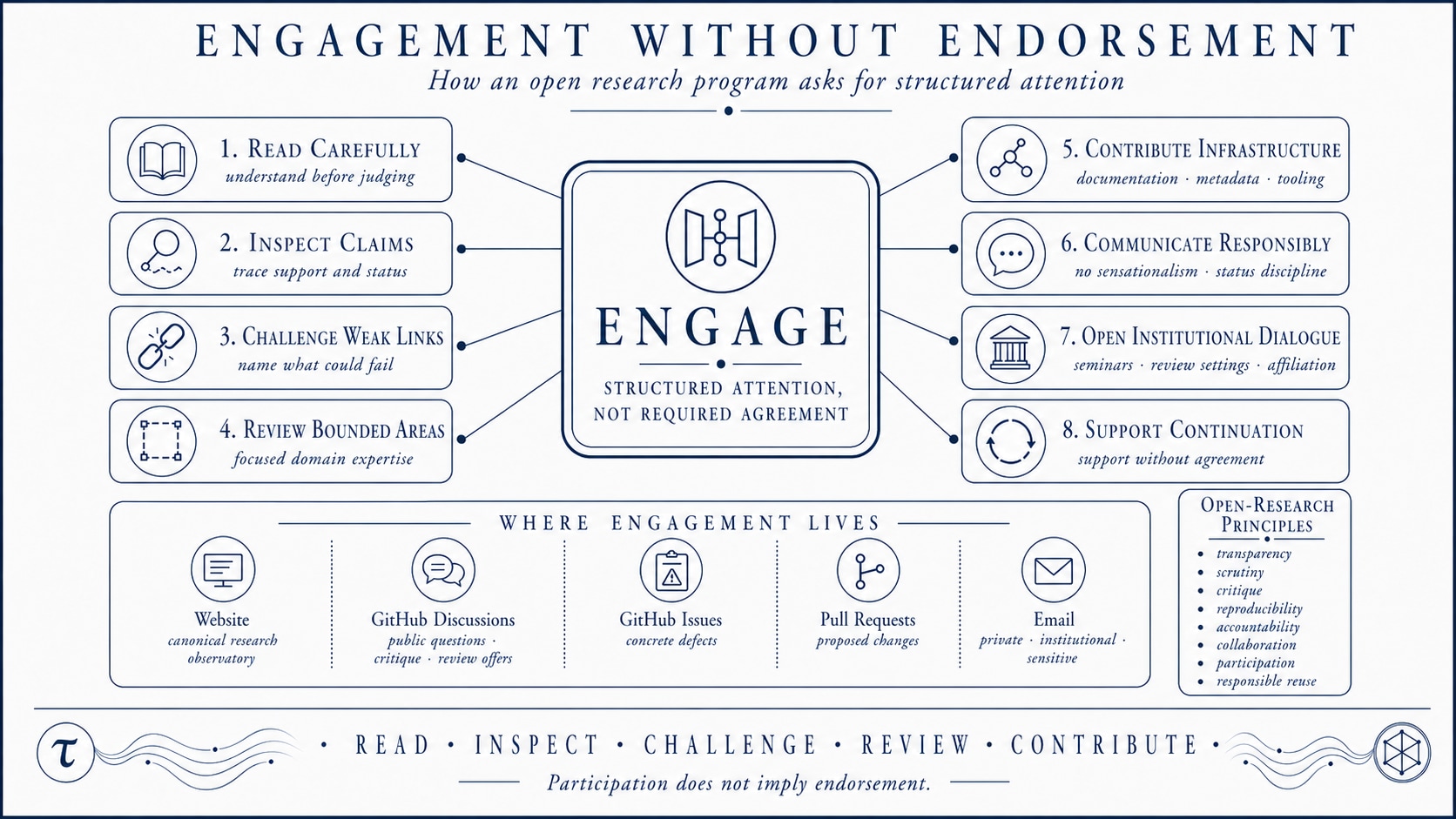
Public discussion routes for questions, critique, review offers, correction candidates, and structured open-research engagement through GitHub Discussions.
Public questions, critique, review offers, and correction candidates belong in GitHub Discussions whenever possible.
GitHub Discussions is the primary public discussion home of the Panta Rhei Research Program.
We use it because the program is published as an open research object: questions, challenges, clarifications, and corrections should be linkable, searchable, attributable, and reusable where possible.
Participation does not imply endorsement.
Reading the site does not require a GitHub account. Posting publicly does.
For private, institutional, media, sensitive, or support-related contact, use email instead.
Where public engagement lives
Public questions, critique, review offers, and correction candidates belong in GitHub Discussions where possible. Concrete defects belong in Issues; proposed changes belong in Pull Requests; private or institutional matters belong in email.

What belongs in public discussions
Use GitHub Discussions for:
- orientation questions;
- program and theory questions;
- Agenda questions;
- Corpus and Construction Spine questions;
- TauLib and formalization questions;
- Results and World Readout questions;
- prediction and falsification challenges;
- Research Note discussions;
- Public-Good Briefing discussions;
- review offers;
- errata candidates before they become formal issues;
- public clarification requests.
If you are unsure how to frame your question, use AI-Assisted Discovery to generate a first-pass route recommendation, then post the specific page, claim, or question in GitHub Discussions.
What belongs in issues
Use GitHub Issues for concrete, actionable defects:
- broken links;
- wrong metadata;
- typo batches;
- bad redirects;
- raw template rendering;
- source/import problems;
- build failures;
- reproducible formalization or site failures.
Issue routing:
- Site issues for website defects.
- TauLib issues for Lean and formalization defects.
- Publications issues for public artifact defects.
- Research issues for public scripts, notebooks, and import tooling defects.
- Community issues for contribution guidelines, templates, and routing defects.
What belongs in pull requests
Use Pull Requests for concrete proposed changes:
- documentation improvements;
- wording corrections;
- metadata fixes;
- template changes;
- site improvements;
- publication artifact updates;
- TauLib documentation or formalization contributions.
What belongs in email
Use email for:
- private contact;
- institutional contact;
- media requests;
- sensitive critique;
- funding or support discussion;
- non-public collaboration context.
The general public contact route is [email protected]. Typed contact routes remain listed on Contact.
Discussion categories
The GitHub discussion space is organized around the program’s public research surfaces:
- Announcements;
- Start Here / Orientation;
- Ask About the Program;
- Agenda;
- Corpus & Construction Spine;
- TauLib / Formalization;
- Results & World Readouts;
- Predictions & Falsification;
- Research Notes;
- Impact & Public-Good Briefings;
- Corrections / Errata Candidates;
- Structured Review / Domain Expertise;
- Meta / Infrastructure.
Participation norm
Strong criticism is welcome when it is specific.
A useful challenge names the exact claim, where it appears, what seems unsupported or false, and what would count as correction or failure.
Open-research context
This engagement model is aligned with open-research principles: transparency, scrutiny, critique, reproducibility, collaboration, participation, accountability, and responsible reuse.
See also:
These references are context, not authority claims.
Start now
Save or share this page for inspection
Download a portable dossier, copy a reviewer note, or send this page to someone who can inspect it.