
The Bi-Square Motif
The repeated proof-organizing shape of the kernel: tower coherence on the left, spectral naturality on the right, and a pasted constraint that becomes richer across the construction.
What the bi-square is

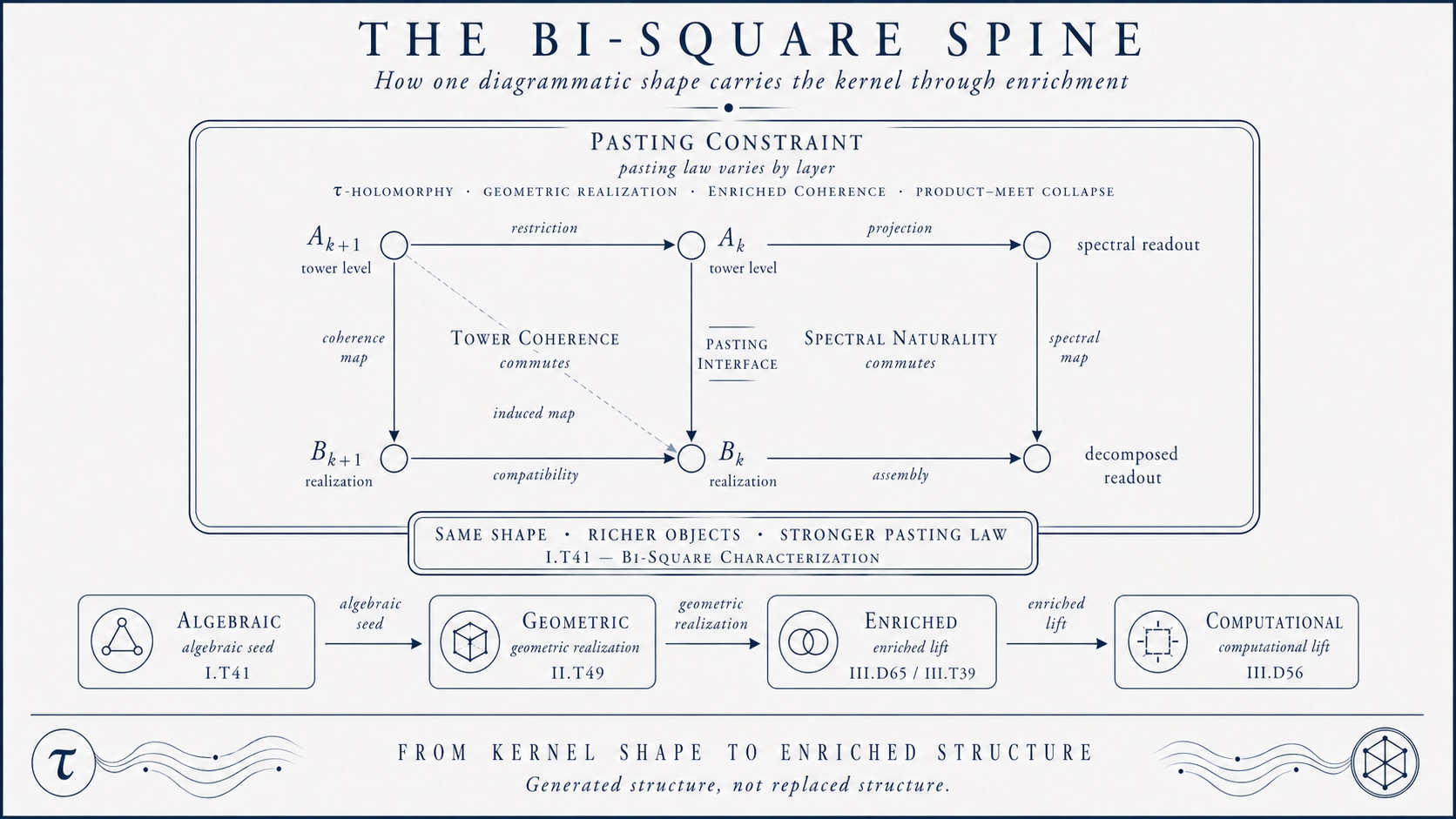
The bi-square is the Corpus route for a repeated categorical shape. It is a pasted 2 x 3 diagram: the left square records tower coherence, the right square records spectral naturality, and the whole pasted rectangle carries the layer-specific constraint.
The first form appears in Book I as I.T41, the Bi-Square Characterization. There it says that a family is tau-holomorphic precisely when both squares commute. That same shape is then lifted into richer settings: geometry in Book II, arithmetic enrichment in Book III, and computation in the tau-admissible layer.
Why it matters
The Construction Spine explains the build order of the Corpus. The Bi-Square Motif explains a different thing: the stable diagrammatic form that keeps reappearing inside that build.
That distinction matters. A reader can follow the construction step by step and still miss the repeated categorical shape. The bi-square makes that shape visible. It shows how the framework can preserve one proof architecture while changing the carried objects, morphisms, and pasting law. Wave 3 models this as construction motif metadata, not as a second spine parallel to the Construction Spine.
The scaling chain
| Stage | Registry anchors |
|---|---|
| Algebraic / holomorphy | I.T41 |
| Geometric | II.D77, II.T49 |
| Enriched | III.D65, III.T39 |
| Computational | III.D56 |
The public lesson is compact: same shape, richer objects.
Source anchors
The bi-square is already present in the public Corpus, but until now it was distributed across several projections.
- Book I gives the algebraic seed in Chapter 70: The Holomorphy Bi-Square.
- Book II gives the geometric lift in Chapter 60: The Geometric Bi-Square.
- Book III gives the enriched lift in Chapter 47: The Enriched Bi-Square.
- Book III gives the computational lift in Chapter 61: The Computational Bi-Square.
Use this page as the synthesis route. Use the linked chapters, registry entries, and TauLib docs when you need exact local detail.
Verification routes
The bi-square should be inspected through three public projections:
- Registry for atomic objects and dependencies.
- Monograph Corpus for narrative proof order.
- TauLib for formalization surfaces where the corresponding modules are available.
The key TauLib routes are:
- Book I Holomorphy / Presheaf Essence
- Book II Geometric Bi-Square
- Book III Enriched Bi-Square
- Book III Computational Bi-Square
What this route does not claim
This page is an orientation route, not a substitute for proof checking or external review.
- The plate is a diagrammatic guide, not a proof.
- The bi-square is a proof-organizing motif, not empirical evidence.
- The bi-square is not a second construction spine or separate construction order.
- The four stages are not identical in content; they preserve shape while changing objects, morphisms, and constraints.
- The computational stage is about the tau-admissible fragment, not a claim about unrestricted classical complexity.
Use the page to see the spine. Use Registry, TauLib, the monographs, and external review to inspect whether the spine holds.
Save or share this page for inspection
Download a portable dossier, copy a reviewer note, or send this page to someone who can inspect it.