
Landmark Results
A curated guide to the results with the highest interpretive force inside the program.
What makes a result a landmark
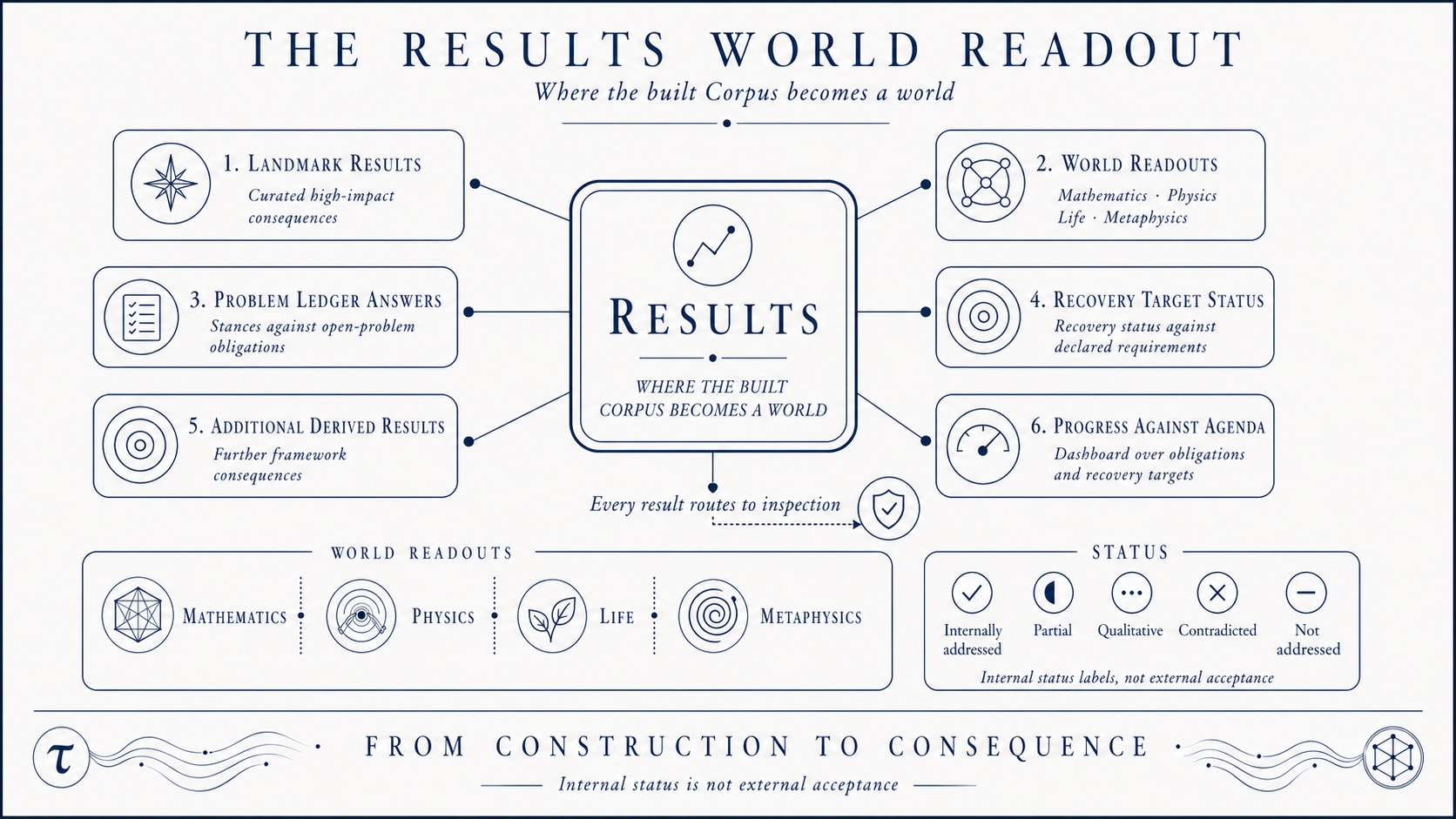
A Landmark Result is not a trophy case and not a claim of external settlement. It is a result whose interpretive force is unusually high inside the program: if the result holds, the reader has to redraw the map of what the framework is doing.
The selection is intentionally editorial. It is not balanced sampling, not completion accounting, and not a proxy for peer review. The full Results lane remains the ledger; this page is the guided route through the results that most strongly change the shape of the picture.

A small kernel, many consequences
The first landmark is the kernel itself: the τ-coherence kernel claims that the program is not starting from a large catalogue of assumptions, but from a small generator and axiom base. The Central Theorem then carries that base into a spectral bridge, while the Canonical Ladder turns domain expansion into staged construction rather than thematic analogy.
That is why the Four-Layer Architecture of Reality belongs here. It is the point where a mathematical spine becomes a world-facing architecture: mathematics, physics, life, and reflective/metaphysical structure are read as consequence surfaces of one built Corpus.
The physics shock
The physics landmarks are not presented as external validation. They are presented as the places where the framework becomes most exposed to measurement, numerical precision, and falsification. The electron-mass derivation is the sharpest numerical pressure point; the dark-sector closure result reframes the dark-matter search; and the vacuum-catastrophe account asks whether a scale mismatch can be read through the Corpus instead of patched around it.
The same arc continues through the Hubble-tension result, the neutrino-mass sum, the question of why matter has three generations, and the forward-facing primordial gravitational waves surface. These are landmarks because they force the program into contact with precision, bridge adequacy, and empirical accountability.
Life stops being a side case
The life-facing landmarks ask whether life is an accidental late add-on or a structural consequence of the same construction. The page What is Life? sets the definitional burden. The abiogenesis timescale bound and homochirality derivation then make that burden concrete: timing, handedness, and biochemical asymmetry become places where the framework has to earn its claims.
The most worldview-changing formulation is Life as Structurally Favored Rather Than Accidental. Its current status remains qualitative, but the direction is unmistakably landmark-like: life is no longer merely appended to physics; it becomes a test of whether the construction really has life-facing consequence.
Mind, meaning, and normativity as result surfaces
The final landmarks are the most philosophically volatile. Why Something Rather Than Nothing asks whether existence can be treated as an inspectable burden rather than a hidden premise. The Hard Problem of Consciousness is included precisely because its status is partial: it marks the boundary between structural explanation and remaining phenomenological burden.
The Categorical Imperative Derivation is the normativity landmark. If it remains supported after scrutiny, the ethical surface is not imported as a private preference; it is treated as a structural consequence that still has to pass the program’s verification and external-review boundaries.
Browse the landmark results
How to challenge this page
Start with the selection, then follow the evidence. Use Browse All Results to see what was not selected, Progress Against Agenda to see the obligation/status dashboard, and Construction Spine Verification to trace the build-order checks. For physics-facing claims, the decisive pressure is always the Predictions / Falsification route.
Save or share this page for inspection
Download a portable dossier, copy a reviewer note, or send this page to someone who can inspect it.