
No Externalities
No externality may remain hidden: decisive scaffolding must be internalized, derived, typed, factored out, bridged, or marked unresolved.
Why this principle matters
The program is not allowed to win by moving decisive work offstage.
If a claim depends on an unexamined runtime, imported semantics, free parameter, substrate, background space, bridge convention, or interpretive rule, that dependence is part of the claim. It must be visible.
The rule
No externality may remain hidden.
This does not mean the program has solved every boundary. It means unresolved boundaries must be named as unresolved boundaries rather than disguised as completed explanations.
The Ontic Closure Burden

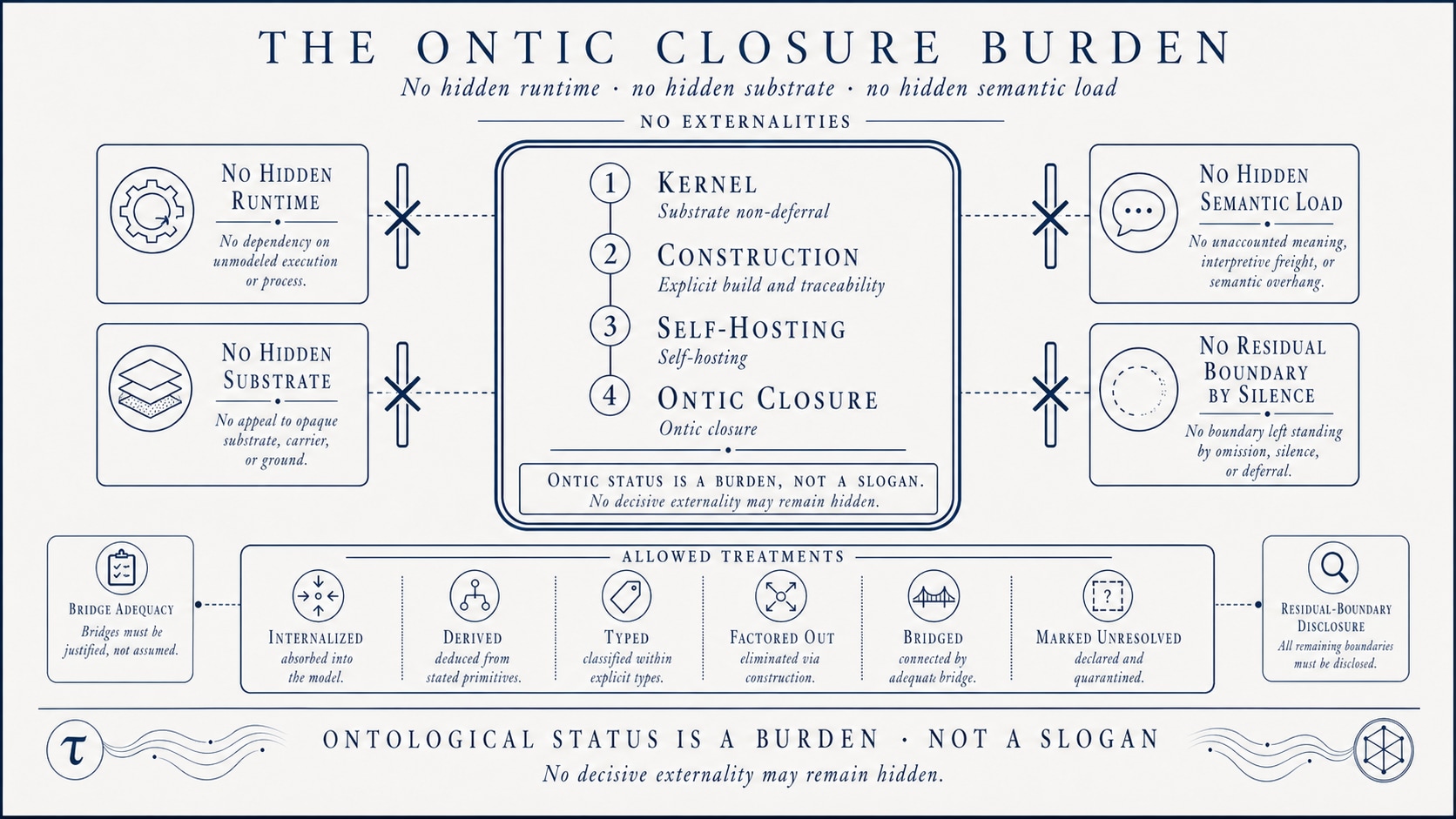
Ontic status is not asserted by slogan. The theory treats ontic status as a burden: no decisive externality may remain hidden as runtime, substrate, semantic load, or unspoken boundary.
The six allowed treatments
Externalities by domain
In mathematics, externalities include hidden metatheory, proof assumptions, encodings, and untracked dependence.
In physics, they include background spacetime, units, constants, measurement, regimes, empirical bridge rules, and explanatory parameters.
In life, they include boundary conditions, organization, agency, heredity, development, ecology, and mind/life transitions.
In metaphysics, they include being, identity, relation, causality, modality, truth, language, value, and the ultimate boundary of the account.
What the rule does not mean
No Externalities does not mean the program has already solved everything. It does not mean boundaries disappear. It does not mean empirical science is optional. It does not mean classical mathematics is rejected.
It means a boundary cannot remain hidden while the claim depending on it is treated as complete.
Relation to substrate
Substrate Non-Deferral is a special case of this rule. If a framework depends on computation, information, law, or formal execution, it must say what carries that dependence or how the dependence is removed.
Open frontiers
The program should be judged partly by how cleanly it exposes what remains external. A well-marked unresolved boundary is better than a hidden one.
Save or share this page for inspection
Download a portable dossier, copy a reviewer note, or send this page to someone who can inspect it.