
Verify the Construction Spine
Maps the ten Corpus Construction Spine steps to the relevant verification modes, including formal proof, bridge checks, empirical prediction, falsification, and answer-shape scrutiny.
In plain language
The Construction Spine is the program's 10-step build of reality: kernel → core math → self-enrichment → physical carrier → physical grammar → measurement bridges → life → reflection → self-host → ontic closure. Each step makes a different *kind* of claim, so each step needs a different *kind* of inspection. This page maps every step to the verification modes that apply — formal proof for steps 1–3, bridge verification for steps 4–6, empirical prediction + falsification for measurement-bearing steps, and answer-shape scrutiny for the closure-level steps. Outside reviewers can use this map to find their entry point: 'I'm a category theorist — start me at step 3' or 'I'm an empirical physicist — show me steps 6 and 8.'
How each step of the Corpus Construction Spine can be inspected, checked, or challenged.
Why construction-step verification matters
The Corpus shows how the structure was built. Verify shows how each construction step can be inspected. This is where the aligned spine becomes explicit:
Agenda -> Corpus -> Results -> Verify
Obligation -> Construction -> Consequence -> Inspection
Construction steps inside the verification matrix

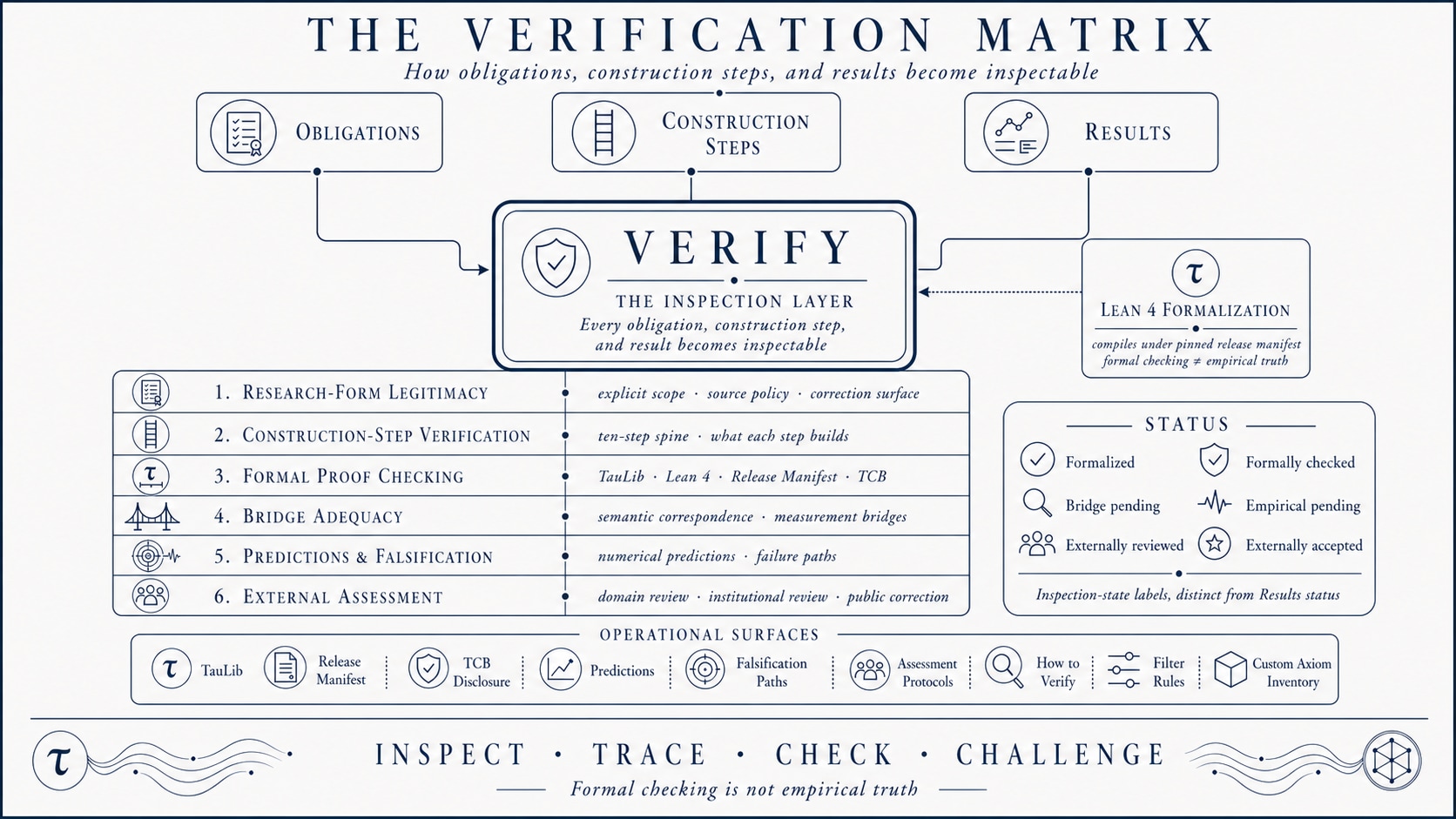
Construction-step verification asks what each step builds, what supports it, and which formal, bridge, empirical, or external checks apply.
Step-by-step verification table
| Step | Construction step | Primary verification modes |
|---|---|---|
| 1 | Build the τ-Kernel | formal proof checking, axiom inventory, TCB disclosure, kernel consistency, foundational hinge review |
| 2 | Recover Core Mathematics | formal proof checking, mathematical bridge verification, refusal discipline, foundational hinge review |
| 3 | Internalize Self-Enrichment | internal-logic checks, categorical consistency, semantic correspondence, meta-verification review |
| 4 | Identify the Physical Carrier | carrier identification, semantic adequacy, bridge plausibility |
| 5 | Recover Internal Physical Grammar | internal law-structure checks, dimensional consistency, physics bridge preparation |
| 6 | Build Measurement, Prediction, and Empirical Bridges | bridge verification, empirical verification, prediction timing, falsification |
| 7 | Recover Life as a Structural Class | life-recovery checks, structural biology mapping, scope discipline |
| 8 | Recover Reflective Structure | answer-shape checks, conceptual consistency, life-metaphysics bridge verification |
| 9 | Self-Host Formal Systems and the Kernel Itself | meta-verification, object-theory hosting checks, proof-as-act analysis |
| 10 | Test Universal Closure and Ontic Status | no-externalities audit, substrate non-deferral, residual-boundary disclosure, ontic-status burden |
End-to-end verification view
The ten construction steps are not isolated inspection targets. They form one verification chain.
Each step inherits what earlier steps have earned and hands forward what later steps need:
- Build the τ-Kernel — axiom inventory, primitive signature, trusted-base disclosure, kernel consistency, and foundational hinge review.
- Recover Core Mathematics — formal proof checking, mathematical bridge verification, refusal discipline, and foundational hinge review.
- Internalize Self-Enrichment — internal-logic checks, categorical consistency, semantic correspondence, and meta-language internalization.
- Identify Physical Carrier — carrier identification, semantic adequacy, local/global gluing, and bridge plausibility.
- Internal Physical Grammar — internal law-structure checks, dimensional consistency, observables, and physics bridge preparation.
- Measurement Bridges — bridge verification, empirical accountability, prediction timing, falsification paths, and measurement calibration.
- Recover Life — Core Semantics alignment for life, structural biology mapping, boundary/encoding/evolution checks, and scope discipline.
- Reflective Structure — answer-shape checks, conceptual consistency, life/mind bridge verification, and meaning/value/normativity status.
- Self-Host Formal Systems — meta-verification, object-theory hosting checks, proof-as-act analysis, and formal-system internalization.
- Test Ontic Closure — no-externalities audit, substrate non-deferral, residual-boundary disclosure, proof/commitment boundary, and ontic-status burden.
The verification chain therefore runs from kernel integrity to mathematical bridge discipline, physical semantic adequacy, empirical falsification, life and reflective structure, self-hosting, and ontic-closure scrutiny.
Verification-status legend
| Status phrase | Meaning |
|---|---|
| Available | A public inspection route exists for this step or mode. |
| Partial | Some evidence is public, but the route is not complete enough to close the burden. |
| Pending mapping | The public route is known to be needed but not yet mapped in this projection. |
| Not applicable | The mode is not a relevant burden for this step. |
Verification modes by step
1. Build the τ-Kernel
- Construction page: Build the τ-Kernel
- Current build status: Internally addressed; formalization partial
- Primary verification modes: formal proof checking, axiom inventory, TCB disclosure, kernel consistency, foundational hinge review
- Bridge checks: No dedicated bridge check declared yet.
- Empirical checks: Not applicable at this step. Empirical accountability begins after internal physical grammar and measurement bridges are constructed.
- Unresolved frontiers: Kernel construction does not by itself settle later bridge, empirical, life, metaphysical, or ontic-status burdens.
Related Verify pages:
2. Recover Core Mathematics
- Construction page: Recover Core Mathematics
- Current build status: Partially built; bridge verification continuing
- Primary verification modes: formal proof checking, mathematical bridge verification, refusal discipline, foundational hinge review
- Bridge checks: Check that recovered mathematics is explicit about what transfers to standard mathematics and what remains τ-effective, qualified, refused, or conjectural.
- Empirical checks: Not applicable as a direct empirical check. This step supports later empirical accountability by recovering mathematical capacity under kernel discipline.
- Unresolved frontiers: Bridge adequacy to unrestricted standard mathematics remains a separate burden from internal formal success.
Related Verify pages:
3. Internalize Self-Enrichment
- Construction page: Internalize Self-Enrichment
- Current build status: Partially built; meta-verification frontier remains open
- Primary verification modes: internal-logic checks, categorical consistency, semantic correspondence, meta-verification review
- Bridge checks: Check that internal logical operations and enrichment remain faithful to the kernel discipline and do not silently import external proof power.
- Empirical checks: Not applicable as a direct empirical check. This step concerns internal logic, categorical structure, and semantic self-containment.
- Unresolved frontiers: Internalization of logic does not yet self-host object theories, settle semantic bridge adequacy, or establish final ontic closure.
Related Verify pages:
4. Identify the Physical Carrier
- Construction page: Identify the Physical Carrier
- Current build status: Framed; detailed bridge work continuing
- Primary verification modes: carrier identification, semantic adequacy, bridge plausibility
- Bridge checks: Check that the identified carrier is exposed through explicit dependency chains rather than ontological hand-waving.
- Empirical checks: Downstream of this step. Measurement, calibration, and falsification burdens begin once empirical bridge surfaces are constructed.
- Unresolved frontiers: Carrier identification is not yet empirical bridge success or quantitative prediction.
Related Verify pages:
5. Recover Internal Physical Grammar
- Construction page: Recover Internal Physical Grammar
- Current build status: Partially built; empirical bridge pending
- Primary verification modes: internal law-structure checks, dimensional consistency, physics bridge preparation
- Bridge checks: Check that internal physical grammar exposes unit structure, lawfulness, and sector closure before empirical calibration begins.
- Empirical checks: Downstream of this step. Measurement, calibration, and falsification burdens begin once empirical bridge surfaces are constructed.
- Unresolved frontiers: Internal tau-physics remains distinct from observation-facing accountability until measurement bridges are explicit.
Related Verify pages:
6. Build Measurement, Prediction, and Empirical Bridges
- Construction page: Build Measurement, Prediction, and Empirical Bridges
- Current build status: Bridge pending; prediction surfaces visible
- Primary verification modes: bridge verification, empirical verification, prediction timing, falsification
- Bridge checks: Check the SI bridge, calibration cascade, and the distinction between dimensionless structure and SI-anchored outputs.
- Empirical checks: Check numerical predictions against current measurements and named falsification targets.
- Unresolved frontiers: Prediction visibility is not the same as experimental confirmation or external acceptance.
Related Verify pages:
7. Recover Life as a Structural Class
- Construction page: Recover Life as a Structural Class
- Current build status: Framed; life verification pending
- Primary verification modes: life-recovery checks, structural biology mapping, scope discipline
- Bridge checks: Check that biological recovery claims distinguish structural recovery from complete empirical biology.
- Empirical checks: Check whether life-facing claims are routed to explicit biological examples, constraints, and open residuals.
- Unresolved frontiers: Life recovery does not by itself settle consciousness, subjectivity, or every biology-side open problem.
Related Verify pages:
8. Recover Reflective Structure
- Construction page: Recover Reflective Structure
- Current build status: Framed; metaphysics verification pending
- Primary verification modes: answer-shape checks, conceptual consistency, life-metaphysics bridge verification
- Bridge checks: Check that reflective-structure claims expose their dependence on earlier life and logic construction rather than bypassing them.
- Empirical checks: Downstream or domain-dependent at this step. Reflective-structure claims require separate life, semantic, and metaphysical verification routes.
- Unresolved frontiers: Reflective structure does not by itself settle external acceptance, phenomenological adequacy, or ontic closure.
Related Verify pages:
9. Self-Host Formal Systems and the Kernel Itself
- Construction page: Self-Host Formal Systems and the Kernel Itself
- Current build status: Framed; self-hosting remains frontier work
- Primary verification modes: meta-verification, object-theory hosting checks, proof-as-act analysis
- Bridge checks: Check that self-hosted formal systems are represented as constructed objects rather than silently adopted primitives.
- Empirical checks: Not the primary burden at this step. This step is assessed through meta-verification, no-externalities review, and explicit boundary disclosure.
- Unresolved frontiers: Self-hosting does not by itself imply final closure or universal bridge adequacy.
Related Verify pages:
10. Test Universal Closure and Ontic Status
- Construction page: Test Universal Closure and Ontic Status
- Current build status: Framed; ontic closure not externally established
- Primary verification modes: no-externalities audit, substrate non-deferral, residual-boundary disclosure, ontic-status burden
- Bridge checks: Check whether every remaining externality, substrate deferral, or unexplained boundary is explicitly named.
- Empirical checks: Not the primary burden at this step. This step is assessed through meta-verification, no-externalities review, and explicit boundary disclosure.
- Unresolved frontiers: Ontic closure remains the strongest evaluative burden, not a theorem the site should present as already settled.
Related Verify pages:
Related Corpus Construction Spine
Use the Corpus Construction Spine when you want the build narrative rather than the verification matrix.
Related Results and Progress Dashboard
Use Progress Against Agenda to see how public Structural Challenge Ledger and Core Semantics obligations currently map to Results-side status surfaces.
Related Assessment Protocols
Use Assessment Protocols when you want a manual or LLM-assisted review route after identifying the relevant construction step.
Save or share this page for inspection
Download a portable dossier, copy a reviewer note, or send this page to someone who can inspect it.