
Predictions & Falsification
How the program exposes possible failure modes and testable consequences.
Accountability, Not Decoration
Predictions and falsification are not merely outputs of the program. They are accountability structures for Results.
Predictions and falsification are Verify-owned accountability surfaces.
The Results lane provides world-facing interpretation and result-family context. Verify owns the accountability grammar: prediction IDs, target results, failure conditions, timing assumptions, falsification paths, and pack structure.
Publication artifacts such as the numerical prediction supplement may package these surfaces for reading and review.
Falsification inside the verification matrix

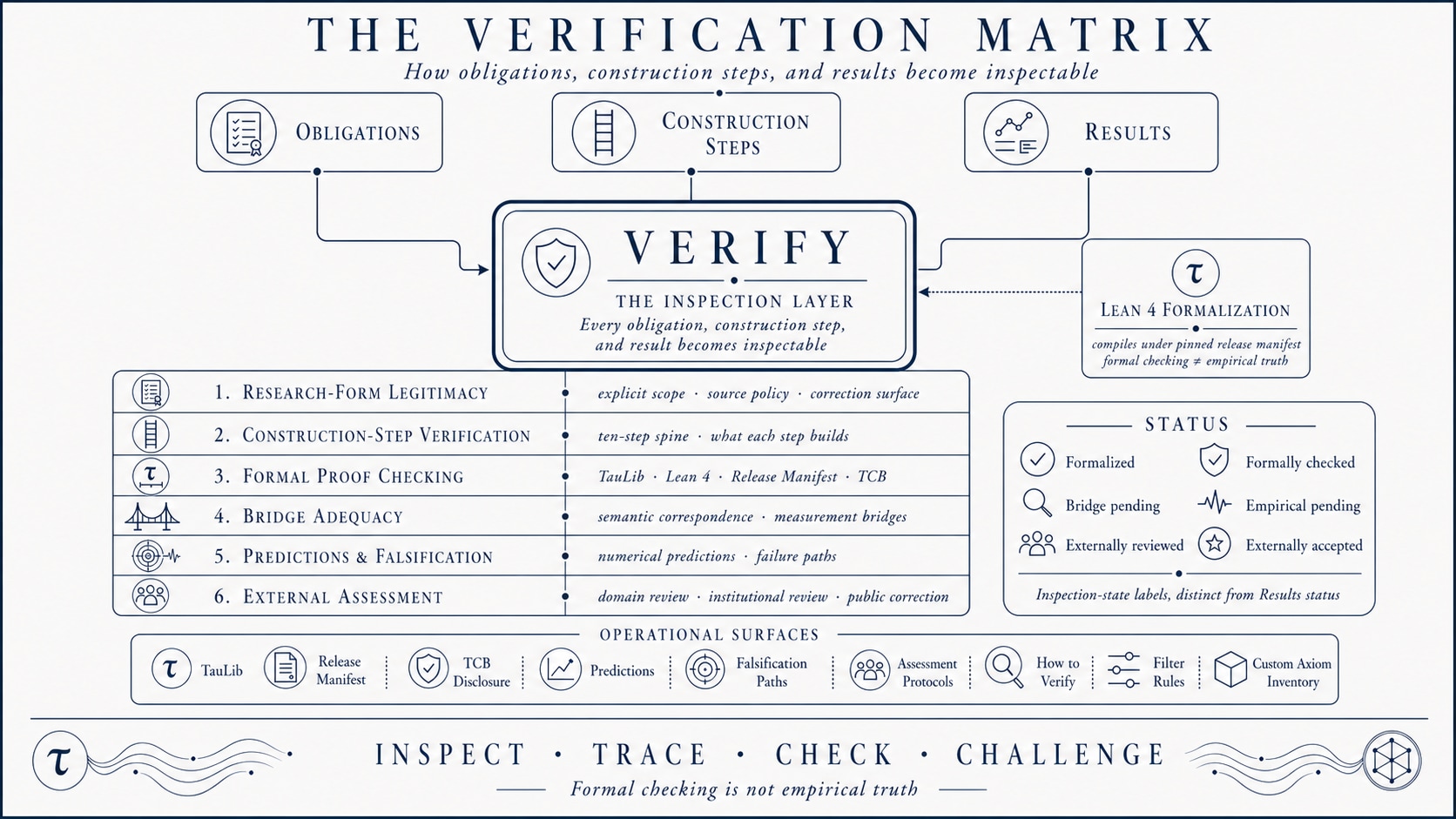
Predictions and falsification are inspection routes for empirical claims. They complement formal proof checking and bridge adequacy; they do not replace them.
Lean linkage on every prediction
Every public prediction now carries an auto-derived Lean-modules linkage: the set of TauLib modules in its registry-depends_on closure with lean.formalization in {formalized, skeleton}. The linkage is visible directly on each prediction’s detail page (e.g. Three generations of fermions) as a chip-row of GitHub-linked module names.
67
Public predictions on the accountability surface.
0 / 67
Predictions whose derivation chain reaches at least one formalized or skeleton TauLib module.
Auto-derived
The linkage is computed at corpus export time by walking the registry's depends_on graph; no hand-curation of paths.
From Kernel to Measurement

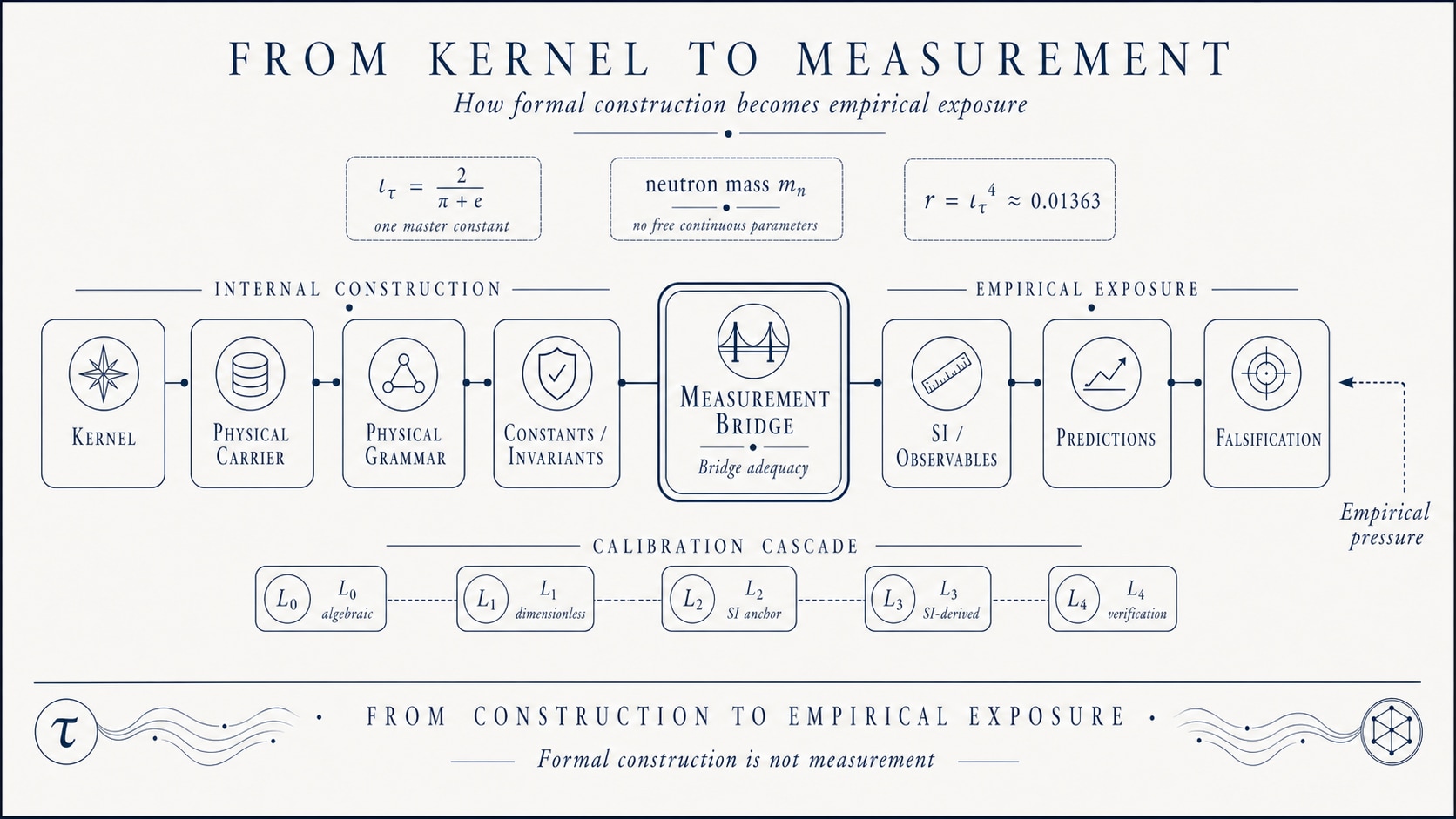
The theory distinguishes internal construction from empirical exposure. Formal derivation becomes physics only through measurement bridges, observable translation, predictions, and falsification pressure.
Prediction and falsification surfaces are downstream of the Construction Spine’s Measurement Bridges step. Internal physical grammar is not empirical accountability until the bridge and failure condition are exposed.
Cross-Lane Reading
The Results lane presents what the program currently derives. This Verify subtree asks how those results could be checked or defeated. For physics, the first concrete surfaces are the Predictions browse, the Prediction Timing Ledger, and the Falsification Pack.
Save or share this page for inspection
Download a portable dossier, copy a reviewer note, or send this page to someone who can inspect it.