Foundational Science
What would change for the foundations of inquiry if the construction remains supported.
 v4.0 · 2 May 2026 · manifest 07ea80a
Impact is conditional: no consequence is stronger than the Results, verification status, translation assumptions, and domain uptake on which it depends.
Impact maps what could matter if relevant claims remain supported through inspection, correction, verification, translation, and domain uptake.
Impact is the conditional consequence layer of the site. It asks what might become relevant if specific Results remain supported through verification, translation, and domain uptake.
Impact pages describe conditional consequence structures. They help readers understand possible implications without turning those implications into promises.
Panta Rhei is an independent open research program dedicated to building a coherent theory of reality. That scope creates a public-relevance obligation: the program must explain why the work could matter beyond its founders and immediate reviewers if the construction and results remain supported through inspection and correction.
Impact is not a claim of success. It is the conditional public-relevance map of the program.
It asks:
The impact chain begins downstream of Results, but the Impact lane also explains why the program’s scope is worth making inspectable in the first place.
Impact is not a promise of social, scientific, technological, educational, existential, or institutional adoption.
It is not a product roadmap. It is not a deployment claim. It is not a claim that the Panta Rhei construction has already transformed any domain.
Results and Verify remain upstream. Translation and domain uptake remain required before any impact claim becomes actionable.
Readers who think in terms of fundability, partnership, or institutional uptake sometimes ask: if the τ-framework is validated, what would translation to a working artefact look like? The program does not yet commit to any such artefact, but three plausible translation surfaces can be named without compromising the no-deployment-claim posture above:
None of these are commitments. All three are conditional on results that are not yet complete — contingent on upstream verification, translation discipline, and external uptake. None is a present-tense product claim.
Naming the conditional shape here is itself a discipline: it lets the program acknowledge that fundable, partnerable, and institutionally-actionable consequences are downstream of the framework — without pretending those consequences are present-tense, and without abandoning the engagement-without-endorsement posture that governs the rest of the site.
Impact is conditional: no consequence is stronger than the Results, verification status, translation assumptions, and domain uptake on which it depends.
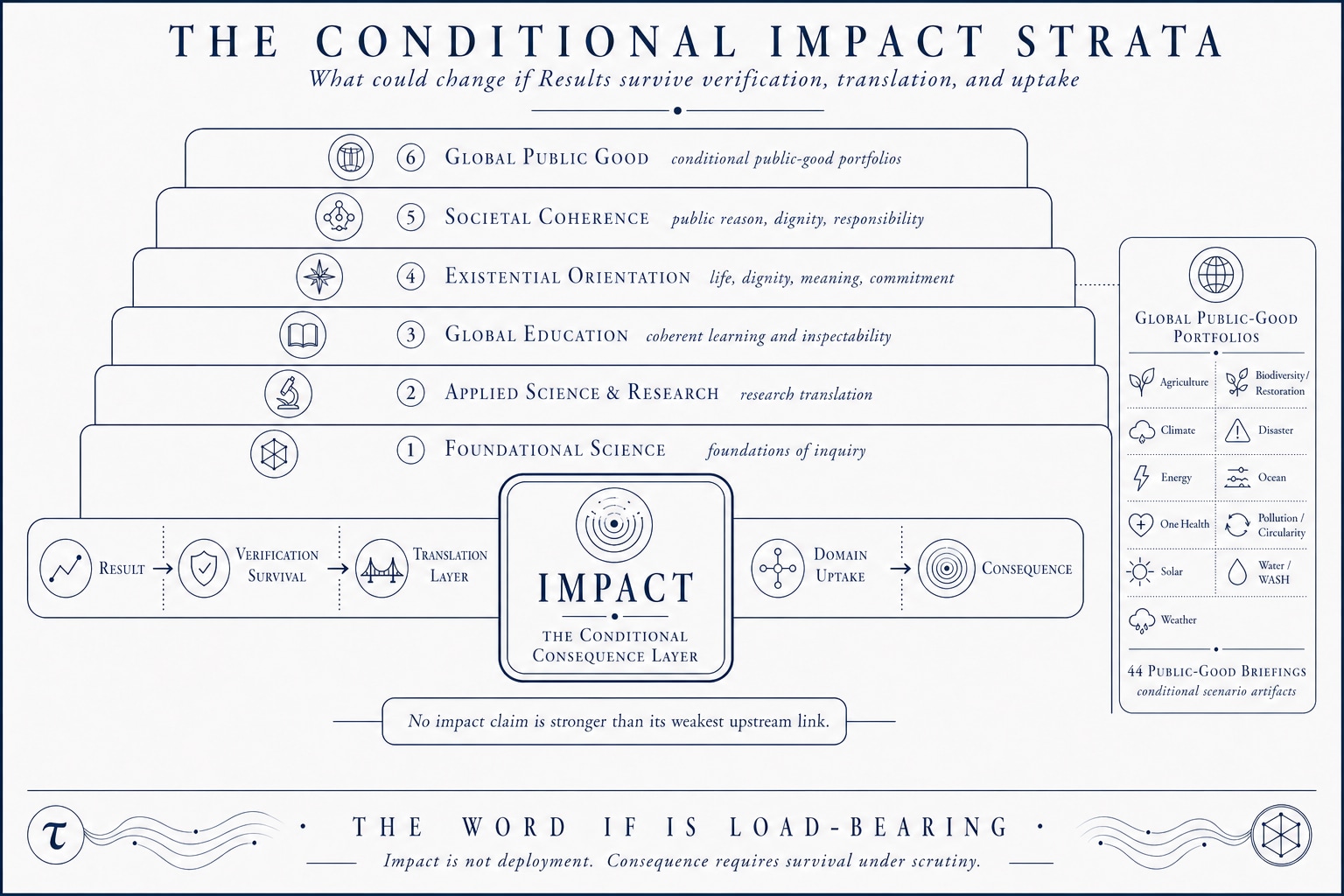
The conditional consequence layer at a glance

Impact is conditional. Each consequence depends on upstream Results, verification and review status, translation assumptions, domain uptake, and real-world constraints. Consequence requires accountable passage through scrutiny, correction, translation, and uptake.
Updated chain language: the Impact lane now reads this plate through the conditional sequence above.
What would change for the foundations of inquiry if the construction remains supported.
How active research fields could change if bridges to observation, measurement, and computation remain supported after review and domain testing.
How difficult domains may become teachable as related layers of one coherent construction.
What becomes existentially thinkable if the framework holds.
How public reason could change if a coherence-based scientific image is available.
Conditional public-good portfolios and their Public-Good Briefings.
A conditional public-good portfolio for translating better agro-climate-water-biology intelligence into lower crop loss, improved water productivity, earlier pest and disease warnings, stronger anticipatory action, and faster climate-resilient crop design.
5 briefingsA conditional public-good portfolio for translating better coupled ecological intelligence into stronger restoration targeting, functional connectivity, blue-green habitat resilience, earlier stress warnings, and more accountable biodiversity finance.
1 briefingA conditional public-good portfolio for making the climate system's causal tree more legible so that mitigation, adaptation, finance, infrastructure, and international coordination can align with the true critical path of risk.
4 briefingsA conditional public-good portfolio for translating better hazard physics into earlier warnings, more resilient lifelines, and forecast-linked anticipatory action across multi-hazard disaster domains.
4 briefingsA conditional public-good portfolio for exploring whether a verified tau-informed energy-system model could become relevant to grid reliability and dispatch, DER and storage orchestration, fusion and fission digital twin research, and whole-system energy planning.
5 briefingsA conditional public-good portfolio for exploring whether a shared ocean-state model could become relevant to trade, climate decarbonization, blue food systems, search and rescue, and marine stewardship simultaneously.
4 briefingsA conditional public-good portfolio for exploring whether an integrated environmental-biological-operational model could become relevant to disease early warning, health-system resilience, environmental surveillance, food safety, and precision public health simultaneously.
4 briefingsA conditional public-good portfolio for translating better physical intelligence about emissions, toxic pathways, waste flows, plastics leakage, and material dynamics into lower exposure, cleaner cities, stronger remediation, better waste operations, and circular-system redesign.
4 briefingsA conditional public-good portfolio for translating better solar-weather-grid physics into lower reserve costs, faster DER interconnection, stronger critical-load resilience, and solar-synchronized flexible demand.
5 briefingsA conditional public-good portfolio for translating better water-system physics into safer drinking water, fewer network losses, stronger sanitation and reuse, better basin allocation, and improved WASH continuity in the places where vulnerability is highest.
5 briefingsA conditional public-good portfolio for making weather, climate intelligence, and disaster early warning materially better - from extreme-event forecasting and flood impact translation to wildfire/smoke intelligence, grid-weather coupling, drought planning, and climate adaptation.
3 briefingsThe word if is load-bearing. Impact remains downstream of explicit assumptions, review, correction, translation layers, and domain uptake. For the publication index of these conditional scenario artifacts, see Public-Good Briefings.
For why the program asks for public attention through importance, seriousness, inspectability, and conditional relevance rather than certainty, see Why This Work Matters.
Download a portable dossier, copy a reviewer note, or send this page to someone who can inspect it.