Self-Enrichment Bridge
τ enriches over itself — the gateway from mathematics to the enrichment ladder.
Module Thesis
Hom objects are τ-objects with tower-coherent staging; the Yoneda embedding is fully faithful and bipolar-preserving.
Overview
In most categories, morphism spaces are external – they live in the ambient category Set, not in the category under study. Category is different: its morphism spaces are themselves -objects. The framework enriches over itself. This is not assumed – it is proved as a theorem (II.D53), building on the Mutual Determination results and the holomorphic machinery earned in earlier parts. Self-enrichment is the mathematical precondition for the enrichment ladder that structures the entire seven-book series.
The Core Idea
For any two objects , the morphism space is itself a -object (II.D53). It has an NF-address, split-complex values, and tower-coherent staging inherited from the primorial tower: . Each Hom object inherits the bipolar decomposition: .
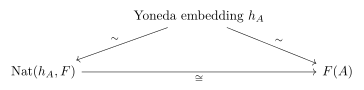
The Yoneda Embedding Theorem (II.T36) is then proved – not assumed. The embedding is fully faithful and bipolar-preserving. The proof uses probe naturality: the same condition that forced continuity in earlier parts now forces the Yoneda embedding. This is the deep reason holomorphy is primitive in .
Enrichment layers then iterate: . Two-morphisms arise from . The split-complex structure propagates to all higher layers. This is the beginning of the enrichment ladder that structures the entire series architecture. The self-describing property (II.D54) – describes its own morphisms – is the precondition for the framework to eventually describe its own physics.
Why This Matters
Self-enrichment is the bridge from pure mathematics to everything else. In the series architecture, is the mathematical layer (Books I-III), is physics (Books IV-V), is life (Book VI), and is metaphysics (Book VII). The transition from one layer to the next is powered by self-enrichment: each layer can describe the next because it can describe its own morphism spaces.
Key Claims
- II.D53 – Self-enrichment: Hom objects are -objects with tower-coherent staging (established, machine-checked in TauLib)
- II.T36 – Yoneda Embedding: fully faithful and bipolar-preserving, proved as theorem (established, machine-checked)
- II.T43 – Enrichment iteration produces higher morphism spaces (established, machine-checked)
- II.D54 – Self-description: describes its own morphisms internally (established, machine-checked)