Spectral Algebra & Millennium Problems
RH, Poincaré, BSD, and Navier-Stokes as instances of one structural pattern.
Module Thesis
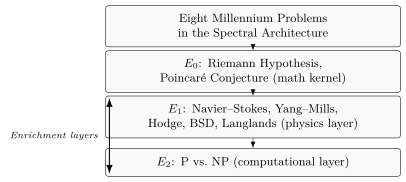
The Master Schema frames all Millennium Problems as instances of Mutual Determination at different enrichment levels.
Overview
The spectral algebra is the algebraic vocabulary for the Millennium Problems – and for everything that follows. Book III earns number theory from the kernel: primes, residue rings, p-adic fields, adeles, the Hensel lifting machinery, and the internal bipolar classifier. This is not imported classical algebraic number theory – it is earned constructively from the kernel’s arithmetic and the primorial tower.
The Core Idea
The primorial ladder emerges as the canonical cofinal filtration that unifies finite-level verification across all Millennium Problems. The Cofinality Theorem (III.T09) proves that checking a property at primorial levels is sufficient – the primorial ladder is cofinal among all modular towers.
From the ladder, three constructions are earned:
-
CRT Decomposition (III.T10): a -native Chinese Remainder Theorem via modular Bezout without signed arithmetic – earned-language discipline in action.
-
Hensel Lifting (III.T11): constructive lifting in residue carriers, producing -native local fields that are the split-complex analogues of p-adic fields.
-
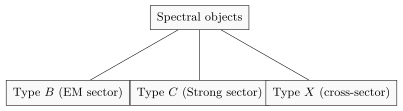
Internal Bipolar Classifier (III.D23): the informal B/C lobe language is replaced by computable predicates. Every boundary character decomposes uniquely into B-supported, C-supported, and X-mixing components via the Spectral Trichotomy (III.T14).
The Master Schema then frames each Millennium Problem as an instance of Mutual Determination applied at a specific enrichment level and sector. The Riemann Hypothesis becomes spectral purity of the -function in the B/C classifier. P vs NP becomes the question of whether -admissible collapse respects the Interface Width Principle. Each problem gets a -effective statement that reduces to verification at primorial levels.
Why This Matters
The spectral algebra is the toolkit that all subsequent books draw from. The physics modules use the primorial ladder to compute coupling constants. The life modules use the CRT decomposition to derive the genetic code. The metaphysics modules use the classifier to distinguish ontological registers. Everything flows through the spectral algebra earned here.
Key Claims
- III.T09 – Primorial Cofinality: checking at primorial levels suffices (established, machine-checked in TauLib)
- III.T19 – Spectral Trichotomy: every character is B-supported, C-supported, or X-mixing (established, machine-checked)
- III.D25 – Master Schema: Millennium Problems as Mutual Determination instances (tau-effective)
- III.T23 – Hensel lifting earned constructively in -native local fields (established, machine-checked)