Orbit Generation & Ontic Closure
The generative act unfolds four infinite orbit rays, seals the universe, and proves rigidity.
Module Thesis
A single generative act executes the kernel, producing four orbit rays; the Ontic Closure Theorem and Rigidity Theorem prove the universe is complete and the model unique.
Overview
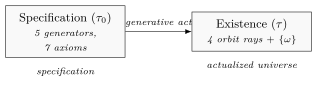
Once the Coherence Kernel is specified, a single generative act brings the universe into existence. The progression operator ρ is applied to each non-ω generator, producing four infinite orbit rays. Together with the beacon singleton {ω}, these five sets exhaust all of reality — pairwise disjoint, individually countable, collectively ℵ₀. The Ontic Closure Theorem makes this precise: no further objects can be created. The Rigidity Theorem then proves that the model is unique: there is exactly one universe satisfying the seven axioms.
After this module, the gate closes. Everything that follows — arithmetic, coordinates, holomorphy, category theory — is naming, not creating.
The Core Idea
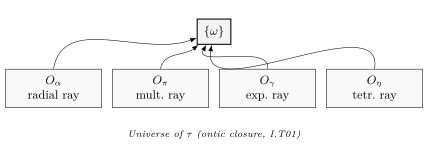
The operator ρ, applied iteratively to each generator g, produces an orbit ray: O_g = {g, ρ(g), ρ²(g), …}. The four non-ω generators produce four such rays:
- O_α (the radial orbit): becomes the natural numbers and the counting scaffold
- O_π (the first solenoidal orbit): encodes primes and the multiplicative spine
- O_γ (the second solenoidal orbit): carries exponentiation structure
- O_η (the third solenoidal orbit): carries tetration (iterated exponentiation)
The No-Jump axiom (K4) guarantees that ρ(x) is the immediate successor within each orbit — no elements are skipped. The Unreachability axiom (K5) ensures ω is never reached from below. Together, these force each orbit to be a copy of the natural numbers, with ω as the “point at infinity.”
The Ontic Closure Theorem (I.T01) then proves that O_α ∪ O_π ∪ O_γ ∪ O_η ∪ {ω} = Obj(τ). There are no other objects. The universe is ontically sealed.
The iterator-of-iterator ladder climbs through four levels of structural complexity: raw iteration, multiplication, exponentiation, and tetration. At the fifth level (pentation), canonical injectivity fails — because no fifth orbit channel exists. This saturation at exactly four levels is a structural consequence of having exactly four non-ω generators.
Finally, the Rigidity Theorem (I.T07) proves Aut(τ) = {id}: the automorphism group is trivial. There is no non-trivial relabeling of the universe that preserves the structure. Combined with the Categoricity Theorem (I.T08), this establishes that τ is not merely a model of the kernel specification — it is the unique model.
Why This Matters
Ontic closure means the framework can never introduce new objects by fiat. Every mathematical construction in the later modules — real numbers, geometric points, sheaves, physical states — must be named from the objects already present, not created ex nihilo. This is the structural foundation of the program’s earnedness discipline.
Rigidity and categoricity mean there are no hidden choices. The specification determines everything. Two independent implementations of the kernel will produce the same universe, with the same objects in the same positions. This is confirmed by the TauLib formalization, which compiles all results in this module with 0 sorry.
Key Claims
- I.T01 — Ontic Closure Theorem: the five orbits plus {ω} exhaust Obj(τ) (established, machine-checked)
- I.T07 — Rigidity Theorem: Aut(τ) = {id} (established, machine-checked)
- I.T08 — Categoricity Theorem: the model is unique (established, machine-checked)
- The iterator-of-iterator ladder saturates at level 4 (tetration) due to four orbit channels (tau-effective)