The Central Theorem
O(τ³) ≅ A_spec(L) — the structural heart of the series.
Module Thesis
The ring of holomorphic functions on τ³ is canonically isomorphic to the spectral algebra of the lemniscate boundary.
Overview
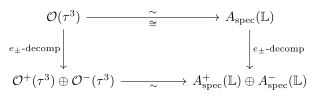
The Central Theorem is the climax of Book II and one of the most important results in the entire series. It states that the ring of holomorphic functions on the fibered product is canonically isomorphic to the spectral algebra of the lemniscate boundary :
This is an exact holographic principle: the boundary completely determines the interior, and the interior completely encodes the boundary. Every tool forged across both books – the coherence kernel, the ABCD chart, the omega-germs, the Identity Theorem, the Mutual Determination – was forged for this single result.
The Core Idea
The proof assembles four preceding results into one chain:
-
Boundary characters are idempotent-supported (II.T37): every spectral character on the lemniscate decomposes into B-channel and C-channel components via the bipolar idempotents .
-
Each character extends uniquely to the interior (II.T38): the Hartogs extension machinery lifts boundary data to holomorphic functions on . The extension lives in the calibrated split-complex codomain .
-
Extensions are omega-germ transformers (II.T39): stagewise naturality carries forward the boundary character structure. The Yoneda embedding (II.T36) applied to proves that omega-germs are holomorphic functions.
-
The loop closes (II.T40): characters extensions omega-germs holomorphic functions characters. The correspondence is bijective at every step. The spectral coefficients are numerically calibrated via .
The accompanying Categoricity Theorem (II.T42) proves that the seven axioms (K0-K6) force uniquely. The moduli space is a single point – there are no free parameters. The fibered product is discovered, not constructed.
Why This Matters
The Central Theorem is the mathematical foundation for every physical prediction the framework makes. When the physics modules derive the fine-structure constant or the Hubble parameter, they do so by reading spectral coefficients from the lemniscate boundary via this isomorphism. Without it, boundary data would not determine interior values, and the readout mechanism would fail.
The result also closes the foundational arc of the first two books: from five generators and seven axioms, the framework has earned arithmetic, coordinates, holomorphic analysis, categorical structure, and now a complete boundary-interior correspondence – all without importing any structure from outside the kernel.
Key Claims
- II.T40 – Central Theorem: (established, machine-checked in TauLib)
- II.T42 – Categoricity: the seven axioms force uniquely (established, machine-checked)
- II.C01 – Holographic principle: boundary determines interior exactly (established, machine-checked)
- The proof chain uses all results from Books I and II – no external imports (tau-effective)