The ABCD Coordinate Chart
Every object receives a canonical 4-dimensional address via the greedy peel algorithm.
Module Thesis
The ABCD chart maps every tau-object to a unique quadruple (A, B, C, D) using tower atoms and greedy peel-off, forcing dim_tau = 4.
Overview
With arithmetic earned from the kernel, the framework now asks: can every object be addressed? The ABCD Coordinate Chart provides a canonical map from objects to four-dimensional coordinates, using a greedy decomposition algorithm that peels off tower atoms in order of structural priority. The result is a forced dimensionality: every object in Category receives a unique quadruple , and the dimension of the universe is exactly four. This is not postulated – it is a theorem.
The Core Idea
The ABCD chart begins with internal primes. Divisibility on is defined from earned multiplication: if and only if there exists such that . Internal primes are the irreducible elements under this relation, and the Fundamental Theorem of Arithmetic (I.T09) proves that every element of has a unique prime factorization – earned, not assumed from classical number theory.
From prime factorization, tower atoms are extracted by a greedy algorithm. Every integer decomposes into a canonical normal form:
where the four coordinates map to the four orbit channels:
- A (the -channel): the largest prime factor – multiplicative spine
- B (the -channel): the maximal exponent – outer power
- C (the -channel): the maximal tetration height – inner power
- D (the -channel): the remainder after tower extraction – counting scaffold
The ABCD Coordinate Chart (I.D17) is then the map , sending each object to its four-coordinate address. The map is total: every object has an address.
The four coordinates are not arbitrary labels – they correspond one-to-one with the four orbit channels established by the Coherence Kernel. This is why : four orbit channels produce four independent coordinate axes. A fifth coordinate would require a fifth orbit channel, which the diagonal discipline forbids.
Why This Matters
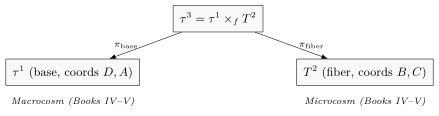
The ABCD chart transforms Category from an abstract orbit structure into a coordinatized universe where every object has a unique position. This is the foundation for all subsequent geometric and analytic constructions. The fibered product that carries the framework’s holomorphic geometry is built from these four coordinates.
The forced dimensionality is structurally significant: it matches the dimension of spacetime, and this matching is not an input but a consequence. Whether this structural coincidence carries physical meaning is tested in the physics modules.
The Hyperfactorization Theorem (next module) will prove that this chart is not merely total but injective – distinct objects always receive distinct addresses.
Key Claims
- I.T09 – Fundamental Theorem of Arithmetic on : unique prime factorization (established, machine-checked in TauLib)
- I.D17 – ABCD Coordinate Chart: canonical four-coordinate address for every object (established, machine-checked)
- I.D16 – Tower atoms and greedy peel algorithm (established, machine-checked)
-
is forced by four orbit channels – not postulated (tau-effective)