Neutron Primacy
The neutron is the first stable ontic particle — all others derive from it.
Module Thesis
The neutron emerges as the minimal stable defect on T²; bi-rotation at speed c with phase-lock ι_τ gives E = mc².
Overview
Physics begins with the neutron. In the standard model, the neutron is one particle among hundreds – a composite of quarks and gluons, explained only after the full gauge machinery is in place. In Category , the neutron is the first physical object: the minimal stable defect bundle on the torus fiber of the fibered product . Everything else – protons, electrons, atoms, forces, stars – is derived from what the neutron does when it transforms.
This module sits at the transition from mathematics to physics. The Hinge Theorem (Book III) proved that every physical result is a sector instantiation of the enrichment ladder. Book IV begins the instantiation.
The Core Idea
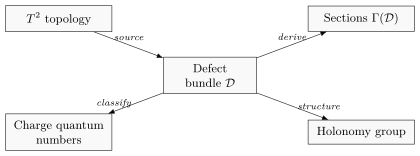
An ontic particle (IV.D14) is defined as a quadruple where is a defect configuration with winding numbers , is a character on the lemniscate , is stability persistence along the -orbit (proto-time), and is localization in a bounded region of .
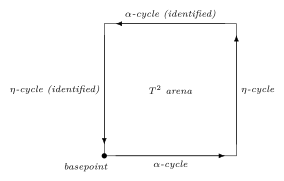
The neutron (IV.D17) is the minimal quasi-stable defect bundle on – the simplest configuration with nonzero breathing amplitude. Its bi-rotation on the torus is locked by the master constant , and this phase-lock yields as a geometric identity (IV.T01): the energy of a defect bundle equals its mass times the square of the torus bi-rotation speed.
The photon (IV.T02) is derived as the null transport mode: a massless excitation that carries electromagnetic information at speed along the base . The photon is not postulated – it is the unique zero-mass solution of the defect equation.
The ontic sequence then unfolds: vacuum neutron (via beta decay) proton + electron + antineutrino hydrogen. All of particle physics begins with this sequence. The neutron mass is the single dimensional calibration anchor of the entire framework – the one number that converts -internal units to SI units. Every other mass, coupling constant, and physical parameter is a dimensionless ratio times .
Why This Matters
Neutron primacy inverts the standard pedagogy. Instead of starting from quantum fields and building particles from perturbative expansions, the framework starts from a single stable defect and derives everything else as transformations of that defect. The neutron is not explained by physics – physics is explained by the neutron.
The single calibration anchor means the framework has one dimensional parameter and zero free dimensionless constants. Every coupling constant is a ratio derived from the spectral algebra of the lemniscate. This is the strongest possible falsifiability posture: one anchor, zero knobs.
Key Claims
- IV.D14 – Ontic particle definition as defect bundle quadruple (established, machine-checked in TauLib)
- IV.T01 – as geometric identity from torus bi-rotation (established, machine-checked)
- IV.T02 – Photon as null transport mode at (established, machine-checked)
- IV.D17 – Neutron as minimal stable defect; is the single calibration anchor (tau-effective)