Black Holes as Topology
Horizon = T², no singularity, no evaporation. QNM ratio = ι_τ⁻¹.
Module Thesis
Black holes are topological events with torus horizons; profinite structure prevents divergences.
Overview
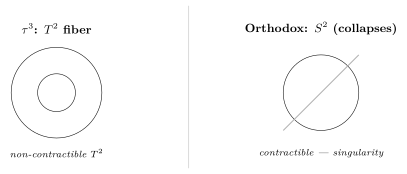
In general relativity, black holes harbor singularities – points where spacetime curvature diverges to infinity and physics breaks down. In Category , there are no singularities. The profinite structure of prevents divergences at every scale. Black holes are topological events with torus horizons – the horizon is a surface, not a mathematical boundary of spacetime. There is no information loss, no evaporation (Hawking radiation does not occur), and no singularity.
The Core Idea
A -black hole (V.T37) is defined by the topological transition where the fiber becomes self-referencing: the defect bundle wraps entirely around the torus, and the horizon emerges as the locus where this wrapping closes. The quasi-normal mode (QNM) frequency ratio is predicted as – testable against gravitational wave ringdown observations.
The No-Shrink Theorem proves that mature black holes cannot decrease in size: the profinite tower structure ensures monotonic growth along the -orbit. The merger normal form classifies binary black hole mergers as topological reconnection events on . These predictions are directly testable against LIGO/Virgo/KAGRA observations and Event Horizon Telescope imaging.
Why This Matters
Black holes connect the microcosm to the macrocosm and bridge to life: in the E2 modules, black holes satisfy all seven hallmarks of life and the merger-directed net converges to . The no-singularity, no-evaporation stance is one of the framework’s most distinctive and falsifiable claims.
Key Claims
- V.T37 – Black holes as topological events with horizons (tau-effective)
- QNM ratio – testable against gravitational wave data (tau-effective)
- No singularity: profinite structure prevents divergences (tau-effective)
- No Hawking radiation: the framework predicts no evaporation (conjectural – contradicts mainstream expectation)
Canonical Source
This module traces to Book V, Part V.6.