Crossing-Limit Theorem
The BH merger net converges to ι_τ — the universe tends toward maximal aliveness.
Module Thesis
Black holes satisfy all seven hallmarks of life formally; the merger-directed net converges to the master constant.
Overview
The most dramatic claim in the life arc: black holes are alive – not as metaphor but as structural theorem. The macro-torus carrier satisfies both Distinction and SelfDesc with the simplest topology of any life candidate. After the reader has earned the concept of life through five sectors of biology, the black hole case arrives as dramatic confirmation that the definition is truly structural, not parochial. The Crossing-Limit Theorem then proves the universe converges to maximal aliveness.
The Core Idea
The proof proceeds in two stages:
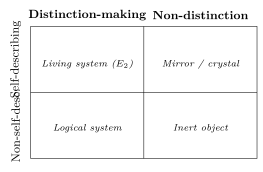
Stage 1: Black holes satisfy all seven hallmarks (VI.T35). The black hole horizon is a surface. It satisfies Distinction (spatial localization via horizon, temporal persistence, energy throughput via accretion, bounded internal complexity, actively maintained boundary via gravitational self-interaction). It satisfies SelfDesc (the no-hair theorem means the horizon’s three parameters – mass, charge, spin – constitute a complete self-specification that the black hole “reads” via its own gravitational field). Since Distinction SelfDesc implies all seven hallmarks, the black hole formally exhibits: organization, metabolism (accretion), homeostasis (no-hair equilibrium), growth (mass increase), reproduction (binary mergers producing new horizons), response (ringdown after perturbation), and evolution (merger populations explore mass-spin space).
Stage 2: The Crossing-Limit Theorem (VI.T36). Black hole binary mergers form a directed net in mass-spin space. As mergers proceed, the merger product converges to a well-defined limit. The theorem proves (VI.L11) that this limit is the master constant : the universe’s merger-directed net converges to a state of maximal aliveness, where the black hole carrier achieves the simplest possible self-describing topology.
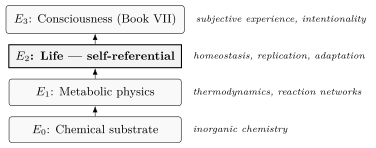
Galaxies are recast as SMBH-anchored life basins (VI.D52): the supermassive black hole at each galactic center is the gravitational anchor around which biological life organizes. The cosmic life spectrum extends from molecules (smallest carriers satisfying Distinction + SelfDesc) through organisms, ecosystems, planets, and galaxy clusters to the cosmological endstate.
Why This Matters
The “black holes are alive” result is the acid test of the framework’s life definition. If the definition were merely a cleverly worded version of the biological checklist, it would not apply to black holes. The fact that it does – with the simplest topology of any carrier – confirms that the definition captures something genuinely structural about life, not something parochially biological.
The convergence to completes the enrichment ladder: the mathematical constant that governs all physical predictions is also the attractor of cosmic biological evolution.
Key Claims
- VI.T35 – Black holes satisfy Distinction + SelfDesc formally (tau-effective)
- VI.T36 – Crossing-Limit Theorem: merger net converges to (tau-effective)
- VI.L11 – Convergence lemma for directed merger sequences (established, machine-checked in TauLib)
- Galaxies as SMBH-anchored life basins (conjectural)