Life Defined
Life = Distinction + SelfDesc — two predicates from which all seven hallmarks follow.
Module Thesis
A system is alive iff it carries a five-condition distinction that is self-describing via an internal evaluator.
Overview
What distinguishes living from non-living? Aristotle, Schrodinger, NASA – every classical answer captures a necessary condition but none is sufficient: fire metabolizes, mules don’t reproduce, crystals grow, computers process information. Book VI replaces every classical laundry list with two categorical predicates – Distinction and SelfDesc – whose conjunction is life. This is the second self-enrichment layer : where the kernel’s physical structure becomes capable of recognizing itself.

The Core Idea
The definition rests on two predicates, each earned from the geometry:
-Distinction (VI.D02): a system carries a distinction if it maintains a five-condition boundary between self and non-self – (i) spatial localization on , (ii) temporal persistence along , (iii) metabolic throughput (energy flows in and waste flows out), (iv) bounded internal complexity, and (v) the boundary is actively maintained, not passively given. A flame satisfies (i)-(iv) but not (v) – its boundary is a thermodynamic accident, not a maintained structure.
SelfDesc (VI.D06): a system is self-describing if it carries an internal evaluator that can read and execute its own structural specification. This is not metaphorical – it means the system contains a code (like DNA) and a decoder (like the ribosome) such that the code describes the system that reads it. The self-referential loop is what makes life genuinely rather than merely complex physics.
Life (VI.T02): a system is alive if and only if it satisfies both Distinction and SelfDesc simultaneously. The conjunction is essential – a crystal has distinction but no self-description; a computer program has self-description but no physical distinction. Only their conjunction produces what we recognize as life.
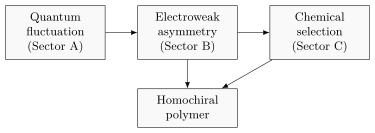
The Parity Bridge Theorem (VI.T03) identifies the mechanism: the weak sector’s unique parity violation (the only force that breaks left-right symmetry) provides the sole polarity seed for the self/non-self distinction. This is why life requires the weak force – not for energy, but for distinction.
Why This Matters
This definition replaces the classical seven-hallmark checklist (organization, metabolism, homeostasis, growth, reproduction, response, evolution) with two predicates from which all seven hallmarks follow as theorems. The definition is structural, not phenotypic – it applies to any carrier that satisfies the two predicates, whether carbon-based, silicon-based, or (as the Crossing-Limit Theorem will show) black-hole-based.
Key Claims
- VI.D02 – -Distinction: five-condition self/non-self boundary (established, machine-checked in TauLib)
- VI.D06 – SelfDesc: internal evaluator reads and executes own structural specification (established, machine-checked)
- VI.T02 – Life = Distinction SelfDesc (established, machine-checked)
- VI.T03 – Parity Bridge: weak-sector parity violation seeds the distinction (tau-effective)
This module traces to Book VI, Part VI.1.