The 4+1 Life Sectors
Persistence, Agency, Source, Closure, Consumer — the same template that produces four forces.
Module Thesis
The 4+1 sector template at E₂ produces five life sectors with biological archetypes.
Overview
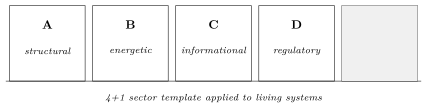
The same 4+1 sector template that produces four forces at produces five life sectors at , each with a biological archetype. The sectors are not a classification imposed on biology from outside – they are derived from the generator structure of Category .
The Core Idea
The five generators map to five life sectors (VI.T07):
-
Persistence (-sector, VI.D13): temporal stability, homeostasis, deep time. Archetype: Archaea – Earth’s oldest lineage, surviving extremes of temperature, salinity, and acidity for billions of years. The origin of life is recast as the first persistence event.
-
Agency (-sector, VI.D14): spatial motility, environmental interaction. Archetype: Bacteria – the most abundant organisms on Earth, colonizing every environment via flagellar motility and chemotaxis. ATP as universal energy currency.
-
Source/Producer (-sector, VI.D15): structure generation, photosynthesis, carbon fixation. Archetype: Plants – sessile autotrophs converting inorganic precursors into organic structure. The genetic code lives here.
-
Closure/Recycler (-sector, VI.D16): decomposition, nutrient cycling, death. Archetype: Fungi – mycelial networks that decompose organic matter and return nutrients to the biosphere. Death and aging complete the closure loop.
-
Consumer ( mixed sector, VI.D17-D18): acquires structure and energy from other life forms. Archetype: Animals – coupling source and closure channels. The most complex sector: neural architecture, immune systems, and consciousness emerge here.
Why This Matters
The sector classification organizes all of biology into a structurally derived taxonomy. It explains why these five functional roles recur across all ecosystems and why the three-domain taxonomy (Archaea, Bacteria, Eukarya) maps onto the sector structure. The sectors are not merely descriptive – they generate testable predictions about which biological functions must coexist and which are structurally independent.
Key Claims
- VI.T07 – 4+1 sector template instantiated at produces five life sectors (tau-effective)
- VI.D13-D18 – Five sectors with biological archetypes: archaea, bacteria, plants, fungi, animals (tau-effective)
- Sector structure is derived from generators, not imposed on biology (established, machine-checked in TauLib)
- Three-domain taxonomy maps onto the sector structure (conjectural)
Canonical Source
This module traces to Book VI, Parts VI.2, VI.3, VI.4, VI.5.