The 4+1 Sector Template
Five generators induce four primitive sectors plus one coupling — the recurring structural pattern.
Module Thesis
The boundary-to-interior functor induces exactly 4 primitive sectors (A,B,C,D) and 1 ω-coupling sector at every enrichment level.
Overview
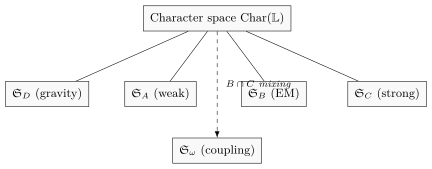
The Canonical Ladder establishes four enrichment layers. This module derives the organizational blueprint that every layer shares: the 4+1 sector template. The five generators of induce four primitive sectors (, , , ) plus one mixed sector (-coupling) at every enrichment level. This decomposition is not imposed – it is a functorial consequence of the boundary-to-interior map.
The Core Idea
The lemniscate carries a natural space of characters indexed by a lattice whose two axes encode multiplicative and additive structure. A canonical functor maps boundary characters on to holomorphic functions on . The central result – Langlands (boundary functoriality, III.T05) – proves that preserves the bipolar decomposition: the -sector maps into one holomorphic sector, the -sector into another, and mixed characters into the -coupling sector.
At the first enrichment level , the template instantiates as: A==Weak, B==Electromagnetic, C==Strong, D==Gravity, plus =Higgs/mass coupling. But the derivation of physical content is strictly deferred to Books IV and V.
The No Knobs Principle (III.T05, Chapter 13) establishes that all sector couplings are determined by – not by free parameters. Every inter-sector coupling is a rational function of the master constant evaluated at a specific primorial depth. The Parity Bridge Theorem identifies the weak sector as the canonical carrier for the computational bootstrap – the bridge from physics to life.
Why This Matters
The 4+1 template means the series has a uniform organizational structure: every enrichment level decomposes the same way. Physics, biology, and metaphysics are not different kinds of content – they are the same categorical template instantiated at different enrichment levels. This structural unity is what allows the framework to bridge from mathematics to physics to life without changing its formal language.
Key Claims
- III.D13 – 4+1 sector decomposition at every enrichment level (established, machine-checked in TauLib)
- III.T05 – Boundary functoriality (Langlands): the functor preserves sector structure (established, machine-checked)
- III.D14 – No Knobs Principle: all couplings determined by (tau-effective)
- The force mapping A=Weak, B=EM, C=Strong, D=Gravity, =Higgs is a sector instantiation (conjectural – tested in physics modules)