Omega-Germs & Split-Complex Scalars
Compatible towers on the primorial ladder yield the split-complex ring H_τ with j² = +1.
Module Thesis
Omega-germs partition into B- and C-polarized families; the bipolar spectral algebra with j² = +1 emerges as the natural scalar ring.
Overview
The Prime Polarity Theorem established that primes carry a bipolar structure in the finite regime. This module makes the passage from finite to infinite – the most delicate move in the entire mathematical arc. An omega-germ is a compatible tower on the primorial ladder: the framework’s native analogue of a Cauchy sequence, built from bare-metal ontic elements without importing any topology. These germs inherit the bipolar partition, producing a split-complex scalar ring with – the natural algebra for all boundary functions.
The Core Idea
The key construction principle is “elements before points.” In standard mathematics, points exist first and sequences converge to them. In Category , ontic elements exist first (created by the generative act), and points are defined later as equivalence classes of compatible towers.
An omega-germ (I.D25) is a sequence of elements indexed by the primorial ladder , satisfying a compatibility condition: at each stage, the element at the next primorial level reduces correctly to the element at the current level via the canonical projection. No metric, no epsilon-delta, no imported topology – just CRT-compatible towers on the earned arithmetic.
The bipolar partition of primes (from the previous module) propagates to germs. B-polarized germs have their eta-coordinate frozen (the tetration channel stabilizes), while C-polarized germs have their gamma-coordinate frozen (the exponent channel stabilizes). Every omega-germ falls into one class or the other.
This bipolar partition forces the scalar ring. The bipolar spectral algebra (I.T10) is:
This is a split-complex ring with the defining relation (not the elliptic of classical complex analysis). The canonical idempotents are and , satisfying . Each idempotent projects onto one lobe of the lemniscate.
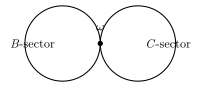
The algebraic lemniscate now receives its full geometric realization: the two idempotent sectors form two lobes meeting at the crossing-point germ (I.D26) – the unique germ where both projections coincide. This is the geometric avatar of the lemniscate , now grounded in the limit structure of omega-germs.
Why This Matters
The split-complex scalar ring governs all boundary functions in the framework. Every holomorphic function, every physical readout, every spectral decomposition uses this ring. The choice of over is not arbitrary – it is forced by the bipolar structure of the primes. The Split-Complex Holomorphy module will show how this ring supports a full holomorphic theory despite its zero divisors.
Key Claims
- I.D25 – Omega-germs as compatible towers on the primorial ladder (established, machine-checked)
- I.D26 – Crossing-point germ at the lemniscate node (established, machine-checked)
- I.T10 – Bipolar spectral algebra with (established, machine-checked in TauLib)
- I.D18 – The split-complex ring is forced by the bipolar prime partition (tau-effective)