The Coherence Kernel
Five generators, one operator, seven axioms — the minimal specification from which everything is earned.
Module Thesis
Category τ is specified by five generators (α, π, γ, η, ω), one progression operator ρ, and seven axioms (K0-K6) that define a complete, rigid, countable categorical universe.
Overview
The Coherence Kernel is the foundation of everything that follows. It is a minimal formal specification — five constant symbols, one unary operator, and seven axioms — from which the entire mathematical, physical, biological, and metaphysical structure of Category τ is derived. Nothing is imported from outside. No set theory, no real numbers, no geometry, no logic is assumed as given. These must all be earned from the kernel’s own resources.
The specification is deliberately spare. Where Peano Arithmetic begins with one constant and one successor, and ZFC begins with one binary relation, Category τ begins with five constants (α, π, γ, η, ω), one unary function ρ (progression), and one binary relation < (strict order). The total vocabulary is seven symbols. This is the entire primitive language of the theory.
The Core Idea
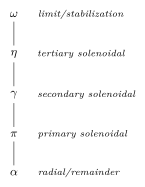
The five generators are arranged in a strict total order: α < π < γ < η < ω. Four of them (α, π, γ, η) seed infinite orbit rays when the progression operator ρ is iterated. The fifth, ω, is the fixed point of ρ — the closure beacon that bounds the universe from above.
Seven axioms govern this structure:
- K0 (Universe Postulate): The totality τ exists as a universe of discourse distinct from ω.
- K1 (Strict Order): The five generators satisfy α < π < γ < η < ω.
- K2 (Fixed Point): ω is the unique fixed point of ρ — it is unmoved by progression.
- K3 (Orbit-Seeded Generation): Each non-ω generator seeds an infinite orbit ray under iterated ρ.
- K4 (No-Jump Cover): Within each orbit, ρ(x) is the immediate successor — no elements are skipped.
- K5 (Unreachability of ω): ω cannot be reached from below by any finite iteration of ρ.
- K6 (Object Closure): The five orbits and the beacon {ω} exhaust the universe — there are no other objects.
Together, these define the static kernel τ₀: a finite, complete specification that is precise, categorical, and inert. No objects have been created yet; no arithmetic has been earned. That is the work of the modules that follow.
Why This Matters
The number five is not arbitrary. The diagonal discipline (Part I, Chapter 5) shows that exactly four orbit channels — and no more — can carry independent structural information without violating the cover relation. A fifth orbit would require a diagonal reuse that the kernel forbids. This is why the framework has five generators and not four, six, or infinitely many.
This constraint is what makes the later derivations non-trivial. When the framework later derives arithmetic, geometry, analysis, and physics from these five generators, it does so without hidden free parameters — because the kernel leaves no room for them.
Key Claims
- I.D01 — Five generators defined (α, π, γ, η, ω) with strict total order (established)
- I.K0–K6 — Seven axioms specifying the complete kernel (established)
- I.P01 — Generator distinctness: all five are pairwise distinct (established, machine-checked in TauLib)
- The number of generators (five) is structurally forced by the diagonal discipline (tau-effective)