Seven Hallmarks as Theorems
Organization, metabolism, homeostasis, growth, reproduction, response, evolution — all derived.
Module Thesis
The seven classical hallmarks of life follow as logical consequences of Distinction ∧ SelfDesc.
Overview
Every biology textbook lists the hallmarks of life: organization, metabolism, homeostasis, growth, reproduction, response to stimuli, and evolution. These are typically presented as an empirical checklist – observe enough of them, and you call the system “alive.” In Category , all seven hallmarks are derived as theorems from the conjunction of Distinction and SelfDesc. The checklist becomes a theorem list.
The Core Idea
Each hallmark is proved as a logical consequence of the two defining predicates:
-
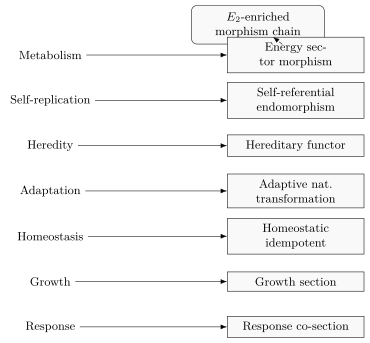
Organization (VI.T08): Distinction requires a maintained boundary with bounded internal complexity. Internal structure must be organized to maintain the boundary – random arrangement would violate condition (v).
-
Metabolism (VI.T09): Distinction requires energy throughput (condition iii). A living system must process energy – taking in nutrients and expelling waste – to maintain its self/non-self boundary.
-
Homeostasis (VI.T10): Distinction requires active boundary maintenance (condition v). The system must regulate its internal state against perturbation – homeostasis is the dynamic expression of active maintenance.
-
Growth (VI.T11): SelfDesc requires an internal code that specifies the system. When the decoder executes the code, the system can grow by following its own specification – adding structure according to the blueprint.
-
Reproduction (VI.T12): SelfDesc means the system carries a complete specification of itself. If the code can be copied and executed in a new carrier, the result is reproduction – a new system built from the same specification.
-
Response to stimuli (VI.T13): Distinction creates a boundary. Perturbations at the boundary must be detected (to maintain it), and the system must respond (to preserve conditions i-v). Response is boundary defense.
-
Evolution (VI.T14): Reproduction with imperfect code-copying introduces variation. Distinction under resource constraints produces selection. Variation + selection = evolution. This is not postulated as a separate principle – it follows from SelfDesc (copying) + Distinction (selection).
The derivation (VI.P04) shows that the seven hallmarks are not independent – they form a dependency hierarchy rooted in the two predicates. Remove either predicate and specific hallmarks disappear: without SelfDesc, you lose reproduction and evolution; without Distinction, you lose homeostasis and response.
Why This Matters
Deriving the hallmarks as theorems rather than assuming them as criteria is what makes the framework’s definition of life structural rather than phenotypic. It applies to any carrier – carbon, silicon, or black holes – and it generates falsifiable predictions: any system satisfying both predicates must exhibit all seven hallmarks. The life sectors module will show how these hallmarks organize into the 4+1 template.
Key Claims
- VI.T08-T14 – All seven classical hallmarks derived as theorems from Distinction SelfDesc (established, machine-checked in TauLib)
- VI.P04 – Hallmark dependency hierarchy: not independent, rooted in two predicates (established, machine-checked)
- The derivation is carrier-independent – applies to any physical substrate (tau-effective)
- Removing either predicate eliminates specific hallmarks (falsifiable prediction) (tau-effective)