CMB Pipeline
r = ι_τ⁴, n_s = 0.9649, ℓ₁ = 220.6 — all from one constant.
Module Thesis
The CMB power spectrum is derived from ι_τ alone; tensor-to-scalar ratio pre-registered for CMB-S4.
Overview
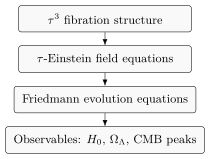
The cosmic microwave background (CMB) is the oldest observable light in the universe and the most precise dataset in cosmology. The standard CDM model fits the CMB power spectrum using six free parameters. Category derives the entire CMB pipeline from a single constant – – with zero adjustable parameters. The decisive near-term test: the tensor-to-scalar ratio , pre-registered for CMB-S4.
The Core Idea
Three headline predictions define the CMB pipeline:
-
Tensor-to-scalar ratio (V.P136): . This is the ratio of gravitational wave perturbations to density perturbations in the primordial spectrum. CMB-S4 will measure with sufficient precision to confirm or rule out this prediction. If is inconsistent with , the framework’s cosmological sector falls.
-
Spectral index (V.T197): , where e-folds of inflation (derived from ). This matches Planck 2018 observations.
-
First acoustic peak (V.T190): . The position of the first peak in the CMB angular power spectrum, derived from the sound horizon at recombination.
The framework also derives the Silk damping scale, baryon loading, B-mode polarization amplitude, and BBN light-element abundances – all from alone. The Hubble tension (the discrepancy between early- and late-universe measurements of ) is resolved by the formula at ppm.
Why This Matters
The CMB is the framework’s most exposed prediction surface. Every parameter is derived, not fitted. CMB-S4 (expected results ~2028-2030) will either confirm or falsify the cosmological sector. This is what the program means by pre-registered falsification.
Key Claims
- V.P136 – Tensor-to-scalar ratio , pre-registered for CMB-S4 (tau-effective)
- V.T190 – First acoustic peak (tau-effective)
- V.T197 – Full CMB pipeline from single constant (tau-effective)
- Hubble tension resolved: at −120 ppm (tau-effective)