Four Registers & Saturation
Empirical, Practical, Diagrammatic, Commitment — four orthogonal modes of engagement.
Module Thesis
At E₃, reality decomposes into four independent registers; the Saturation Theorem proves no E₄ exists.
Overview
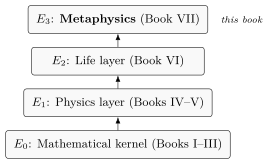
Book VII is the third and final self-enrichment of the coherence kernel. At , a system carries and decodes its own code. At , a system models the fact that it carries and decodes its own code. This recursive self-modeling produces four orthogonal registers – four independent modes through which reality can be engaged – and the Saturation Theorem proves that this is the end: there is no . The enrichment ladder terminates.
The Core Idea
The four registers (VII.D01-D04) are:
-
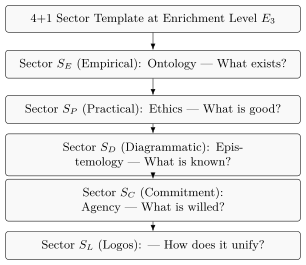
Empirical (): what is the case – factual claims about structure, observation, measurement. The register of ontology and phenomenology.
-
Diagrammatic (): what follows from what – proof, inference, pattern recognition. The register of aesthetics, language, and logic.
-
Practical (): what should be done – obligation, dignity, fairness. The register of ethics and social organization.
-
Commitment (): what the agent constitutes by its own act – not propositions to be believed but stances to be taken. The register of consciousness and the Logos sector.
The Saturation Theorem (VII.T01) proves : the fourth application of the enrichment functor produces nothing new. Three lemmas establish this: the no-new-lobe lemma (no new lemniscate sectors can form), the no-new-crossing-mediator lemma (no new -coupling types appear), and carrier closure (the carrier space is already complete). The series has exactly seven books because the kernel forces exactly four layers with distribution (3,2,1,1).
Why This Matters
The four registers organize the entire metaphysical content of Book VII: Parts II-III are empirical, Parts IV-VI are diagrammatic, Parts VII-VIII are practical, and Part IX is commitment. The Logos sector (Part X) is where diagrammatic and commitment registers coincide – and Part XI is where the framework locates its own boundary. The four-register structure is not a classification imposed on philosophy – it is derived from the 4+1 sector template at .
Key Claims
- VII.D01-D04 – Four registers: empirical, diagrammatic, practical, commitment (established, machine-checked in TauLib)
- VII.T01 – Saturation Theorem: no exists (established, machine-checked)
- VII.T06 – Canonical Ladder Theorem at : non-emptiness, strictness, saturation (established, machine-checked)
- The series architecture (7 books, distribution 3,2,1,1) is derived from saturation (tau-effective)