Categorical Ethics & the Kantian Bridge
The Categorical Imperative as the unique minimal j-closed fixed point — ethics derived, not postulated.
Module Thesis
Kant's CI is the minimal fixed point of the dignity modality in the presheaf topos; dignity is label-independence; no-conflict theorem proves CI-derived duties cannot conflict.
Overview
Moral philosophy has lived for two and a half centuries on an unresolved tension: Kant’s Categorical Imperative feels right – act only on maxims you could will as universal law – but its foundation is postulated, not derived. The framework dissolves this tension. In Book VII, the CI is not a starting axiom but a theorem: the unique minimal -closed fixed point of the dignity modality in the presheaf topos . Ethics is earned, not assumed.
Dignity as Label-Independence
The foundational move is a precise definition of dignity. The Label-Independence Theorem (VII.T30) states: a maxim possesses dignity if and only if it remains coherent when the label of the affected party is erased. This is not a vague appeal to empathy or perspective-taking. It is a formal operation on the presheaf: replace the name, social position, group membership, or any other identifying label of the person affected by the action with an anonymous placeholder. If the maxim still yields a well-defined morphism in the action category, it carries dignity. If it collapses – if the maxim depends for its coherence on who is affected – then it fails the dignity test and is excluded from the ethical domain.
This definition captures what Kant was reaching for with universalizability, but with surgical precision. Racism fails because erasing the racial label destroys the maxim’s coherence. Nepotism fails because erasing the family label collapses the justification. Genuine duties – honesty, non-harm, promise-keeping – survive label erasure intact.
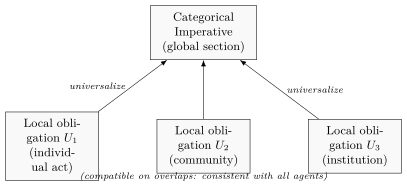
The dignity modality acts on the subobject classifier of . A subobject is -closed when it is invariant under the label-erasure operation. The CI is then the minimal such fixed point – the smallest collection of maxims that is both closed under the dignity modality and non-empty. Minimality matters: it ensures that no extraneous content is smuggled into the ethical law.
The No-Conflict Theorem
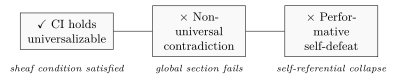
The most striking consequence is the No-Conflict Theorem (VII.T31): genuine CI-derived duties never conflict with one another. The trolley problem, the inquiring murderer, and every other supposed moral dilemma in the philosophical literature are resolved not by ranking duties but by diagnosing the problem as a misspecified frame. A trolley problem arises only when the action category has been artificially truncated – when options that exist in the full presheaf have been pruned to create an appearance of forced choice. In the correctly specified frame, the conflict dissolves. This is not a dodge; it is a theorem with a proof. The -closure property guarantees that no two minimal fixed-point maxims can demand incompatible actions from the same agent in the same well-formed situation.
Four Ethical Tests and Virtue
The CI unfolds into four concrete tests (VII.T32), each corresponding to a different face of label-independence: the universalizability test (can the maxim be willed as universal law?), the humanity test (does the maxim treat persons as ends?), the autonomy test (does the maxim respect the agent’s rational self-legislation?), and the kingdom-of-ends test (is the maxim consistent with a community of dignity-bearing agents?). These are not four separate principles but four projections of the single -closure condition.
Virtue receives a categorical treatment in VII.T33: a virtue is a stable presheaf pattern – a disposition that persists across contexts because it is structurally invariant under label permutation. Courage, honesty, and justice are not mere habits but fixed points of the character functor. Vice, conversely, is context-dependent: it requires knowing who benefits.
The 2nd Edition: Kant-τ Correspondence
The 2nd Edition introduces the Kant- Correspondence (VII.T35), which maps each structural feature of the CI to a specific construction in the four-register architecture. The practical register is the native home of ethical reasoning, but the Correspondence shows that the CI also constrains the empirical register (through the factual conditions of dignity) and the diagrammatic register (through the proof structure of the No-Conflict Theorem). The commitment register enters through a new structural element: the commitment register as the fourth mode of reason, where the agent does not merely recognize the moral law but constitutes it through their own act of adherence.
This is where categorical ethics meets categorical societies: the dignity-bearing agents of VII.T30 are precisely the base objects of the social ontology developed in the next module. The ethical structure is not layered on top of social reality – it is the foundation from which social organization is derived.
Key Claims
- VII.T30 – Label-Independence Theorem: dignity is invariance under label erasure (established, machine-checked in TauLib)
- VII.T31 – No-Conflict Theorem: CI-derived duties never conflict (established, machine-checked)
- VII.T32 – Four ethical tests as projections of -closure (established, machine-checked)
- VII.T33 – Virtue as stable presheaf pattern (established, machine-checked)
- VII.T35 – Kant- Correspondence: structural map between CI and four-register architecture (tau-effective)