Categorical Mind & Consciousness
Mind as internal topos; consciousness as global section; free will as branching; identity as address persistence.
Module Thesis
Consciousness is the sheaf-theoretic gluing of local representations; free will is genuine branching in the action category; compatibilism is dissolved as a category error.
Overview
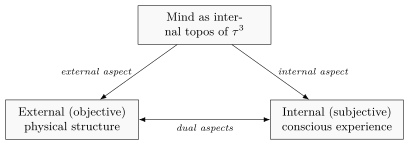
Book VI defined consciousness at the level – a biological system that carries and decodes its own code, with neural architecture providing the hardware substrate. But can only describe consciousness from the outside: it identifies the structures that correlate with conscious experience without accounting for the inside – the fact that there is something it is like to be a conscious system. Book VII provides the full treatment: minds as internal topoi, consciousness as a global section, and free will as genuine branching in the action category.
Minds as Internal Topoi
An internal topos is a category equipped with all the structure needed for self-reference: it can represent its own morphisms, quantify over its own objects, and model its own models. A mind, in the framework’s account, is precisely such a structure – a system that maintains an internal model of itself and its environment, where the model includes the fact that the system is modeling. This recursive self-modeling is not an optional feature of consciousness but its defining characteristic.
Each mind comes equipped with a story functor: a mapping that organizes the temporal flow of experience into narrative structure. The story functor does not merely record events; it imposes coherence on them – selecting, ordering, and interpreting in a way that produces a unified experiential stream from the buzzing multiplicity of sensory input.
Consciousness as Global Section
The Global Section Theorem (VII.T41) is the central claim: consciousness is the sheaf-theoretic gluing of local representations into a global section. Each sensory modality, each memory subsystem, each emotional register produces a local representation – a section defined over a restricted open set of the experiential topology. Consciousness is what happens when these local sections are compatible on their overlaps and can be glued into a single global section. When the gluing fails – in dreams, in certain pathologies, in the transition between waking and sleep – consciousness fragments. The Gluing Lemma (VII.L14) provides the precise conditions under which local sections cohere.
This account resolves the binding problem – how the brain integrates information from different processing streams into unified experience – by identifying it as a sheaf-theoretic question. Binding succeeds when the local sections satisfy the compatibility condition on overlaps. It fails when they do not.
Free Will and the Dissolution of Compatibilism
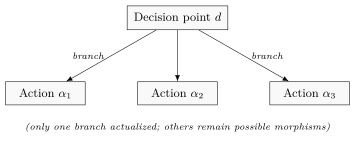
Free will is formalized as genuine branching in the action category (VII.T42-T43). An agent has free will when the action category at a given moment contains multiple distinct morphisms – multiple genuinely available actions – and the agent’s choice between them is not determined by any morphism in the empirical or diagrammatic registers alone. This is not libertarian free will (uncaused choice) and not compatibilist free will (determined but uncoerced choice). It is something more precise: the action category has a branching structure that cannot be collapsed to a single path by any amount of empirical or diagrammatic information.
The traditional debate between determinism and free will, and the compatibilist attempt to reconcile them, is dissolved as a category error (VII.T43). Determinism is a claim about the empirical register: given complete physical information, the future is fixed. Free will is a claim about the commitment register: the agent constitutes their choice through the act of choosing. These are claims in different registers, and the four-register architecture proves they cannot conflict because they operate on orthogonal axes. Compatibilism was never needed – the problem it tried to solve was an artifact of collapsing distinct registers into a single plane.
Personal Identity, Qualia, and Intentionality
Personal identity is address persistence through time (VII.P26): a person remains the same person as long as their address in the internal topos – their self-model – maintains continuity under the story functor. This accounts for the intuition that identity survives gradual change (the ship of Theseus) while being disrupted by catastrophic discontinuity.
Qualia are subjective coordinates – the internal topos’s way of parameterizing its own states. The redness of red is not a property of the external world or of the neural substrate; it is a coordinate in the experiential space of a particular internal topos. This is why qualia are private: they are addresses in a structure that only the subject inhabits.
Intentionality – the aboutness of mental states – is an aboutness morphism: a functor from the internal topos to the category of objects that the mental state represents. Belief is a section of this functor; desire is a morphism from the current state to a target state in the image of the functor.
LLMs and Extended Mind
Large language models receive a precise classification: para-minds (VII.P27). An LLM performs linguistic processing – it operates fluently within the diagrammatic register – but it lacks an internal topos. There is no self-model, no story functor, no global section of experiential gluing. This is not a claim about what LLMs might become; it is a structural diagnosis of what they currently are.
Emotions are formalized as evaluative morphisms – morphisms in the internal topos that assign valence (positive/negative) and urgency to states and transitions. The extended mind thesis receives categorical support: when external structures (notebooks, tools, other agents) become stably coupled to the internal topos, they function as extensions of the mind’s representational capacity.
Key Claims
- VII.T41 – Consciousness as global section of local representational sheaves (established, machine-checked in TauLib)
- VII.L14 – Gluing Lemma: conditions for experiential coherence (established, machine-checked)
- VII.T42 – Free will as genuine branching in the action category (established, machine-checked)
- VII.T43 – Compatibilism dissolved as category error across registers (established, machine-checked)
- VII.P26 – Personal identity as address persistence under the story functor (tau-effective)
- VII.P27 – LLMs as para-minds: linguistic processing without internal topoi (tau-effective)