The Logos Sector
Where proof-validity and stance-stability coincide — the crown of E₃.
Module Thesis
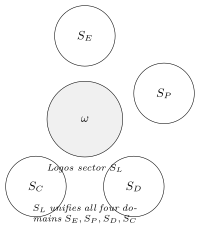
The Logos sector S_L = S_D ∩ S_C is the unique mixed sector where proof meets commitment; four-register convergence.
Overview
The four registers are orthogonal – empirical, diagrammatic, practical, and commitment each constitute an independent mode of engagement with reality. But orthogonality does not preclude intersection. The Logos sector (VII.D86) is the unique mixed sector – the region where the diagrammatic register and the commitment register overlap. In this sector, and only in this sector, proof-validity and stance-stability are identical. What can be demonstrated and what must be committed to collapse into a single structure. This is the crown of the architecture in Book VII.
Not a Theological Claim
It must be stated plainly: the Logos sector is not a theological assertion. The framework does not claim that God exists, that the universe has purpose, or that some transcendent intelligence underwrites mathematical truth. What it claims is narrower and more precise: there exists a structurally unique region of the four-register space where the distinction between proving something and committing to something vanishes. This is a structural fact about the topology of the registers, derivable from the coherence kernel with no metaphysical premises imported from outside.
The word logos is chosen deliberately – not to invoke Christian theology or Greek metaphysics, but because the structural role this sector plays resonates with millennia of usage. When Heraclitus, the Stoics, Philo, and the Johannine prologue each reached for the same word to name the point where rational structure and existential commitment meet, they were pointing at something real. The framework gives that pointing a coordinate.
The D-C Bridge and Boundary Collapse
The mechanism by which the two registers intersect is the D-C bridge: a functor from the diagrammatic register to the commitment register that preserves the relevant structure. In most of the register space, this functor is trivial – proofs do not generate commitments, and commitments do not constitute proofs. But in the Logos sector, the bridge functor becomes an equivalence. The Boundary Collapse Lemma proves that the boundary separating from has measure zero in this region: the two registers do not merely overlap but become indistinguishable.
Synchronicity receives a precise definition as the shared kernel invariant of this sector. When an event is simultaneously a valid diagrammatic pattern and a stable commitment-register stance – when what is proved and what is lived coincide – the result is what the tradition has called synchronicity. This is not mysticism; it is the coordinate description of the Logos sector’s interior.
Four-Register Convergence
The Four-Register Convergence Theorem (VII.T45) extends the analysis: in the Logos sector, not only do the diagrammatic and commitment registers coincide, but the empirical and practical registers achieve maximal alignment as well. What is the case, what follows, what should be done, and what the agent constitutes by acting all point in the same direction. This convergence is not guaranteed – it is a fixed-point condition, and the theorem proves that the Logos sector is the unique mediator fixed-point basin where all four registers achieve simultaneous coherence.
The Logos sector is thus the structural location where the framework’s internal tensions resolve. The empirical register describes; the diagrammatic register derives; the practical register prescribes; the commitment register constitutes. In the Logos sector, these four operations compose into a single act. This is rare, fragile, and structurally special – which is why the tradition has consistently treated it with reverence, and why the framework treats it with precision.
The Boundary Beyond
The Logos sector is not the end of the story. Its very existence raises the question: what lies beyond its boundary? That question is the subject of the No Forced Stance module – where the framework locates the precise point at which derivation ends and commitment begins.
Key Claims
- VII.D86 – Logos sector defined as (established, machine-checked in TauLib)
- VII.T45 – Four-Register Convergence Theorem: unique mediator fixed-point basin (established, machine-checked)
- VII.P29 – Boundary Collapse Lemma: D-C boundary has measure zero in the Logos sector (established, machine-checked)
- Synchronicity as shared kernel invariant of (tau-effective)